nLab cyclic operad
Context
Higher algebra
Algebraic theories
Algebras and modules
Higher algebras
-
symmetric monoidal (∞,1)-category of spectra
Model category presentations
Geometry on formal duals of algebras
Theorems
Categorical algebra
internalization and categorical algebra
-
algebra object (associative, Lie, …)
Contents
Idea
The notion of cyclic operads (Getzler & Kapranov 1995) is a variant of that of symmetric operads in which the distinction between “inputs” and “output” of operations is made to disappear.
Where a symmetric operad consists of sets (spaces, objects) of -to-1 operations for all , acted on by the symmetric group permuting the inputs (only), for a cyclic operad this is extended to an action of , which permutes all “ports” (inputs and output) among each other.
This larger symmetric group may be regarded a generated from the smaller together with the cyclic group which rotates the in/outputs into each other. This cyclic group action is essentially what the term cyclic operad is alluding to, though the terminology was more concretely motivated by applications to cyclic homology, see below. (Cyclic operads also appear in (2D) TQFT, in the further refinement to modular operads.)
Accordingly, where the composition operations in a symmetric operad are indexed by grafting of rooted trees (the unique root of one tree to any of the leaves of another), in a cyclic operad the composition operations are indexed by unrooted trees, any of their leaves (external legs) can be attached among each other.
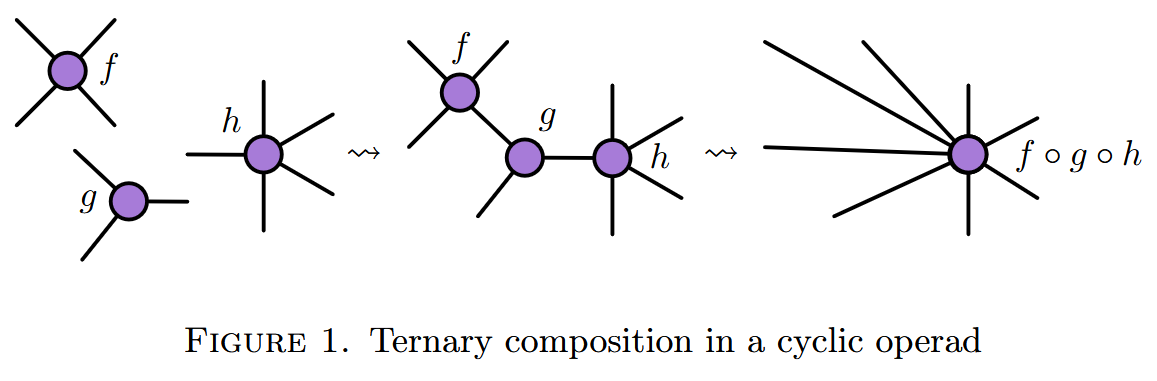
In fact, in terms of unrooted indexing trees the notion of cyclic operads may be formulated more intrinsically (cf. the idea of hyperstructure) as certain cyclic dendroidal sets. In this form the definition seamlessly generalizes to cyclic -operads (Doherty & Hackney 2025).
Motivation in cyclic homology
Hochschild homology and cohomology have a natural meaning via Tor and Ext groups; and they also have an -category theoretic interpretation. The Hochschild complex for associative algebras has a remarkable quotient, the cyclic complex; this construction is not as general as the mentioned construction, and it can not be generalized to algebras over an arbitrary operad. Instead there is an additional structure on an operad which enables one to produce an analogue of cyclic homology. However the long exact sequence of Connes which in the classical case involves cyclic homology and Hochschild homology, here involves the cyclic homology for the original cyclic operad but also the one for the Koszul dual operad and the Hochschild. In the classical, associative case of course the operad and its Koszul dual coincide.
Related concepts
References
The original article:
- Ezra Getzler, Mikhail Kapranov: Cyclic operads and cyclic homology, in: Geometry, topology and physics, International Press (1995) 167-201 [pdf, intlpress:1698885469150470146]
Generalization to cyclic -operads via cyclic dendroidal sets:
- Brandon Doherty, Philip Hackney: Models for cyclic infinity operads [arXiv:2506.15622]
See also:
-
Benjamin C. Ward: Maurer-Cartan elements and cyclic operads, J. Noncommut. Geom. 10 4 (2016) 1403–1464 [arXiv:1409.5709, doi:10.4171/JNCG/263]
-
Pierre-Louis Curien, Jovana Obradović: A formal language for cyclic operads, Higher Structures 1 1 (2017) 22-55 [arXiv:1602.07502, pdf]
-
Jovana Obradović: Monoid-like definitions of cyclic operad, Theory and Applications of Categories 32 12 (2017) 396-436 [tac:32-12, pdf]
-
Pierre-Louis Curien, Jovana Obradović: Categorified cyclic operads, Appl. Categ. Struct. 28 (2020) 59–112 [doi:10.1007/s10485-019-09569-7]
Last revised on April 27, 2026 at 15:40:21. See the history of this page for a list of all contributions to it.