nLab category of elements
Context
Category theory
Concepts
Universal constructions
Theorems
Extensions
Applications
Contents
Idea
The category of elements of a functor is a category sitting over the domain category , such that the fiber over an object is the set . Or more precisely, the discrete category .
This is a special case of the Grothendieck construction for covariant functors, by considering sets as discrete categories. There is a similar special case of the Grothendieck construction for contravariant functors which takes a functor to a category over . In fact, there is a common construction which generalises these, the so-called two-sided category of elements for a profunctor, which we will discuss later in this article.
We may think of Set as the classifying space of “Set-bundles;” see generalized universal bundle. The category of elements of is, in this sense, the Set-bundle classified by . It comes equipped with a projection to which is a discrete opfibration, and provides an equivalence between -valued functors and discrete opfibrations. There is a dual category of elements that applies to contravariant -valued functors, i.e. presheaves, and produces discrete fibrations. And the two-sided version applies to profunctors, producing two-sided fibrations.
Forming a category of elements can be thought of as “unpacking” a concrete category. For example, consider a concrete category consisting of two objects and two non-trivial morphisms
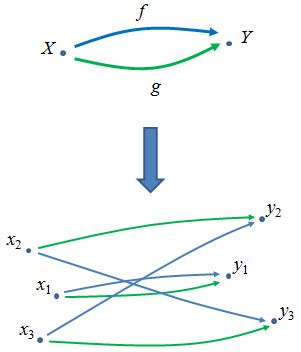
The individual elements of are “unpacked” and become objects of the new category. The “unpacked” morphisms are inherited in the obvious way from morphisms of .
Note that an “unpacked” category of elements can be “repackaged”.
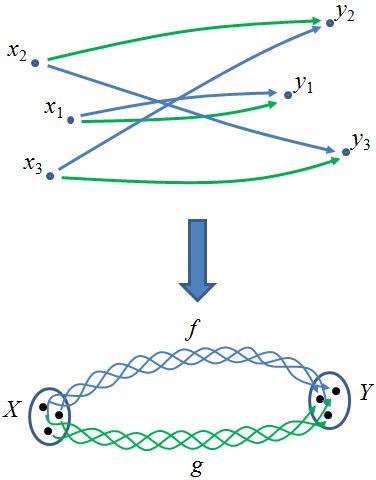
The generalization of the category of elements for functors landing in Cat, rather than just , is called the Grothendieck construction.
Definition
For covariant Set-valued functors
Given a functor , the category of elements or (or obvious variations) may be understood in any of these equivalent ways:
-
It is the category whose objects are pairs where is an object in and is an element in and morphisms are morphisms such that .
-
It is the pullback along of the universal Set-bundle
where is the forgetful functor from pointed sets to sets.
-
It is the comma category , where is the inclusion of the one-point set and is itself:
- Its opposite is the comma category , where is the Yoneda embedding and is the functor which picks out itself:
is also often written with integral notation as . This suggests the fact the set of objects of the category of elements is the disjoint union (sum) of all of the sets .
- It is the (strict) oplax colimit of the composite ; see Grothendieck construction.
When is a concrete category and the functor is simply the forgetful functor, we can define a functor
This is intended to illustrate the concept that constructing a category of elements is like “unpacking” or “exploding” a category into its elements.
For Profunctors
Applying the above construction to a presheaf produces a category with a projection . However, the true category of elements for a presheaf is normally taken to have a projection into itself - this can be accomplished by taking the opposite category, producing . In fact, both the covariant and contravariant constructions are special cases of the category of elements of a profunctor, whose construction we now outline.
Take a profunctor , viewed as a functor . For , we can view the elements as heteromorphisms . The action of the profunctor can be encoded in a “composition” operation of these heteromorphisms with ordinary morphisms, defining for and . The unit and associativity laws for this composition operation encode the fact that preserves identities and composites.
This gives a nice visual picture for the category of elements of - it is a “heteromorphic arrow category”! More precisely, it is the category whose objects are triples for , and whose morphisms are pairs with . Much like the arrow category, this has a projection functor that is a two-sided fibration.
We also have a coend formula for this category:
, where is a slice category and is a coslice category.
The category of elements of a set-valued functor and of a presheaf then arise as categories of elements of the profunctors and respectively, where is the terminal category.
Properties
The category of elements defines a functor . This is perhaps most obvious when viewing it as an oplax colimit. Furthermore we have:
Remark
The functor is cocontinuous.
It’s easiest to prove this by showing that, in fact, it has a right adjoint:
Theorem
The functor has a right adjoint.
Proof
By a simple coend computation:
where , sending a pair to the set of objects of the functor category .
Now for any , the terminal object of is the functor constant at the point. The category of elements of is easily seen to be just itself, so the unique transformation induces a projection functor defined by and . The projection functor is a two-sided fibration, and can be viewed also as a -indexed family of sets. When we regard as equipped with , we have an embedding of into .
Note that the canonical projection is not usually full. For example, let be the one-object category which carries the monoid as its endomorphism monoid, and let be the action of on the set by . Then the image of any hom-set between is a subsingleton subset of .
More generally, the universal covering groupoid of a groupoid is just the category of elements of its action on itself by composition. Since this action is faithful and transitive, hom-sets in the category of elements are always or , while objects in the groupoid might have nontrivial automorphism groups.
Categories of elements of set-valued functors and presheaves have a close tie to representability:
Proposition
The category of elements of has an initial object if and only if is a representable functor. In this case, if the initial object is , then is isomorphic to the functor .
Examples
Pointed Sets
Perhaps the simplest example of a category of elements comes from the identity functor . The objects of this category are where is a set and . And morphisms are functions with . This is precisely the category of pointed sets! We recognise this as the “universal set bundle” .
Representable Presheaves
Let be a representable presheaf with . Consider the contravariant category of elements . This has objects with , hence is just an arrow in . A map from to is just a map such that but this is just a morphism from to in the slice category . Accordingly we see that .
This equivalence comes in handy when one wants to compute slices of presheaf toposes over representable presheaves since in general for presheaves , whence . An instructive example of this construction is spelled out in detail at hypergraph.
Action Groupoid
In the case that is the delooping groupoid of a group , a functor is a permutation representation of and its category of elements is the corresponding action groupoid .
Proof
This is easily seen in terms of the characterization , the category having as objects triples , namely elements of the set , and as arrows those such that
commutes, namely . We can also present the right adjoint to : one must consider the functor , which represents in , and sends the unique object to , the left action groupoid of . The functor sends to an automorphism of , obtained multiplying on the right to .
Now for any category , is exactly the set of functors , which inherits from an obvious action: given we define .
Category of Simplices
For a simplicial set regarded as a presheaf on the simplex category, the corresponding category of elements is called its category of simplices. See there for more.
Category of Cones
Let be a diagram. Then we can define a presheaf mapping to the set of cones over with tip , with the functorial action given by precomposition of cone morphisms. The category of elements of this presheaf is precisely the category of cones over !
Thus, we observe that this presheaf is representable if and only if the category of cones has a terminal object - or, in more familiar terms, has a limit if and only if there exists a universal cone.
Comma Categories
Let and be functors. We can form a profunctor by defining , the set of morphisms in between and . We can use the functorial actions of and to “compose” these heteromorphisms with ordinary morphisms , sending to , which defines the action of on morphisms.
Then, the category of elements of this profunctor is precisely the comma category ! Which has a projection functor that forms a two-sided fibration.
As a special case, taking the category of elements of , viewed as a profunctor from to , produces the familiar arrow category. On the other hand, if we simply apply the ordinary “covariant” category of elements construction to produce a category with a projection to , we obtain the twisted arrow category.
This illustrates an important general point - when taking the category of elements of a functor, it’s not enough to simply specify the domain. We need to specify it as a profunctor with chosen domain and codomain categories, so that the resulting heteromorphisms have the desired domain and codomain, and we get the correct kind of projection.
Related concepts
Reference
A very nice introduction emphasizing the connections to monoid theory is ch. 12 of
- Michael Barr, Charles Wells, Category Theory for Computing Science , Prentice Hall 1995³. (TAC reprints no.22 (2012))
Last revised on July 12, 2026 at 04:01:00. See the history of this page for a list of all contributions to it.