nLab representable functor
Context
Category theory
Concepts
Universal constructions
Theorems
Extensions
Applications
Yoneda lemma
Ingredients
Incarnations
Properties
Universal aspects
Classification
Induced theorems
…
In higher category theory
Contents
Idea
For a locally small category , a presheaf on or equivalently a functor
on the opposite category of with values in Set is representable if it is naturally isomorphic to a hom-functor , which sends an object to the hom-set in
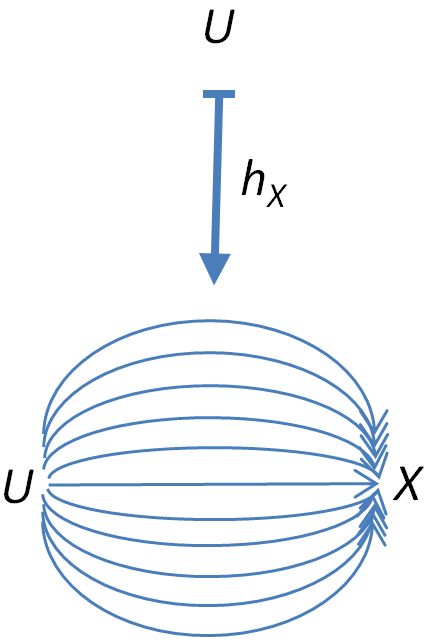
and which sends a morphism in to the function which sends each morphism to the composite
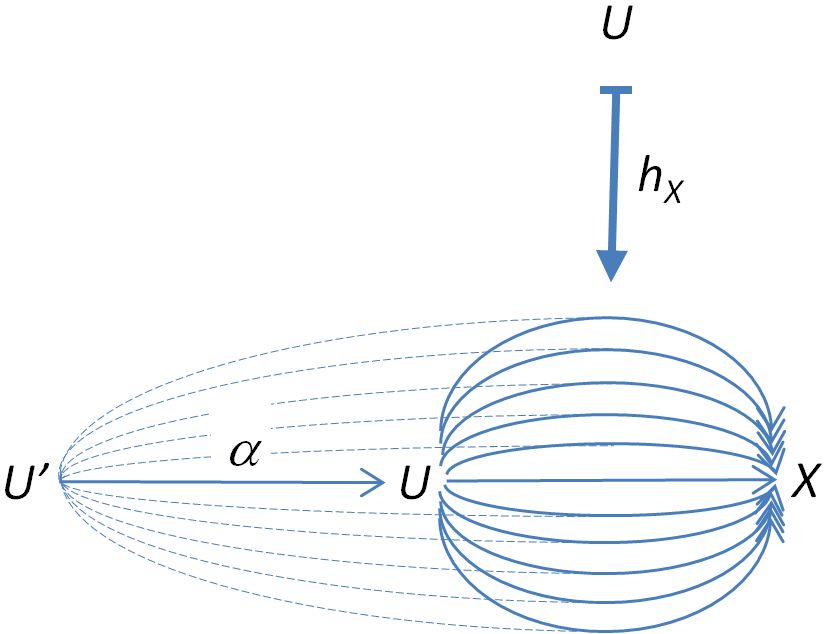
If we picture as strands of morphisms as above, then the morphism serves to “comb” the strands back from to , i.e.
The object is determined uniquely up to isomorphism in , and is called a representing object for .
Representability is one of the most fundamental concepts of category theory, with close ties to the notion of adjoint functor and to the Yoneda lemma. It is the crucial concept underlying the idea of universal property; thus for example crucial concepts such as “limit”, “colimit”, “exponential object”, “Kan extension” and so on are naturally expressed in terms of representing objects. The concept permeates much of algebraic geometry and algebraic topology.
Definition
In ordinary category theory
For a functor (also called a presheaf on ), a representation of is a specified natural isomorphism
By the Yoneda lemma, any such transformation (isomorphism or not) is uniquely determined by an element . As above, the object is called a representing object (or often, universal object) for , and the element is called a universal element for . Again, it follows from the Yoneda lemma that the pair is determined uniquely up to unique isomorphism.
Following the proof of the Yoneda lemma, representability means precisely this: given any object of and any element , there exists a unique morphism such that the function carries the universal element to . Such a dry formulation fails to convey the remarkable power of this concept, which can really only be appreciated through the myriad examples which illustrate it.
Abstractly, a presheaf is representable if and only if it admits a left adjoint relative to the functor from the terminal category, picking out the terminal object in Set. The representing object is given by evaluating the left relative adjoint at the unique object of .
In enriched category theory
The above definition generalizes straightforwardly to enriched category theory.
Let be a closed monoidal category and a -enriched category.
Then for every object there is a -enriched functor
from to regarded canonically as a -enriched category.
This is defined
-
on objects by
-
on morphisms between and by
being the adjunct of the composition morphism
A -enriched functor is representable if there is and a -enriched natural transformation .
If is symmetric monoidal one can form the opposite category and have the analogous definition for representable functors .
In higher category theory
The notion of representable functors has its straightforward analogs also in higher category theory.
-
For 2-category theory see … .
-
For (∞,1)-category theory theory see (∞,1)-presheaf
In homotopy type theory
Discussion for category theory in homotopy type theory:
Proposition
(representability is a mere proposition)
If is a univalent category, then the type “F is representable” is a mere proposition.
Proof
By definition “F is representable” is just the fiber of over . Since is an embedding by Corollary 9.5.7 in the HoTT book (see Yoneda lemma), this fiber is a mere proposition.
Examples
The central point about examples of representable functors is:
Representable functors are ubiquitous .
To a fair extent, category theory is all about representable functors and the other universal constructions: Kan extensions, adjoint functors, limits, which are all special cases of representable functors – and representable functors are special cases of these.
Listing examples of representable functors in category theory is much like listing examples of integrals in analysis: one can and does fill books with these. (In fact, that analogy has more to it than meets the casual eye: see coend for more).
Keeping that in mind, we do list some special cases and special classes of examples that are useful to know. But any list is necessarily wildly incomplete.
Limits
If is a diagram in , we obtain a diagram in the functor category (presheaf category) as the composite of with the curried hom-functor (the Yoneda embedding). The object-wise limit of this diagram in Set, that is, the functor sending an object to the set which is the limit of the diagram , is representable iff the diagram has a limit in ; in fact, a representing object for that limit functor is exactly , and we obtain a natural isomorphism
(see at hom-functor preserves limits).
Products
For an example in the case of the product, let be objects of , and consider the presheaf given by a product of hom-functors
that is, the functor which takes an object of to the set . A product is precisely a representing or universal object for this presheaf, where the universal element is precisely the pair of projection maps
We leave it to the reader to check that the representability here means precisely that given a pair of maps
there exists a unique element in , denoted , such that
Weighted limits
The above example has an important straightforward generalization.
Noticing that the limit over the functor is just the collection of cones over whose tip is the point
the above expression can be rewritten equivalently as . Replacing in this expression the constant terminal functor by any other functor leads to the notion of weighted limit, as described there.
Exponential objects
Suppose is a category which admits finite products; given objects , consider the presheaf
A representing or universal object for this presheaf is an exponential object ; the universal element
is a morphism called the evaluation map .
Classifying bundles
Consider a category of ‘nice’ spaces (just to fix the discussion, let’s say paracompact spaces, although this is a technical point), and a topological group therein, i.e., a group internal to . There is a presheaf
which assigns to each space the set of isomorphism classes of -bundles over , and assigns to each continuous map the function
which carries a (class of a) -bundle to the (class of the) pullback bundle . It is well-known that the pullback construction is invariant with respect to homotopic deformations; that is, this presheaf descends to a functor on the homotopy category,
A classifying space is precisely a representing object for this functor; the universal element is the (isomorphism class of the) classifying -bundle .
These general considerations are quite commonplace in algebraic topology, where they crop up for example in the connection between generalized cohomology theories and spectra; cf. Brown’s representability theorem.
Related concepts
-
classifying space, classifying stack, moduli space, moduli stack, derived moduli space
-
Artin representability theorem, Artin-Lurie representability theorem
References
Early accounts:
- Alexander Grothendieck, Section A.1 of: Technique de descente et théorèmes d’existence en géométrie algébriques. II. Le théorème d’existence en théorie formelle des modules, Séminaire Bourbaki : années 1958/59 - 1959/60, exposés 169-204, Séminaire Bourbaki, no. 5 (1960), Exposé no. 195, 22 p. (numdam:SB_1958-1960__5__369_0)
A discussion of representable functors in the context of enriched category theory is in section 1.6 and section 1.10 of
A query discussion on differences between representable functor and representation of a functor is archived here.
Last revised on December 10, 2023 at 15:15:24. See the history of this page for a list of all contributions to it.