nLab Yoneda embedding
Context
Category theory
Concepts
Universal constructions
Theorems
Extensions
Applications
Yoneda lemma
Ingredients
Incarnations
Properties
Universal aspects
Classification
Induced theorems
…
In higher category theory
Contents
Idea
For a locally small category, every object of induces a presheaf on : the representable presheaf represented by . This assignment extends to a functor from to its category of presheaves. The Yoneda lemma implies that this functor is full and faithful and hence realizes as a full subcategory inside its category of presheaves.
Recall from the discussion at representable presheaf that the presheaf represented by an object of is the functor whose assignment is illustrated by
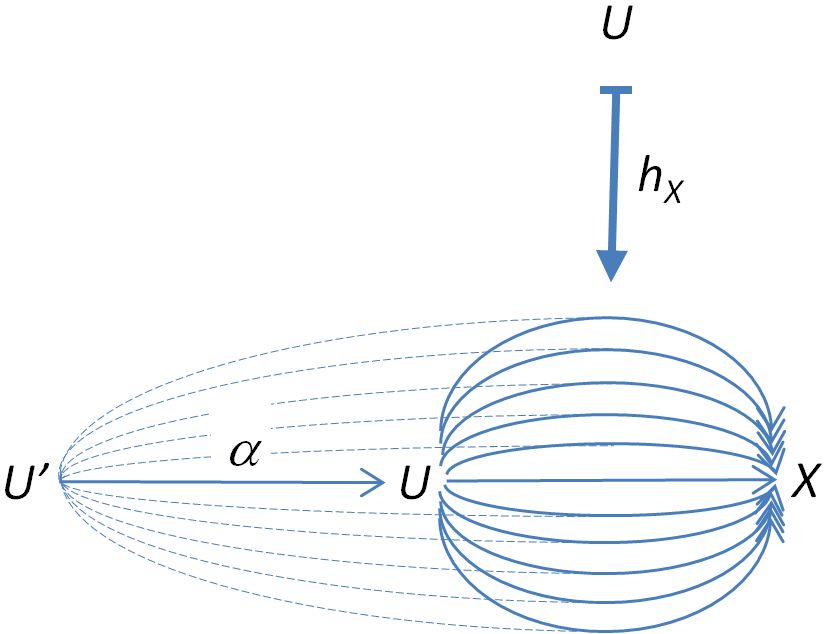
which sends each object to and each morphism to the function
Moreover, for a morphism in , this induces a natural transformation , whose component on in is illustrated by
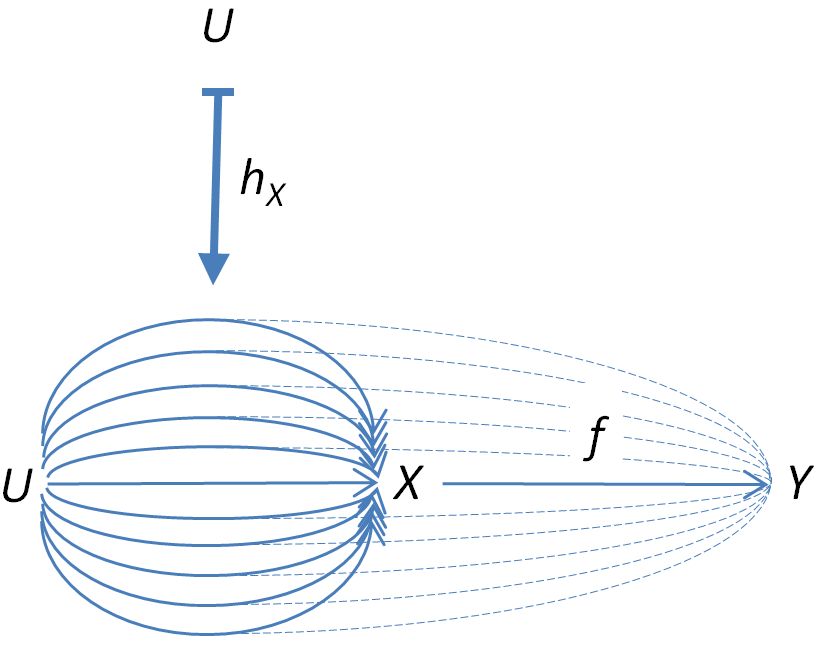
For this to be a natural transformation, we need to have the commuting diagram
but this simply means that it doesn’t matter if we first “comb” the strands back to and then comb the strands forward to , or comb the strands forward to first and then comb the strands back to
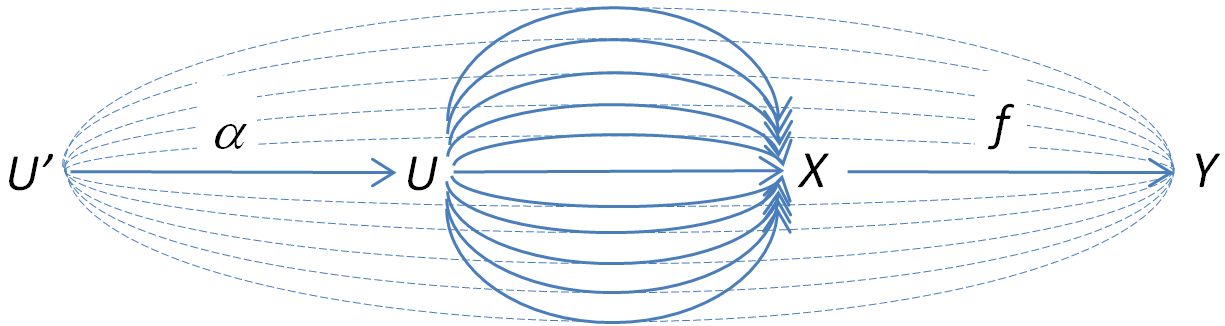
which follows from associativity of composition of morphisms in .
Definition
The Yoneda embedding for a locally small category is the functor
from to the category of presheaves over which is the image of the hom-functor
under the Hom adjunction
in the closed symmetric monoidal category Cat.
Hence sends any object to the representable presheaf which assigns to any other object of the hom-set of morphisms from into :
The Yoneda embedding is sometimes denoted by よ, the hiragana for “Yo”; see the references below.
Remarks
We can also curry the Hom functor in the other variable, thus obtaining a contravariant functor
which is explicitly given by . This is sometimes jokingly called the contravariant Yoneda embedding.
However, since , it is easy to see that the contravariant Yoneda embedding is just the Yoneda embedding of , and hence does not require special treatment.
Properties
Proof
We need to show that for any two objects, we have that every morphism of presheaves between their represented presheaves
is of the form
for a unique morphism
in . This follows by the Yoneda lemma, which says that morphisms as above are identified with the elements in
Proposition
The Yoneda embedding preserves limits, hence is a continuous functor.
Proof
This follows directly by combining the facts that (1.) hom-functors preserve limits and (2.) limits of presheaves are computed objectwise. On limiting objects this immediately yields the following natural isomorphisms:
Another, maybe more precise way to say this:
By this remark, the forgetful functor strictly creates limits, and thus reflects them. Thus, to show preserves limits, it suffices to show that does, by this remark. Since is a composition of functors, it suffices to show each individual functor preserves limits (see here). But these are just the hom-functors , and so we can apply hom-functor preserves limits to finish.
Remark
In contrast, the Yoneda embedding does not in general preserve colimits.
Instead, the Yoneda embedding of a small category is its free cocompletion.
Remark
If the Yoneda embedding of a category has a left adjoint, then that category is called a total category .
Related concepts
-
A category is a total category if its Yoneda embedding has a left adjoint.
-
singleton injection, the Yoneda embedding for 0-category theory.
References
General
Named after Nobuo Yoneda (see at Yoneda lemma and the list of references given there).
Early accounts:
- Alexander Grothendieck, Section A.1 of: Technique de descente et théorèmes d’existence en géométrie algébriques. II. Le théorème d’existence en théorie formelle des modules, Séminaire Bourbaki : années 1958/59 - 1959/60, exposés 169-204, Séminaire Bourbaki, no. 5 (1960), Exposé no. 195, 22 p. (numdam:SB_1958-1960__5__369_0)
Notation
It seems that the notation “よ” for the Yoneda embedding (the hiragana for “Yo”) was first used in
- Theo Johnson-Freyd, Claudia Scheimbauer, p. 33 of (Op)lax natural transformations, twisted quantum field theories, and “even higher” Morita categories, (arxiv:1502.06526)
Their Latex code for the command reads as follows:
\usepackage[utf8]{inputenc}
\DeclareFontFamily{U}{min}{}
\DeclareFontShape{U}{min}{m}{n}{<-> udmj30}{}
\newcommand\yo{\!\text{\usefont{U}{min}{m}{n}\symbol{'207}}\!}
Subsequent references that use this notation include:
-
Emily Riehl, Dominic Verity, p. 10 of Elements of -category theory (web)
-
David Li-Bland, p. 5 of The stack of higher internal categories and stacks of iterated spans (arXiv:1506.08870)
-
Fosco Loregian, p. 4 of This is the (co)end, my only (co)friend (arXiv:1501.02503)
-
Michael Hill, Michael Hopkins, Douglas Ravenel, p. 53 of Equivariant stable homotopy theory and the Kervaire invariant problem, (web)
Last revised on February 13, 2026 at 07:38:48. See the history of this page for a list of all contributions to it.