nLab geometric nerve of a bicategory
Context
Higher category theory
Basic concepts
Basic theorems
-
homotopy hypothesis-theorem
-
delooping hypothesis-theorem
-
stabilization hypothesis-theorem
Applications
Models
- (n,r)-category
- Theta-space
- ∞-category/∞-category
- (∞,n)-category
- (∞,2)-category
- (∞,1)-category
- (∞,0)-category/∞-groupoid
- (∞,Z)-category
- n-category = (n,n)-category
- n-poset = (n-1,n)-category
- n-groupoid = (n,0)-category
- categorification/decategorification
- geometric definition of higher category
- algebraic definition of higher category
- stable homotopy theory
Morphisms
Functors
Universal constructions
Extra properties and structure
1-categorical presentations
Contents
Idea
The (unitary) geometric nerve is a natural nerve operation on bicategories. It is a functor from BiCat to sSet. This is also sometimes called the Duskin nerve. The notion is implicit in work by R. Street (1987). The direct approach was used by Duskin in work at about the same time, as explained in both articles. (Duskin’s article directly on the idea was published in 2002.)
The construction, thus, yields a functor:
extending the ordinary nerve construction on the category of small categories, where morphisms of BiCat are normal lax 2-functors: these are the lax 2-functors which strictly preserve identities.
Special cases of the construction relate to earlier constructions relating to the homotopy coherent nerve, see below for more detail.
Definition
We may think of the simplex category as the full subcategory of Cat on the categories free on non-empty finite linear graphs. This gives the canonical inclusion that defines the ordinary nerve of categories.
There is also the canonical embedding of categories into bicategories. Combined this gives the inclusion
The bicategorical nerve is the nerve induced from that. So for a bicategory we have
There are also an oplax version and two non-normalized versions.
Properties
-
The simplicial sets in the image of the geometric nerve are 3-coskeletal.
-
The geometric nerve identifies precisely bigroupoids with 2-hypergroupoids: those Kan complexes for which the horn fillers in dimension are unique . (Theorem 8.6 in (Duskin 2002))
(This shows in particular that bigroupoids model all homotopy 2-types.)
- The nerve is a full and faithful functor .
Example
Any strict 2-category determines both a ‘bicategory’ in the above sense (since a ‘strict’ thing is also a ‘weak’ one) and a simplicially enriched category. The latter is found by taking the nerve of each ‘hom-category’. The Duskin nerve of a 2-category is the same as the homotopy coherent nerve of the corresponding -category. This can also be applied to 2-groupoids and, thus, results in a classifying space construction for crossed modules.
Picturing the Duskin nerve
Following (Johnson–Yau, Section 5.4), one may picture the Duskin nerve of a bicategory as follows:
-
The -simplices of are the objects of ;
-
The -simplices of are the -morphisms of ;
-
The -simplices of are quadruples as in the diagram
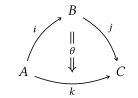
where , and is a -morphism of ;
-
The -simplices of are -tuples
as in the diagram
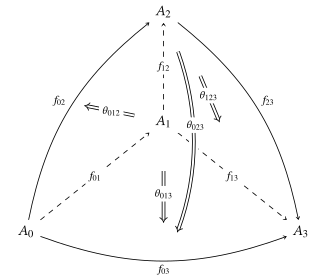 such that we have an equality
 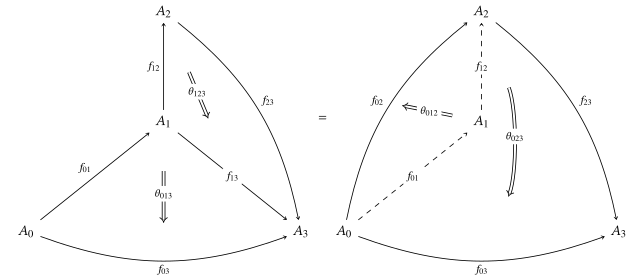 of pasting diagrams in ;
 -
The -simplices of consist of
- A collection of objects of ,
- A collection of -morphisms of , and
- A collection of -morphisms of
such that, for each with , we have an equality
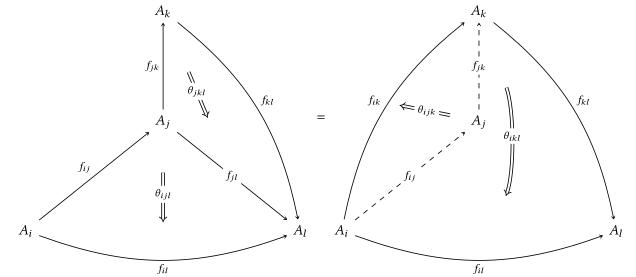 of pasting diagrams in ;
 -
The degeneracy map
of in degree is the map sending a -simplex of (i.e. an object of ) to the -simplex .
-
The degeneracy maps
of in degree are the maps described as follows: given a -simplex of , we have
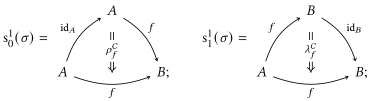
-
The degeneracy maps in degree
of in degree are the maps described as follows: given a -simplex
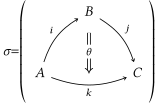 of , we have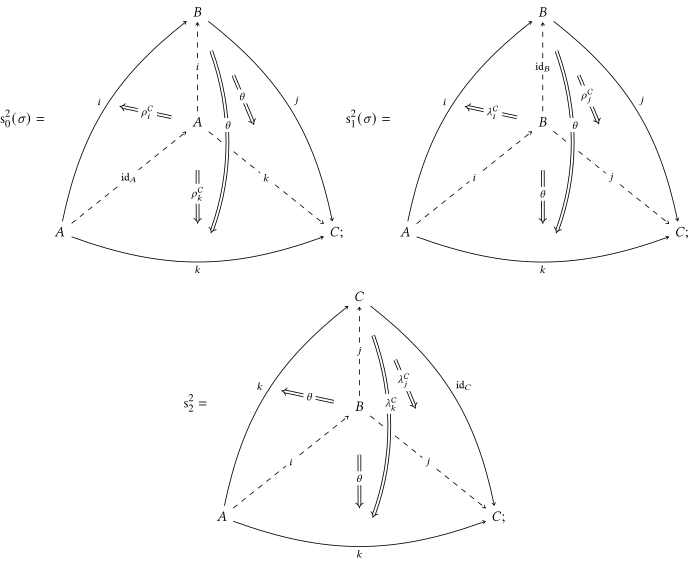
-
The face maps
of in degree are given by
-
The face maps
of in degree are described as follows: given a -simplex
of , we have  11. The face maps
of in degree are described as follows: given a -simplex 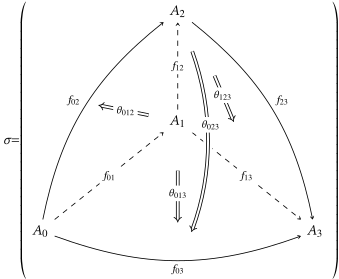 of , we have
 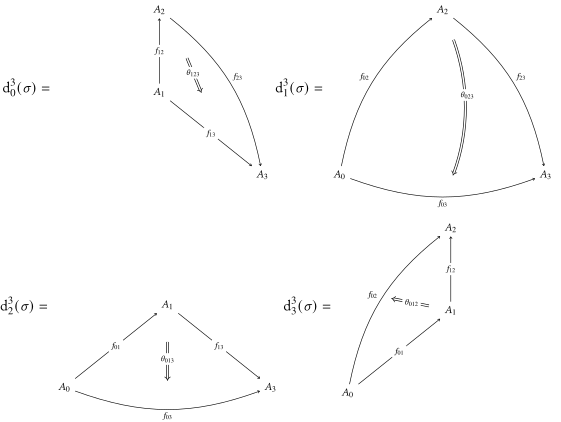 12. The face maps
of in degree are described as follows: given a -simplex of as in the diagram 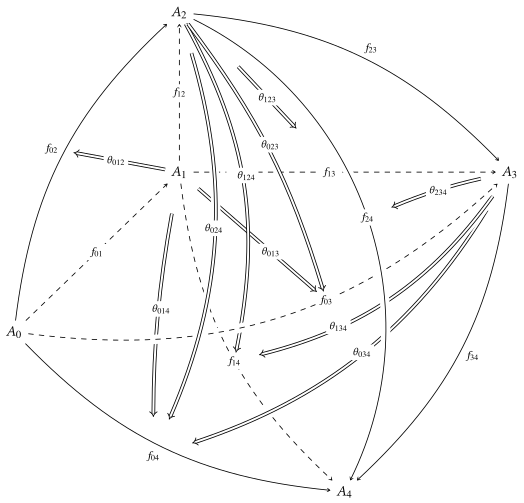 we have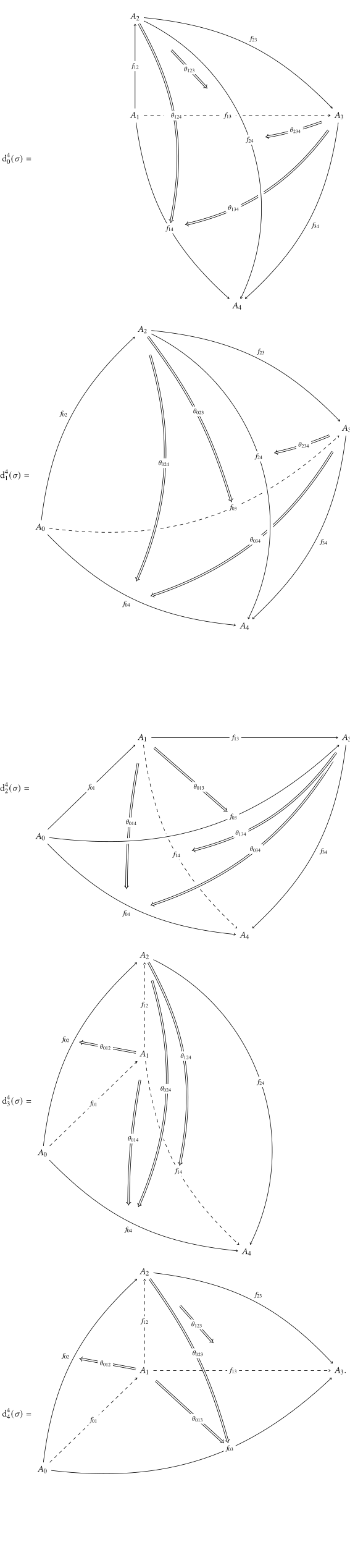
Related concepts
-
geometric nerve of a bicategory
References
-
Ross Street, The algebra of oriented simplexes, Journal of Pure and Applied Algebra, Volume 49, Issue 3, December 1987, Pages 283–335
-
John Duskin, Simplicial matrices and the nerves of weak n-categories I: nerves of bicategories, Theory and Applications of Categories 9 10 (2002) 198–308 [tac:9-10]
-
V. Blanco, M. Bullejos, E. Faro, A Full and faithful Nerve for 2-categories, Applied Categorical Structures, Vol 13-3, 223-233, 2005. (See also arxiv).
-
Niles Johnson, Donald Yau, 2-Dimensional Categories (arXiv:2002.06055).
Last revised on August 20, 2022 at 11:12:00. See the history of this page for a list of all contributions to it.