nLab Schur functor
Context
Representation theory
geometric representation theory
Ingredients
Definitions
representation, 2-representation, ∞-representation
Geometric representation theory
-
Grothendieck group, lambda-ring, symmetric function, formal group
-
principal bundle, torsor, vector bundle, Atiyah Lie algebroid
-
Eilenberg-Moore category, algebra over an operad, actegory, crossed module
Theorems
Contents
- Idea and definition
- The category of Schur functors
- Schur functors on more general categories
- Change of base
- The action of Young symmetrizers
- Constructing Schur functors
- Schur functors are “natural”
- Conceptual description of Schur functors
- Representability
- Composition of Schur functors
- Related concepts
- References
- Old Stuff
Idea and definition
Classically, a ‘Schur functor’ is a specific sort of functor
where FinDimVect is the category of finite dimensional vector spaces over the complex numbers. Namely, it is a functor where is obtained by taking the th tensor power of the vector space and then picking out a subspace that transforms in a certain way with respect to the symmetric group . In fact, Schur functors can be defined on a large class of categories resembling FinDimVect: for example, categories of representations of a group, or vector bundles, or coherent sheaves. After an elementary introduction to Schur functors, this article will give a conceptual approach based on the fact that these functors are precisely those that can be ‘naturally’ — or more precisely, ‘pseudonaturally’ defined on all symmetric monoidal linear Cauchy complete categories.
The most famous examples of Schur functors are these:
-
For each , the symmetric power is a Schur functor.
-
For each , the alternating power is a Schur functor.
More generally, complex irreducible representations of correspond to -box Young diagrams, so Schur functors are usually described with the help of these. An -box Young diagram is simply a pictorial way of writing as a sum of natural numbers listed in decreasing order. For example, this 17-box Young diagram:
describes the partition of as . However, it also can be used to construct an irreducible complex representation of the permutation group , and thus a Schur functor.
In general, here is the recipe for constructing the Schur functor associated to an -box Young diagram . For now we only say what this functor does to objects (that is, finite-dimensional vector spaces):
-
Given an -box Young diagram and a vector space , we first form the tensor power . We think of each factor in this tensor power as corresponding to a specific box of the Young diagram.
-
Then we pick out the subspace of consisting of tensors that are unchanged by any permutation that interchanges two boxes in the same row.
-
Then we project this subspace onto the space of tensors that change sign under any permutation that interchanges two boxes in the same column. The result is called , where is the Schur functor corresponding to .
It is easy to see from this description that:
-
The tall skinny Young diagrams with one column and rows give the Schur functors .
-
The short fat Young diagrams with one row and columns give the Schur functors .
We can also think of this relation between Young diagrams and Schur functors in a slightly more abstract way using the group algebra of the symmetric group, . Suppose is an -box Young diagram. Then we can think of the operation ‘symmetrize with respect to permutations of the boxes in each row’ as an element . Similarly, we can think of the operation ‘antisymmetrize with respect to permutations of the boxes in each column’ as an element . By construction, each of these elements is idempotent:
Now, it is easy to see that the product of commuting idempotents is idempotent. The elements and do not commute, but amazingly, their product
is idempotent up to a scalar multiple!
This element is called the Young symmetrizer corresponding to the -box Young diagram . There is a functor, called a Schur functor:
defined on any finite-dimensional vector space as follows:
Here we are using the fact that , and thus its group algebra, acts on . Thus, acts as an idempotent operator on , and as defined above is the range of this operator.
An even deeper approach to Schur functors is based on the relation between Young diagrams and representations of the symmetric groups. The subspace
has an obvious right action of the algebra , and thus becomes a representation of the group . In fact, it is an irreducible representation of , and every irreducible representation of is isomorphic to one of this form. Even better, this recipe sets up a one-to-one correspondence between -box Young diagrams and isomorphism classes of irreducible representations of .
(Strictly speaking, to think of as an element of , we must choose a way to label the boxes of the Young diagram with numbers . Such an identification is called a Young tableau. For our purposes it will cause no harm to randomly choose a Young tableau for each Young diagram, since different choices give isomorphic representations . In other contexts, the difference between various choices of Young tableaux can be extremely important.)
This description of irreducible representations of paves the way towards an important generalization of Schur functors. First, note that
It follows that
These isomorphisms here are natural, so there is no harm in defining the Schur functor by
This formula defines the Schur functor not only on objects but also on morphisms. Even better, we can use the same formula to define a functor
for any representation of , as follows:
These more general functors are still called ‘Schur functors’.
Even more generally, any finite direct sum of the Schur functors just described may also be called a Schur functor. In other words, if where is a finite-dimensional representation of , and only finitely many of these representations are nonzero, then we define the Schur functor
-
For each , the tensor power is a Schur functor.
-
If and are Schur functors, the functor is a Schur functor.
-
If and are Schur functors, the functor is also a Schur functor.
-
If and are Schur functors, the composite is a Schur functor. This way of constructing Schur functors is known as plethysm.
The category of Schur functors
There is a category with
-
Schur functors as objects. Here
each is a finite-dimensional representation of , and only finitely many of these representations are nonzero.
-
natural transformations between such functors as morphisms.
In the rest of this article, we would like to give a conceptual explanation of this category.
As a warm-up, let us note that has has a nice description in terms of groupoid of finite sets and bijections. This groupoid is the core of the category FinSet, so it is denoted . What is the relation between Schur functors and this groupoid. Every Schur functor is a finite direct sum of Schur functors coming from irreducible representations of symmetric groups for various . But what sort of entity is a direct sum of representations of symmetric groups for various ? It is nothing but a representation of the permutation groupoid:
where objects are natural numbers, all morphisms are automorphisms, and the automorphisms of form the group . In other words, it is a functor
But conceptually, the importance of is that it is a skeleton of the groupoid of finite sets and bijections. So,
As a result, any Schur functor gives a functor
Following Joyal‘s work on combinatorics, such functors are known as -valued species, or -valued structure types. The idea here is that just as an ordinary Set-valued species
assigns to any finite set a set of structures of some type, a -valued species assigns to any finite set a vector space of structures of some type, Thanks to the ‘free vector space on a set’ functor
we can linearize any ordinary species and obtain a linear species . This process is extremely important in the work of Marcelo Aguiar and Swapneel Mahajan:
However, not all -valued species corresond to Schur functors, because we have defined Schur functors to arise from finite direct sums of irreducible representations of permutation groups. So, is equivalent to the category where:
-
objects are polynomial species: that is, functors such that for all sufficiently large finite sets ;
-
morphisms are natural transformations.
We call this the category of polynomial species. The reason for the term ‘polynomial’ is that any functor of the form
gives rise to a formal power series called its generating function:
and this power series is a polynomial precisely when is a polynomial species.
The category of representations of any groupoid has many nice features. For example, it is a symmetric monoidal abelian category, by which we mean a symmetric monoidal category that is also abelian, where tensoring with any object is right exact. So, the category of -valued species is symmetric monoidal abelian — and it is easy to check that the subcategory of polynomial species inherits this structure. Since is equivalent to the category of polynomial species, it too is symmetric monoidal abelian.
In particular, has two monoidal structures, and , defined by
and
Since distributes over , these make into a rig category.
In the literature on species, the operation is often called addition, since adding species this way corresponds to adding their generating functions. Aguiar and Mahajan call the Hadamard product (see section 8.1.2).
But the category of representations of a groupoid has even more nice features when the groupoid itself has a monoidal structure: then the representation category acquires a monoidal structure thanks to Day convolution. The groupoid has, in fact, two important monoidal structures, coming from the product and disjoint union of finite sets. Since distributes over , these make into a rig category. Thanks to Day convolution, these give the category of representations of two more monoidal structures, making it into a rig category in another way. The same is true for the subcategory .
In the literature on species, the monoidal structure coming from is often called multiplication, since multiplying species in this way corresponds to multiplying their generating functions. Aguiar and Mahajan call this monoidal structure the Cauchy product. The monoidal structure coming from has no commonly used name, but it deserves to be called the Dirichlet product.
Aguiar and Mahajan point out that some of the relationships between the “pointwise” products (addition and Hadamard) and the “Day” products (Cauchy and Dirichlet) can be described in terms of duoidal categories. Specifically, the Hadamard and Cauchy products form duoidal structures in both orders.
On top of all this, the composite of Schur functors is again a Schur functor. This gives a fifth monoidal structure: the plethystic tensor product. Unlike the four previous monoidal structures, this one is not symmetric.
Mathematicians often work with a decategorified version of : its Grothendieck group, also known as the ring of symmetric functions. The various structures that possesses endow this ring with corresponding structures. Among other things, it is the free lambda-ring on one generator. As we shall see, this corresponds to the fact that is the free symmetric monoidal Cauchy complete linear category on one object.
Schur functors on more general categories
We have described Schur functors as special functors
But in fact, functors such as the alternating power, symmetric power, etc. make sense in much wider contexts. For starters, we can replace the complex numbers by any field of characteristic zero, and everything in our discussion still works. More importantly, Schur functors can be applied to any symmetric monoidal Cauchy complete linear category (“tensor category”). Here by linear category we mean a category enriched over Vect, the category of vector spaces over . Such a category is Cauchy complete when:
-
it has biproducts, also known as direct sums, and
To illustrate the full breadth of this generalization, here are a few examples:
-
the category Vect, consisting of vector spaces over any field of characteristic zero
-
the category FinDimVect, consisting of finite-dimensional vector spaces over
-
the category of representations of any group on vector spaces (or finite-dimensional vector spaces) over
-
the category of super vector spaces, graded vector spaces or chain complexes over
-
for or , the category of finite-dimensional real or complex vector bundles over any topological space, or smooth vector bundles over any smooth manifold
-
the category of algebraic vector bundles over any algebraic variety (or more generally, scheme or algebraic stack) over
-
the category of coherent sheaves of vector spaces over any algebraic variety (or scheme or algebraic stack) over
These examples can be hybridized, and thus they multiply indefinitely: for example, we could take coherent sheaves of chain complexes, or vector bundles equipped with a group action, and so on.
In the following subsections, we explain how to define Schur functors on any category of this sort. A somewhat novel feature of our treatment is that we do not require the theory of Young diagrams to define and study Schur functors.
Our strategy is as follows. We fix a symmetric monoidal Cauchy complete linear category, . The group algebra begins life as a monoid in the symmetric monoidal category FinDimVect. However, we shall explain how interpret it as living in by a “change of base” functor going from FinDimVect to . This will let us use the Young symmetrizers to construct idempotents on for any object . Splitting these idempotents, we obtain the Schur functors .
Change of base
To achieve the desired change of base, let be the linear category whose objects are integers and whose morphisms are matrices with entries in . Because is Cauchy complete and in particular has finite biproducts (direct sums), there is an evident linear functor
which takes to , the direct sum of copies of the tensor unit . It is the unique linear functor taking to , up to unique linear isomorphism. In the case , the linear functor
taking to , is a linear equivalence (exhibiting as a skeleton of ). Because of this equivalence, we could equally well say that there is a linear functor
which, up to unique linear isomorphism, is the unique linear functor taking to . Notice that a symmetric monoidal functor of this form must take the tensor unit to (up to coherent isomorphism, as always), and in fact is symmetric monoidal, because there is a canonical isomorphism
using the fact that preserves direct sums in each argument, and the fact that there is a canonical isomorphism .
In summary, we have the following proposition.
Proposition
There is exactly one symmetric monoidal linear functor , up to symmetric monoidal linear isomorphism.
The action of Young symmetrizers
Next we explain how given an object , any Young symmetrizer in acts as an idempotent on .
For this we only need to know a little bit about the group algebra , which we recall here. By Maschke's theorem, for any finite group , the group algebra decomposes as a direct sum of matrix algebras
where ranges over isomorphism classes of irreducible representations of . The identity elements of these matrix algebras thus correspond to certain special elements . Clearly these elements are idempotent:
We are particularly interested in the case . In this case, we call the idempotents are ‘Young symmetrizers’. However, we will not need the formula for these idempotents.
The key step is to apply base change to . Here we exploit the fact that
is a monoid in the monoidal category FinDimVect. Since is a monoidal functor, it follows that carries to a monoid object in , which we again call by abuse of notation. As an object of , we have
There is a general concept of what it means for a monoid in a monoidal category to act on an object in that category. In particular, if is an object of , the monoid acts on the tensor power . To see this, note that for each , there is a corresponding symmetry isomorphism
Putting these together with the help of (1) we obtain a morphism
which is the desired action.
Finally, we would like to describe how each Young symmetrizer acts on . Quite generally, any element gives a linear map from to , namely the unique map sending to . Applying the functor to this, we obtain a morphism which by abuse of language we call
This then yields an endomorphism
given as the composite
It is easy to check that for any ,
Thus for any Young symmetrizer , the morphism
is idempotent, because is.
Constructing Schur functors
By construction, the morphisms
are the components of a natural transformation from the functor to itself. Since idempotents split in , we can form the cokernel of , or in other words, the coequalizer of the pair
Definition
For any Young diagram , the Schur functor is defined as follows. Given an object of , let be the cokernel of . Given a morphism in , let be the unique map such that
commutes, where the horizontal arrows are the cokernel maps.
More generally we can define a Schur functor
for any finite-dimensional representation of , as follows. We can write as a finite direct sum of irreducible representations:
and then define
Schur functors are “natural”
Suppose now that we have a symmetric monoidal linear functor . We can think of as a “change of base category”, and Schur functors are “natural” with respect to change of base.
That is to say: if is a symmetric monoidal linear functor , then by definition preserves tensor products (at least up to coherent natural isomorphism), and will automatically preserve both direct sums (by linearity) as well as splittings of idempotents (as all functors do). Therefore, for a Schur functor , we have natural isomorphisms
where the first isomorphism uses the symmetric monoidal structure of ; the second uses the fact that because there is, up to isomorphism, only one symmetric monoidal linear functor ; the third uses the symmetric monoidal structure again and preservation of idempotent splittings.
If is any representation, then by writing as a direct sum of irreducible representations and using the fact that preserves direct sums, we have more generally
In summary, Schur functors transfer “naturally” across change of base functors .
Conceptual description of Schur functors
As we have seen, Schur functors are definable under fairly mild hypotheses: working over a field of characteristic zero, they can be defined on any symmetric monoidal linear category which is Cauchy complete. So, for such we can define a Schur functor
and moreover, if is a symmetric monoidal linear functor, the Schur functors on and are “naturally” compatible, in the sense that the diagram
commutes up to a canonical isomorphism , and moreover these fit together sensibly when we compose symmetric monoidal linear functors.
In this abstract framework, it may be wondered what significant role is played by the representations of the symmetric group. The natural isomorphisms which relate the Schur functors across change of base are pleasant to observe, but surely this is just some piddling general nonsense in the larger story of Schur functors , which are after all deeply studied and incredibly rich classical constructions?
Let us put the question another way. We have seen the Schur functors are constructed in a uniform (or “polymorphic”) way across all symmetric monoidal Cauchy complete linear categories , and this construction is natural with respect to symmetric monoidal change of base functors . Or rather: not natural in a strict sense, but pseudonatural in the sense that naturality squares commute up to isomorphism . Now pseudonaturality is a very general phenomenon in 2-category theory. So the question is: among all such pseudonatural transformations , what is special about the Schur functors ? What extra properties pick out exactly the Schur functors from the class of all pseudonatural transformations ?
The perhaps surprising answer is: no extra properties! That is, the Schur functors are precisely those functors that are defined on all symmetric monoidal Cauchy complete linear and that are pseudonatural with respect to change of base !
Let us now make this precise. Schur functors are defined on certain symmetric monoidal linear categories, but they respect neither the symmetric monoidal structure nor the linear structure. So, we have to forget some of the structure of the objects on which Schur functors are defined. This focuses our attention on the ‘forgetful’ 2-functor
where:
Definition
SymMonLinCauch is the 2-category with
-
small symmetric monoidal Cauchy complete linear categories as objects,
-
symmetric monoidal linear functors as morphisms,
-
symmetric monoidal linear natural transformations as 2-morphisms.
As we shall see, Schur functors correspond to pseudonatural transformations from to itself, and morphisms between Schur functors correspond to modifications between these pseudonatural transformations. For the reader unaccustomed to these 2-categorical concepts, we recall:
Definition
Given two 2-functors between 2-categories, a pseudonatural transformation is a rule that assigns to each 0-cell of a 1-cell of , and to each 1-cell of an invertible 2-cell of :
such that the following pasting diagram equalities hold:
and
There is also a requirement that the assignation f \mapsto \phi(f) should be natural as f varies along a -cell \alpha: f \Rightarrow g. That is, \phi(g).U\alpha =V\alpha.\phi(f).
Definition
With notation as above, let be two pseudonatural transformations. A modification is a rule which associates to each 0-cell of a 2-cell of , such that the following compatibility condition holds:
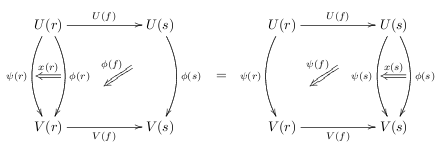
We now propose our conceptual definition of Schur functor:
Definition
An (abstract) Schur functor is a pseudonatural transformation , where
is the forgetful 2-functor. A morphism of Schur functors is a modification between such pseudonatural transformations.
What this proposed definition makes manifestly obvious is that Schur functors are closed under composition. This provides a satisfying conceptual explanation of plethysm, as we will explore in the next two sections. However, we should first check that this proposed definition gives a category of Schur functors equivalent to the category defined earlier!
Before launching into the proof, it is worth pondering an easier problem where we replace categories by sets, and symmetric monoidal linear Cauchy-complete categories by commutative rings.
So, instead of let us consider , and instead of let us consider . There is a forgetful functor
What are the natural transformations from this functor to itself? Any polynomial defines such a natural transformation, since for any commutative ring there is a function given by
and this is clearly natural in . But in fact, the set of natural transformations from this functor turns out to be precisely . And the reason is that is the free commutative ring on one generator!
To see this, note that the forgetful functor
has a left adjoint, the ‘free commutative ring’ functor
The free commutative ring on a 1-element set is
and homomorphisms from to any commutative ring are in one-to-one correspondence with elements of the underlying set of , since
So, we say represents the functor . This makes it easy to show that the set of natural transformations from to itself is isomorphic to the underlying set of , namely :
In the first step here we use the representability ; in the second we use the Yoneda lemma, and in the third we use the adjointness between and .
We shall carry out a categorified version of this argument to prove that is the category of endomorphisms of the 2-functor
The key is that is the free symmetric monoidal linear Cauchy-complete category on one generator.
John Baez: I added explanatory remarks above. Okay?
Representability
To build a bridge from abstract Schur functors as pseudonatural transformations to the more classical descriptions, we start with the following key result. In what follows we use to denote the ‘linearization’ of the permutation groupoid: that is, the linear category formed by replacing the homsets in by the free vector spaces on those homsets. We use to denote the Cauchy completion of the linearization of . As we shall see, is equivalent to the category of Schur functors. But first:
Theorem
The underlying 2-functor
is represented by . In other words:
Proof (Sketch)
It is well-known that the permutation category , whose objects are integers and whose morphisms are precisely automorphisms given by permutation groups , is the representing object for the underlying 2-functor
Let denote the 2-category of small symmetric monoidal linear (but not necessarily Cauchy complete) categories, and let denote the 2-category of small linear categories. Let denote linearization, given by change of base
applied to a -enriched category to yield a linear category . is left 2-adjoint to the underlying 2-functor . For this, we use the fact that if is a nice closed category (here ) – in particular cocomplete – then the lax monoidal functor has a left adjoint (here linearization) which is strong (symmetric) monoidal. This induces a 2-functor -- which is strong 2-symmetric monoidal. It therefore sends symmetric pseudomonoids in - to symmetric pseudomonoids in -. In other words, it sends symmetric monoidal categories to symmetric monoidal linear categories. Therefore, the 2-adjunction between and lifts to one between and :
Finally, let denote the 2-category of small Cauchy complete linear categories. The linear Cauchy completion gives a 2-reflector which is left 2-adjoint to the 2-embedding , and again the 2-adjunction lifts to the level of symmetric monoidal structure to give a 2-adjunction
For this, the key fact is that if denotes the tensor product of two -enriched categories, then there is a canonical enriched functor making Cauchy completion into a lax 2-monoidal functor on -. Even better, it is lax 2-symmetric monoidal. So, it sends symmetric pseudomonoids to symmetric pseudomonoids. In this case, then, it sends symmetric monoidal linear categories to symmetric monoidal linear Cauchy-complete categories.
Putting this all together, the underlying functor is the evident composite
and therefore we have pseudonatural equivalences
so that is the representing object.
John Baez: I took remarks from the query box here and used them to improve the proof above. However, it could still use more improvement. Could you polish it up a bit, Todd?
Structure of the representing object
Let us now calculate . In general, the linear Cauchy completion of a linear category consists of the full subcategory of linear presheaves that are obtained as retracts of finite direct sums of representables . In the case , these are the functors
where for large enough . For it is clear that this category contains the representables and is closed under finite direct sums and retracts. On the other hand, every polynomial is a sum of monomials , and by Maschke’s theorem, each -module is the retract of a finite sum of copies of the group algebra which corresponds to the representable .
So, inspired by Joyal’s work on combinatorial species, we make the following definition:
Definition
A polynomial species is a functor where for all sufficiently large . A morphism of polynomial species is a natural transformation between such functors.
As we have mentioned, the category of polynomial species inherits two monoidal structures from via Day convolution. Most important is the one coming from the additive monoidal structure on , which is given on the level of objects by adding natural numbers, and on the morphism level given by group homomorphisms
which juxtapose permutations. This can be linearized to give algebra maps
which give the monoidal category structure of . This monoidal structure uniquely extends via Day convolution to the Cauchy completion , which is intermediate between and the category of -valued presheaves on . The general formula for the Day convolution product applied to presheaves is
John Baez: Todd had written where I have put here. Okay?
or, in other notation,
and by restriction this formula gives a tensor product on polynomial species. This tensor product is a kind of categorification of the usual definition of product of ordinary polynomials, where given
the Taylor coefficient of the product is
So in summary:
Theorem
is equivalent to the symmetric monoidal category of polynomial species.
Now, having defined Schur functors abstractly as pseudonatural transformations , the representability theorem together with the 2-categorical Yoneda lemma means that the category of Schur functors is equivalent to the category of symmetric monoidal linear functors on . Accordingly, we calculate
In other words,
Theorem
The category is equivalent to the category of polynomial species .
NB: This theorem refers only to the underlying category . In other words, this category certainly has linear tensor category structure as well, but this structure is not respected by Schur functor composition which we consider next.
Composition of Schur functors
Now we consider composition of Schur functors , or equivalently symmetric monoidal linear functors . Composition endows with a monoidal structure, and this monoidal structure transfers across the equivalence of the preceding theorem to a monoidal structure on the underlying category of Schur functors, or equivalently, polynomial species . We proceed to analyze this monoidal structure.
It may be easier to do this in reverse. Any Schur functor may regarded as a functor
This induces a symmetric monoidal functor, unique up to (unique) symmetric monoidal isomorphism:
Here is a Day convolution product of copies of . Finally, the functor is linearized and extended (uniquely) to the linear Cauchy completion, to give a symmetric monoidal linear functor on . The efficient tensor product description is
as this manifestly preserves colimits in the blank argument and therefore all colimits needed for the Cauchy completion. (And since the extension to the Cauchy completion is unique, this formula must be correct! The only question is whether this functor is valued in .)
In the language of species, this construction is called the substitution product, and is denoted . This is morally correct because it is indeed an appropriate categorification of polynomial composition. However, to avoid overloading the symbol in ways that might be confusing, we will rename it . Thus,
In notation which looks slightly less abstract, this is the Schur object given by the formula
It should be noted that is indeed for , so that is indeed a polynomial species. It is just the polynomial special case of the substitution product which is defined on general linear species .
Proposition
The product makes the category of polynomial species into a monoidal category. The unit for this product is polynomial species given by the representable .
Proof (Sketch)
The following proof is adapted from a similar argument due to Max Kelly [ref]: we exhibit an associativity isomorphism on the basis of universal properties. The point is that by the universal property of , the category of functors
is equivalent to the category of symmetric monoidal linear functors
The correspondence in one direction takes to the symmetric monoidal functor , and in the other direction takes to . By the equivalence, we have a unit isomorphism . Also by this equivalence, symmetric monoidal linear transformations between symmetric monoidal linear functors of the form
are in natural bijection with morphisms , which by the unit isomorphism reduce to morphisms . Thus, corresponding to the identity on we obtain an associativity map . By similar arguments that appeal to the universal property of , we get all the required axioms: the invertibility of , the pentagon, etc.
To summarize: we have equivalences between
-
The category of pseudonatural transformations ;
-
The category of symmetric monoidal linear functors ;
-
The category .
The equivalence takes a polynomial species to . Moreover, the associativity isomorphism is precisely a structure
of strong monoidal equivalence from to the monoidal category under endofunctor composition. (The hexagonal coherence condition for a monoidal functor follows from the pentagon; one side of the hexagon is an identity since endofunctor composition is a strict monoidal product.)
The tensor product on goes by another name: it is the plethystic tensor product.
Related concepts
References
A nice introduction to Schur functors can be found here:
- William Fulton and Joe Harris, Representation Theory: a First Course, Springer, Berlin, 1991.
For a quick online introduction to Young tableaux and representations of the symmetric groups, try:
- Yufei Zhao, Young tableaux and the representations of the symmetric group, MIT. (web)
For more details on these topics, see:
-
William Fulton, Young Tableaux, with Applications to Representation Theory and Geometry, Cambridge U. Press, 1997.
-
Bruce E. Sagan, The Symmetric Group: Representations, Combinatorial Algorithms, and Symmetric Functions, Springer, Berlin, 2001.
A treatment of the category of Schur functors as the free 2-rig on one generator is in
- John Baez, Joe Moeller, Todd Trimble, Schur functors and categorified plethysm, (arXiv:2106.00190)
Species were invented here:
-
André Joyal, Une théorie combinatoire des séries formelles, Adv. Math 42 (1981), 1–82.
-
André Joyal: Foncteurs analytiques et espèces des structures, in Combinatoire Énumérative, Lecture Notes in Mathematics 1234, Springer, Berlin, 1986, pp. 126–159.
A standard reference on species is:
- François Bergeron, Gilbert Labelle, Pierre Leroux, Combinatorial Species and Tree-like Structures, Cambridge University Press, Cambridge 1998.
Here is an important new book on combinatorics which emphasizes the use of -valued species:
- Marcelo Aguiar and Swapneel Mahajan, Monoidal Functors, Species and Hopf Algebras, to be published by Cambridge U. Press. (web)
Characteristic-free approach to Schur functors and the notion of Schur complexes are developed in
- Kaan Akin, David Alvin Buchsbaum, Jerzy Weyman, Schur functors and Schur complexes, Adv. Math. 44:3 (1982) 207–278
- Marcin Chałupnik, Extensions of Weyl and Schur functors, Homology, Homotopy and Applications 11(2), s. 27-48, 2009.
See also
- Martin Brandenburg, Operations on categories of modules are given by Schur functors (arXiv:1610.02180)
Old Stuff
John Baez: this stuff should go somewhere, perhaps:
The first thing that should be understood from the beginning is that a general Schur functor is nonlinear: the action on hom-sets
is not assumed to respect the linear structure. In fact, linear Schur functors are rather uninteresting: because every finite-dimensional space is a finite direct sum of copies of the -dimensional space , and because linear functors preserve finite direct sums (that is, biproducts, it turns out that every linear Schur functor is representable as where . So, the category of linear Schur functors is equivalent to .
John Baez: This stuff should get worked into the discussion near the end of how Schur functors are like polynomials…
Modules over a bimonoid
Next we exploit the fact that, just like any group algebra, is a bialgebra — or in fancier language, a bimonoid in the symmetric monoidal category FinDimVect. Since is a symmetric monoidal functor, this means that carries to a bimonoid in . As noted above, we call this bimonoid by the same name, .
The category of modules over a bimonoid is a monoidal category. More explicitly, in the case of the bimonoid in with comultiplication
the tensor product of two -modules in carries a module structure where the action is defined by
where is a symmetry isomorphism and , are the actions on and .
Now we consider a particular case of tensor product representations. If is an object of , the symmetric group has a representation on . (Indeed, for each , there is a corresponding symmetry isomorphism . From this one may construct an action
which is the required representation.) So, if is a Young tableau representation of in , we obtain a tensor product representation
of in .
Consider next the averaging operator :
This operator makes sense since has characteristic zero, and crucially, this operator is idempotent (because for all ). Because we assume idempotents split in , we have a (split) coequalizer
This coequalizer is indeed the object of -coinvariants of , i.e., the joint coequalizer of the diagram consisting of all arrows
ranging over (it is the joint coequalizer because for all ).
We may now define the Schur functor on attached to a Young tableau .
Last revised on June 3, 2024 at 00:09:17. See the history of this page for a list of all contributions to it.