nLab logical conjunction
Context
-Category theory
Logical conjunction
Definitions
In logic, logical conjunction is the meet in the poset of truth values.
Assuming that (as in classical logic) the only truth values are true () and false (), then the conjunction of the truth values and may be defined by a truth table:
That is, is true if and only if and are both true. Conjunction also exists in nearly every non-classical logic.
More generally, if and are any two relations on the same domain, then we define their conjunction pointwise, thinking of a relation as a function to truth values. If instead we think of a relation as a subset of its domain, then conjunction becomes intersection.
Remarks
Conjunction is de Morgan dual to disjunction.
Like any meet, conjunction is an associative operation, so we can take the conjunction of any finite positive whole number of truth values; the conjunction is true if and only if all of the individual truth values are true. Conjunction also has an identity element, which is the true truth value. Some logics allow a notion of infinitary conjunction. Indexed conjunction is universal quantification.
As truth values form a poset, which is a degenerate kind of category, so truth values under conjunction form a meet-semilattice, which is a degenerate kind of cartesian monoidal category. Self-referentially, a poset is (up to equivalence) simply a category enriched over the cartesian monoidal category of truth values. With implication as internal hom, truth values form a closed cartesian category.
In the context of substructural logics such as linear logic, the conjunction defined above is also called additive conjunction to disambiguate it from the multiplicative conjunction.
Rules of inference
That conjunction is a meet means that may be proved in a context if and only if both and may be proved in . This directly yields the introduction and elimination rules for conjunction in natural deduction:
Alternatively, we may use these slightly more complicated (but fewer) inductive forms:
In sequent calculus, the same ideas become these rules:
Equivalently, we can use the following rules with weakened contexts:
The rules above are written so as to remain valid in logics without the exchange rule. In linear logic, the first batch of sequent rules apply to additive conjunction (interpret in these rules as ), while the second batch of rules apply to multiplicative conjunction (interpret in those rules as ).
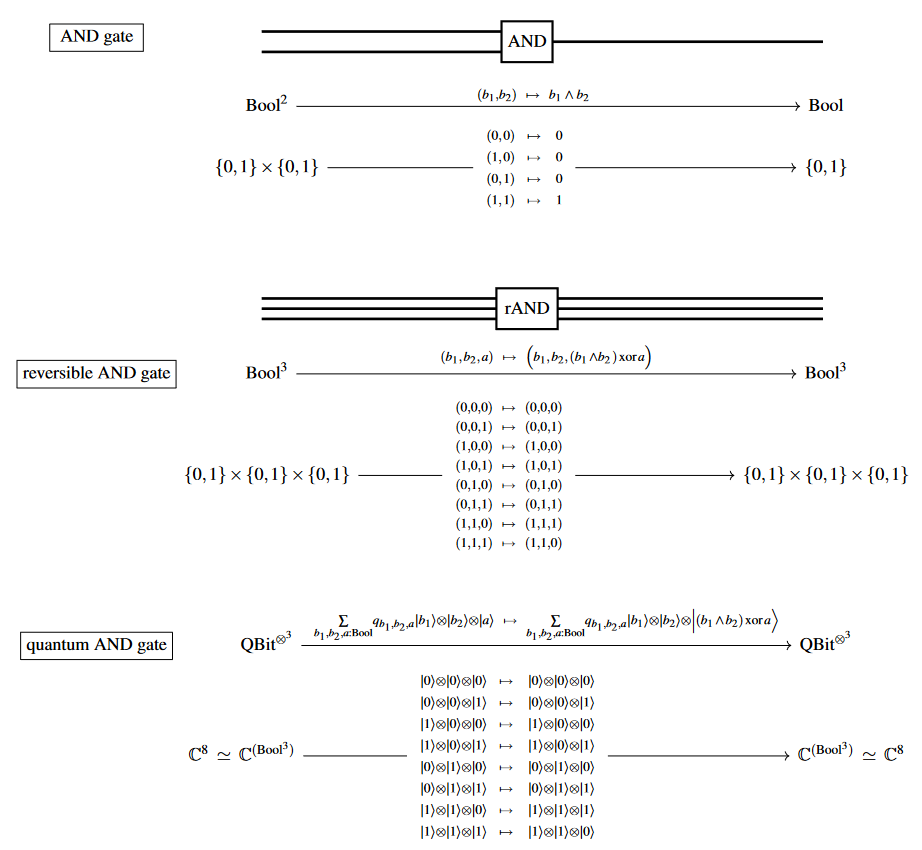
As a logic gate
Logical conjunction as
-
a logic gate,
-
a reversible logic gate and
-
a (reversible) quantum logic gate:
Related concepts
| symbol | in propositional logic | Unicode |
|---|---|---|
| typing relation | U+003A | |
| = | propositional equality relation | U+003D |
| logical negation operator | U+00AC | |
| double negation | U+00AC&U+00AC | |
| , | negation of converse implication, or negation of converse conditional | U+21CD, U+219A |
| , | negation of logical equivalence, or negation of biconditional | U+21CE, U+21AE |
| , | negation of implication, or negation of conditional | U+21CF, U+219B |
| , | converse implication, or converse conditional | U+21D0, U+2190 |
| , | implication, or conditional | U+21D2, U+2192 |
| , | logical equivalence, or biconditional | U+21D4, U+2192 |
| logical conjunctionoperator | U+2227 | |
| logical dysjunction operator | U+2228 | |
| inequality, or apartness relation | U+2260 | |
| syntactic entailment relation | U+22A2 | |
| semantic entailment relation | U+22A8 | |
| truth value, or top element | U+22A3 | |
| false value, or bottom element | U+22A4 | |
| , | logical exclusive dysjunction operator | U+22BB, U+2295 |
| logical non-conjunction operator | U+22BC | |
| logical non-dysjunction operator | U+22BD |
| symbol | in first-order logic | Unicode |
|---|---|---|
| universal quantifier | U+2200 | |
| existential quantifier | U+2203 | |
| uniqueness quantifier | U+2203&U+0021 | |
| negation of existential quantifier | U+2204 |
| symbol | in set theory | Unicode |
|---|---|---|
| × | binary Cartesian product, or binary product | U+00D7 |
| empty, or uninhabited set | U+2205 | |
| membership relation | U+2208 | |
| negation of membership relation | U+2209 | |
| containment relation | U+220B | |
| negation of containment relation | U+220C | |
| n-ary Cartesian product, or product operator | U+220F | |
| n-ary disjoint union, or coproduct operator | U+2210 | |
| binary intersection operator | U+2229 | |
| binary union operator | U+222A | |
| subset of relation | U+2282 | |
| superset of relation | U+2283 | |
| negation of subset relation | U+2284 | |
| negation of superset relation | U+2285 | |
| inclusion relation, or subset of, or equal to | U+2286 | |
| converse of inclusion relation, or superset of, or equal to | U+2287 | |
| binary disjoint union, or binary coproduct operator | U+2294 | |
| n-ary intersection operator | U+22C2 | |
| n-ary union operator | U+22C3 |
| symbol | in linear logic |
|---|---|
| additive truth | |
| additive falsehood | |
| multiplicative falsehood | |
| multiplicative truth | |
| linear implication | |
| multiplicative conjunction | |
| additive disjunction | |
| additive conjunction | |
| multiplicative disjunction | |
| exponential conjunction | |
| exponential disjunction | |
| negation |
Last revised on March 29, 2023 at 10:24:04. See the history of this page for a list of all contributions to it.