nLab inter-universal Teichmüller theory
Context
Arithmetic geometry
- natural number, integer number, rational number, real number, irrational number, complex number, quaternion, octonion, adic number, cardinal number, ordinal number, surreal number
-
transfinite arithmetic, cardinal arithmetic, ordinal arithmetic
-
prime field, p-adic integer, p-adic rational number, p-adic complex number
arithmetic geometry, function field analogy
Contents
Idea
The generalization of Teichmüller theory to arithmetic geometry has been called inter-universal Teichmüller theory (often abbreviated IUTT) by Shinichi Mochizuki. It is a part of anabelian geometry.
The term “Inter-Universal” refers to Mochizuki’s Key Principle of Inter-Universality [IUTT I, Section I3, Page 25-26] which requires one to work with arbitrary geometric base-points for the tempered fundamental groups.
A choice of a geometric base-point for the tempered fundamental group corresponds to a choice of a fiber functor for the galois category of tempered coverings. Hence Mochizuki asserts [IUTT I, Section I3 Page 25-26] that the idea of working with distinct geometric base-points is tantamount to relating the distinct set-theoretic universes the fiber functors arise from and so theory is referred to as being inter-universal. [The fundamental group is, of course, independent (or agnostic) of the choice of the fiber functor, i.e. it is an object which is oblivious to the choice of the set theoretic universe it arises from.]
Hence Mochizuki has asserted that this theory is meant to formulated explicitly in a way that respects universe enlargement, hence that it is universe polymorphic (IUTT IV, remark 3.1.4, Yamashita 13).
While [IUTT I-IV] offers scant mathematical justification of the Teichmuller aspects of the theory (i.e. [IUTT I-IV] provides no mathematical justification why the theory is a Teichmuller Theory), a clearest proof of this Teichmuller aspect has been provided (in all dimensions) in the works of Kirti Joshi.
It is claimed (IUTT IV) that a proof of the abc conjecture can be given in IUTT. In 2018, a document Why abc is still a conjecture was written by Peter Scholze and Jakob Stix raising objections to the argument. More accurate critiques have appeared as a part of the works of Kirti Joshi on the theory of Arithmetic Teichmuller Spaces which includes, in dimension one and genus one, a precise version of Mochizuki’s IUTT.
In brief, the novel idea due to Mochizuki, is to average over deformations of arithmetic (or an arithmetic holomorphic structure) itself (this notion has been precisely quantified in the works of Kirti Joshi). It should be remarked that Classical Teichmuller Theory should be considered as a model for Mochizuki’s (and Joshi’s) theory at any archimedean prime of a number field.
Details
Pilot objects
Important to the arguments in the latter parts of the IUTT series are what Mochizuki refers to as pilot objects. (A precise construction of Pilot objects has been independently provided in Construction of Arithmetic Teichmuller Spaces III: A Rosetta Stone and a proof of Mochizuki’s Corollary 3.12.)
Though the terminology in IUTT III is very dense, Mochizuki explains in Example 3.6, Remark 3.6.1, and subsequently that these can be understood in quite elementary terms, which we now describe.
Let , , , and be as at initial Θ-data: is a once-puncturing of an elliptic curve , is a number field, is the field of moduli of with respect to , is a certain set of valuations, and all of , , , and satisfy certain conditions which will be referred to here only as needed. Let denote the multiplicative group of .
Let . By definition, is a valuation on , where is as defined at initial Θ-data. Denote the completion of with respect to by , denote the ring of integers of by , and denote the group of units of these two rings by and respectively.
Let denote the group homomorphism induced by the composition of the field inclusion with the canonical ring homomorphisms .
Definition
We denote by the category whose objects consist of:
-
An -torsor , where torsor here is understood with respect to the category of sets.
-
For every , a trivialisation of the -torsor obtained from by change of structure group with respect to . We require that there is a such that, for all but finitely many , is equal to the trivialisation of determined by . (See torsor for the details of trivialisation of a torsor, and for the notion of change of structure group of a torsor.)
TODO: FINISH
Remark
Definition is Example 3.6 in IUTT III, and is also discussed in Remark 3.6.1. Remark 3.1.5 of IUTT I is also relevant.
Related concepts
-
poly-morphism (not to be be confused with polymorphism)
References
General
-
Shinichi Mochizuki, Inter-universal Teichmüller theory I, Construction of Hodge theaters (2012) (pdf)
-
Shinichi Mochizuki, Inter-universal Teichmüller theory II, Hodge-Arakelov-theoretic evaluation (2012) (pdf)
-
Shinichi Mochizuki, Inter-universal Teichmüller theory III, Canonical splittings of the Log-theta-lattice (2012) (pdf)
-
Shinichi Mochizuki, Inter-universal Teichmüller theory IV, Log-volume computations and set-theoretic foundations (2012) (pdf)
Surveys:
-
Shinichi Mochizuki, Panoramic overview of inter-universal Teichmuller theory, pdf
-
Benjamin Collas, Anabelian Arithmetic Geometry—a New Geometry of Forms and Numbers: Inter-universal Teichmüller Theory or Beyond Grothendieck’s Vision“, Lobachevskii Journal of Mathematics February 2025, Volume 45, pp. 4954–4979 Springer Nature
-
Go Yamashita, FAQ on ‘Inter-Universality’ (pdf)
-
Ivan Fesenko, Arithmetic deformation theory via arithmetic fundamental groups and nonarchimedean theta functions, European Journal of Mathematics September 2015, Volume 1, Issue 3, pp 405-440 (publisher, pdf)
-
Minhyong Kim, Brief superficial remarks on Shinichi Mochizuki’s Interuniversal Teichmueller Theory (IUTT), version 1, 10/11/2015, (pdf).
-
Taylor Dupuy, Hodge Theaters: A First Look at the Big Hodge Theater, Confused Groups and Torsors
-
RIMS/Symmetries and Correspondences workshop: Inter-universal Teichmüller Theory Summit 2016
-
Jackson Morrow, Kummer classes and Anabelian geometry, notes from Super QVNTS: Kummer Classes and Anabelian Geometry 2017 (pdf)
The following two papers give a statement of Mochizuki's Corollary 3.12 in plain language (not using the elaborate setup in the IUT papers), and assuming the inequality in it as given, derive concrete versions of (weakenings of) Szpiro’s conjecture, again, using conventional terminology and techniques.
-
Taylor Dupuy, Anton Hilado, The Statement of Mochizuki’s Corollary 3.12, Initial Theta Data, and the First Two Indeterminacies, arXiv:2004.13228
-
Taylor Dupuy, Anton Hilado, Probabilistic Szpiro, Baby Szpiro, and Explicit Szpiro from Mochizuki’s Corollary 3.12, arXiv:2004.13108
Formalization attempts
Early verbalization of the idea to formalize the alleged IUT proof of the abc conjecture with a proof assistant:
- Timothy Chow, MathOverflow comment (8 Apr 2020) [MO:a/356937]
“one could ask if it is reasonable to request that the group of people who claim to understand Mochizuki’s proof (and who believe that it is complete and correct) to formalize the proof using a proof assistant. […] When the normal process of socializing a proof breaks down, it should indeed be possible in principle for computers to ”come to the rescue“. […] If the proof really is correct and those people really do understand it, then the project should eventually succeed, and when it does, the skeptics should be convinced. On the other hand, if the proof has a huge gap, then eventually those tasked with formalization (I’m imagining graduate students) will be forced to confront it, and it will become increasingly hard for ”believers“ to make excuses for why the formalization project is stalling.”
Embracing the idea of reaching consensus via (Lean) formalization:
- Shinichi Mochizuki: On the Formalization of IUT: a preliminary progress report, talk at exlean (Apr 2026) [video:yt]
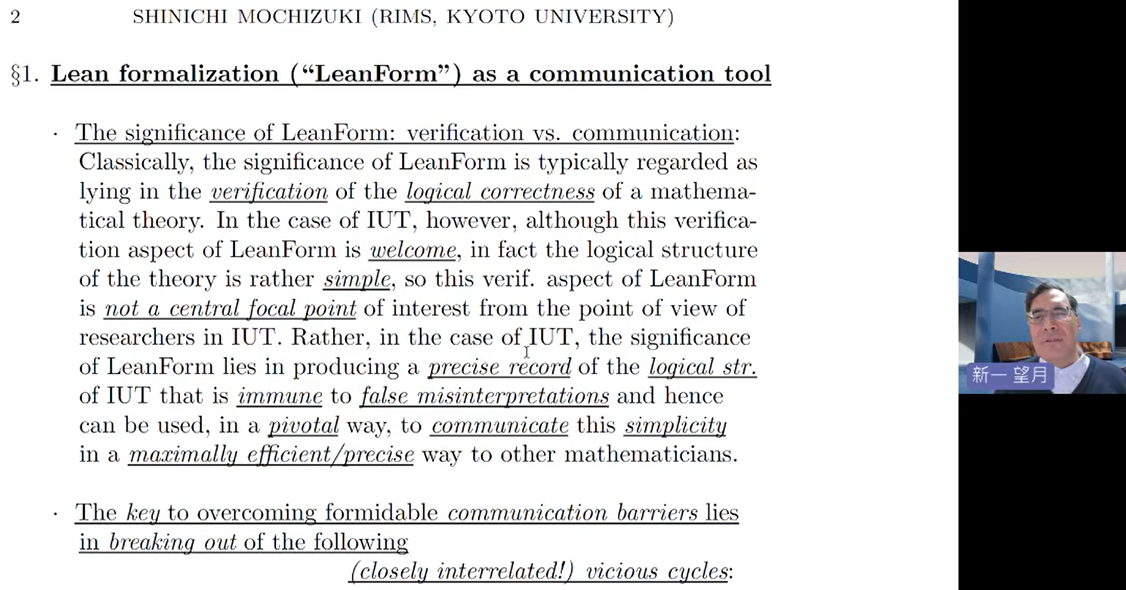
The LANA project carrying out the formalization of the alleged IUT proof of the abc conjecture with a proof assistant (Lean):
-
ZEN Mathematics Center: Lean for ANAbelian geometry (LANA) (March 2026)
-
Alex Wilkins: The secret project to settle controversial maths proof with a computer. New Scientist (April 10, 2026)
Results of this formalization effort:
-
Yuichiro Hoshi, March 2026, here:
“with regard to the logic by which Corollary 3.12 is derived from Theorem 3.11 as I mentioned earlier, I must take seriously the fact that many members of the LANA Project still feel that there is some insurmountable wall there.”
-
LANA Project: Interim Report 2026: Computer-Assisted Verification of IUT Theory (July 2026) [github, pdf]
“we isolate a specific compatibility problem at the final stage of the argument […] Project LANA has not yet reconstructed a proof of the required compatibility”
-
LANA Project Press Conference, Zen Mathematics Center (17 July 2026) [video:YT]
40:45: “This is exactly the point that we don’t understand how to prove”
-
Fumiharo Kato (17 July 2026) (x.com:2078017230537892207):
“In today’s press conference, we explained our efforts over the last two years which resulted in the following conclusion: The way the argument from Theorem 3.11 to Corollary 3.12 is written in the IUT papers is unformalizable. But since Mochizuki’s explanation of this point has recently started evolving, we reserve final judgement at this time.”
[our emphasis]
The problem encountered by the LANA project is claimed to be different from that previously argued in:
- Peter Scholze, Jakob Stix: Why is still a conjecture (Aug 2018) [pdf]
for the LANA report 2026 writes in its final §10 (pp. 46):
“We now compare our analysis with that made by Scholze and Stix in [15] […] In the final part of [15], the occurrence of monodromy in the identifications among the various ordered one-dimensional real vector spaces appearing in the theory is pointed out as a flaw in the proof […] [We] indicate why this occurrence of monodromy does not represent an obstruction to the intended proof strategy of Mochizuki […] [because] our analysis does not give rise to this particular diagram; rather, the elaboration of the -algorithm shows that the proof of the final numerical inequality hinges on the compatibility (9-1) which is not manifestly false. However, we, the LANA project, do not have a proof of (9-1) at this time.”
See also:
-
Lean Zulip Board: LANA project announcement (31 Mar 2026–)
-
Wikipedia, Inter-universal Teichmüller theory
Last revised on September 28, 2026 at 09:06:20. See the history of this page for a list of all contributions to it.