nLab action functional
Context
Variational calculus
Differential geometric version
Derived differential geometric version
Physics
physics, mathematical physics, philosophy of physics
Surveys, textbooks and lecture notes
theory (physics), model (physics)
experiment, measurement, computable physics
-
-
-
Axiomatizations
-
Tools
-
Structural phenomena
-
Types of quantum field thories
-
Contents
Idea
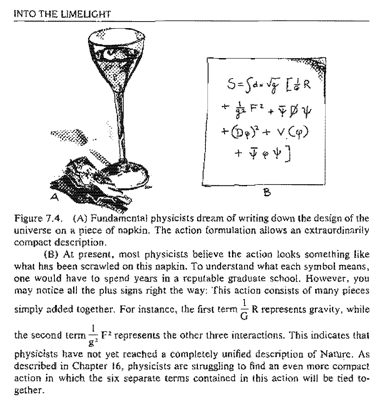
In physics the dynamics of a physical system may be encoded by a nonlinear functional – called the action functional – on its configuration space:
-
in classical mechanics and classical field theory – by the action principle or principle of least action – the extrema of the action functional – obtained by variational calculus and given by Euler-Lagrange equations – encode the physically observable configurations ;
-
in quantum mechanics and quantum field theory the evolution of the quantum states is encoded by the integral – the path integral – of the exponentiated action functional over the space of field configurations.
For emphasis the description of dynamics by action functionals is called the Lagrangean approach. Another formulation of dynamics in physics that does not involve an action functional explicitly is Hamiltonian mechanics on phase space. At least in certain classes of cases the relation and equivalence of both approaches is understood. Generally the formulation of quantum field theory in terms of action functionals suffers from a lack of precise understanding of what the path integral over the action functional really means.
Definition
Let be the ambient (∞,1)-topos with a natural numbers object and equipped with an additive continuum line object (see there). Let be the configuration space of a physical system. Then an action functional is a morphism
(here refers to Planck's constant).
If is a cohesive (∞,1)-topos then there is an intrinsic differential of the action functional to a morphism
The equation
is the Euler-Lagrange equation of the system. It characterizes the critical locus of is the covariant phase space inside the configuration space: the space of classically realized trajectories/histories of the system. If models derived geometry then this critical locus is presented by a BRST-BV complex.
Local action functionals (traditional theory)
An action functional is called local if it arises from integration of a Lagrangian.
In traditional theory this is interpreted as follows: an action functional is called local if
-
the configuration space is the space of sections of a fiber bundle over some parameter space (spacetime );
-
there is a Lagrangian density on the jet bundle of ;
-
on a section/field configuration the action takes the value
where is the jet-prolongation of (the collection of all its higher partial derivatives).
Consider action functional on a configuration space of smooth functions from the line to a smooth manifold .
We can consider
- , where is a path through configuration space, on the time interval , with derivative . When minimising the action, we fix the values of and .
- , where now is a configuration of fields on , which is a region of space. We fix boundary conditions on the boundary of (typically that and go to zero if is all of space).
- , where now is a configuration of fields on , which a region of spacetime, with time derivative . We fix boundary conditions on the boundary of .
The formulation of (3) above is still not manifestly coordinate independent. However, is simply the volume form on spacetime and is merely one choice of coordinate on state space and could just as easily be replaced by a derivative with respect to any timelike coordinate on spacetime (or drop coordinates altogether).
Extended local action functionals in (higher) gauge theory
For gauge theories and higher gauge theories the configuration spaces of the physical system are in general not plain manifolds or similar, but are orbifolds or more generally smooth groupoids, smooth ∞-groupoids. (An exposition of and introduction to much of the following is at geometry of physics.)
For instance for a Lie group and the smooth moduli stack of -principal connections (see at connection on a bundle), then the smooth groupoid of -gauge field configurations is the internal hom/mapping stack Smooth∞Grpd (or some concretification thereof, see at geometric of physics – differential moduli): this is the smooth groupoid whose objects are -gauge field-configurations on (connections on -principal bundles over ), and whose morphisms are gauge transformations between these. The infinitesimal approximation to this smooth ∞-groupoid, its ∞-Lie algebroid is the (off-shell) BRST complex of the theory. The tangent to the -fold higher gauge transformations becomes the -fold ghosts in the BRST complex.
More generally here can by any smooth ∞-group, such as the circle n-group or the String 2-group or the Fivebrane 6-group, and so on, in which case is the smooth ∞-groupoid of higher gauge field, gauge transformations between these, higher gauge transformations between those, and so on.
Notice that this means in particular that in higher geometry a gauge theory is a sigma-model quantum field theory: one whose target space is not just a plain manifold but is a moduli stack of gauge field configurations.
A gauge invariant action functional is then a morphism of smooth ∞-groupoids
This is of particular interest, again, if it is local. In fact, in this context now we can also ask that it is “extended” in the sense of extended topological quantum field theory: that we have an action functional not only in top dimension, being a function, but also in codimension 1, being a prequantum bundle, and in higher codimension, being a prequantum n-bundle.
This is notably the case for all (higher) gauge theories of infinity-Chern-Simons theory type, such as ordinary Chern-Simons theory and such as ordinary Dijkgraaf-Witten theory, as well as its higher generalizations. In these cases the action functional arises itself from transgression of an extended Lagrangian that is defined on the universal moduli stack of gauge field configurations itself, namely from a universal characteristic class in higher nonabelian differential cohomology of the form
Here is the universal smooth moduli infinity-stack for circle n-bundles with connection. Such a morphism of moduli stacks locally takes a connection differential form to a Chern-Simons form , but globally it sends the underlying principal bundle to a circle (n-1)-group principal ∞-bundle and accordingly acts globally on the connection. This is hence a fully local Lagrangian: an extended Lagrangian. Alternatively, one may think of this whole morphism as modulating a prequantum circle n-bundle on the universal moduli stack of gauge fields itself.
For instance for ordinary Chern-Simons theory here is a semisimple Lie group and is a smooth and differential refinement of the first Pontryagin class/second Chern class, or of an integral multiple of that (the “level” of the theory). In this case may also be thought of as modulating the universal Chern-Simons circle 3-bundle. If instead is a discrete group then is a cocycle in the -group cohomology and this is the extended Lagrangian of Dijkgraaf-Witten theory.
This extended Lagrangian becomes an extended action functional after transgression: the operation of fiber integration in ordinary differential cohomology refines to a morphism of moduli stacks of the form
where is an oriented closed manifold of dimension . This morphism locally simply takes a differential n-form to its ordinary integration of differential forms over , but globally it takes the correct higher holonomy of circle n-bundles with connection.
Combining this with an extended ∞-Chern-Simons theory Lagrangian as above yields for each dimension a prequantum circle n-bundle on the space of gauge field configurations over , by forming the transgression composite
This morphism locally takes the local differential form incarnation of a connection on an ∞-bundle to the exponentiation of the integration of differential forms of some higher Chern-Simons form, but globally it computes the correct higher holonomy of the higher circle n-bundle with connection over the universal moduli stack of fields, as modulated by the extended Lagrangian .
Examples
For spacetime field theory:
For branes:
-
A large class of examples of action functionals arises in ∞-Chern-Simons theory. See there for details.
Related concepts
| action functional | kinetic action | interaction | path integral measure |
|---|---|---|---|
| BV differential | elliptic complex + | antibracket with interaction + | BV-Laplacian |
| + | + |
extended prequantum field theory
| (off-shell) prequantum (n-k)-bundle | traditional terminology | |
|---|---|---|
| differential universal characteristic map | level | |
| prequantum (n-1)-bundle | WZW bundle (n-2)-gerbe | |
| prequantum (n-k)-bundle | ||
| prequantum 1-bundle | (off-shell) prequantum bundle | |
| prequantum 0-bundle | action functional |
References
Historical and expository accounts of the “principle of extremal action” or “action principle”, for short:
-
Agamenon R. E. Oliveira, History of Two Fundamental Principles of Physics: Least Action and Conservation of Energy, Advances in Historical Studies 3 2 (2014) [doi:10.4236/ahs.2014.32008]
-
Walter Dittrich, The Development of the Action Principle – A Didactic History from Euler-Lagrange to Schwinger, SpringerBriefs in Physics, Springer (2021) [doi:10.1007/978-3-030-69105-9]
-
Douglas Cline, Variational Principles in Classical Mechanics, University of Rochester (2021) [pdf, online version]
Textbook account in the context of gauge theories:
- Marc Henneaux, Claudio Teitelboim, §1.1.1 in: Quantization of Gauge Systems, Princeton University Press (1992) [ISBN:9780691037691, jstor:j.ctv10crg0r]
Lecture notes with more details are in the section Lagrangians and Action functionals of
Discussion of extended higher local action functional for (higher) gauge theories of generalized ∞-Chern-Simons theory type are discussed in
The extended local action functionals for ordinary 3d Chern-Simons theory/Dijkgraaf-Witten theory and for 7d String 2-group Chern-Simons theory are constructed in
- Domenico Fiorenza, Urs Schreiber, Jim Stasheff, Cech cocycles for differential characteristic classes
and discussed further in
A comprehensive discussion in a general context of higher differential geometry is in
Last revised on August 16, 2025 at 23:37:33. See the history of this page for a list of all contributions to it.