nLab cobordism cohomology theory
Context
Cobordism theory
cobordism theory = manifolds and cobordisms + stable homotopy theory/higher category theory
Concepts of cobordism theory
-
homotopy classes of maps to Thom space MO
-
complex cobordism cohomology theory
flavors of bordism homology theories/cobordism cohomology theories, their representing Thom spectra and cobordism rings:
bordism theoryM(B,f) (B-bordism):
relative bordism theories:
global equivariant bordism theory:
algebraic:
Contents
Idea
In algebraic topology, a Whitehead-generalized cohomology theory represented by a Thom spectrum is called a cobordism cohomology theory (Atiyah 61), in duality with the corresponding generalized homology theory called bordism homology theory.
In both cases, a version of the Pontryagin-Thom construction identifies the (co)homology classes of these (co)homology theories with bordism-equivalence classes of manifolds (carrying some given extra structure), whence the name. For bordism homology theory this was understood since the very inception of the subject (Thom 54), while for cobordism cohomology theory this identification is made explicit in Atiyah 61, Sec. 3, Quillen 71 (relying on results from Thom 54 nonetheless), see below at Geometric model via cobordism classes.
Accordingly, cobordism cohomology theories are fundamental concepts of bordism theory in differential topology. But in addition they turn out to play a special role in the more abstract stable homotopy theory of complex oriented cohomology theories (with its variants such as quaternionic-oriented theories) and in the resulting chromatic homotopy theory, see for instance the universal complex orientation on MU. This way, cobordism cohomology embodies a remarkable confluence of the differential topology of smooth manifolds with deep issues in abstract homotopy theory.
There are many different flavours of cobordism cohomology theories (see the list of Examples below), depending on the tangential structure encoded in the representing Thom spectrum . Among the most commonly considered versions are these:
-
The cohomology theory represented by MO is the base case, in the sense that the orthogonal group is homotopy equivalent to the general linear group (namely the maximal compact subgroup), so that -tangential structure corresponds to no extra tangential structure.
-
The cohomology theory represented by MU is complex cobordism cohomology. Its periodic cohomology theory version is sometimes denoted MP. The cohomology theories MO and MU are unified by the equivariant cohomology theory called MR-theory.
-
On the other hand, framed cobordism cohomology theory MFr is equivalently stable Cohomotopy theory (by the Pontryagin-Thom theorem). In its unstable version as plain Cohomotopy theory this – and its relation to cobordism classes of normally framed submanifolds (the Pontryagin construction) – this was the historical origin of cobordism theory (in Pontrjagin 38, Pontrjagin 55).
Geometric model via cobordism classes
We discuss a geometric model for the cobordism cohomology theory, due to Quillen 71, Section 1. We concentrate on the complex case, corresponding to the Thom spectrum MU:
Proposition
For a smooth manifold , the cobordism cohomology group is equivalently the set of cobordism classes of proper complex-oriented maps of codimension .
This uses the following definitions:
Definition
(complex-oriented maps)
Let be a smooth map.
If the relative codimension of is even at all points of , then a complex orientation is an equivalence class of factorizations of in the form
where is a complex vector bundle and is an embedding equipped with a complex structure on its normal bundle.
Two such factorizations and are regarded as equivalent if there is another factorization together with embeddings of complex vector bundles and and a homotopy over equipped with a complex structure on its normal bundle that restricts to the corresponding complex structures on and .
Definition
(cobordism classes of maps)
Here two proper complex-oriented maps are called cobordant if there is a proper complex-oriented map such that and are transversal to and pulling back to these submanifolds yields and .
Examples
flavors of bordism homology theories/cobordism cohomology theories, their representing Thom spectra and cobordism rings:
bordism theoryM(B,f) (B-bordism):
relative bordism theories:
global equivariant bordism theory:
algebraic:
Related concepts
-
the refinement of cobordism cohomology theory to differential cohomology is differential cobordism cohomology.
References
General
Original articles introducing cobordism as a Whitehead-generalized cohomology theory:
-
Michael Atiyah, Bordism and Cobordism, Mathematical Proceedings of the Cambridge Philosophical Society, Volume 57, Issue 2, April 1961, pp. 200 - 208 (doi:10.1017/S0305004100035064, pdf)
(introducing the concept, with focus onMSO)
-
Pierre Conner, Edwin Floyd, The Relation of Cobordism to K-Theories, Lecture Notes in Mathematics 28 Springer 1966 (doi:10.1007/BFb0071091, MR216511)
(relating complex cobordism theory to topological K-theory and the e-invariant)
-
Daniel Quillen, Elementary Proofs of Some Results of Cobordism Theory Using Steenrod Operations, Advances in Mathematics 7 (1971), 29–56 (doi:10.1016/0001-8708(71)90041-7)
Early survey:
-
Victor Buchstaber, Cobordisms in problems of algebraic topology, J Math Sci 7, 629–653 (1977) (doi:10.1007/BF01084983)
-
Peter Landweber, A survey of bordism and cobordism, Mathematical Proceedings of the Cambridge Philosophical Society, Volume 100, Issue 2 September 1986, pp. 207-223 (doi:10.1017/S0305004100066032)
Textbook accounts:
-
Robert Stong, Notes on Cobordism theory, Princeton University Press, 1968 (toc pdf, ISBN:9780691649016, pdf)
-
Yuli Rudyak, On Thom spectra, orientability and cobordism, Springer Monographs in Mathematics (1998) [doi:10.1007/978-3-540-77751-9, pdf]
The twisted and equivariant versions:
-
James Cruickshank, Twisted Cobordism and its Relationship to Equivariant Homotopy Theory, 1999 (pdf, pdf)
-
James Cruickshank, Twisted homotopy theory and the geometric equivariant 1-stem, Topology and its Applications Volume 129, Issue 3, 1 April 2003, Pages 251-271 (arXiv:10.1016/S0166-8641(02)00183-9)
Pontrjagin-Thom construction
Pontrjagin’s construction
General
The Pontryagin theorem, i.e. the unstable and framed version of the Pontrjagin-Thom construction, identifying cobordism classes of normally framed submanifolds with their Cohomotopy charge in unstable Borsuk-Spanier Cohomotopy sets, is due to:
-
Lev Pontrjagin, Classification of continuous maps of a complex into a sphere, Communication I, Doklady Akademii Nauk SSSR 19 3 (1938) 147-149
-
Lev Pontryagin, Homotopy classification of mappings of an (n+2)-dimensional sphere on an n-dimensional one, Doklady Akad. Nauk SSSR (N.S.) 19 (1950), 957–959 (pdf)
(both available in English translation in Gamkrelidze 86),
as presented more comprehensively in:
- Lev Pontrjagin, Smooth manifolds and their applications in Homotopy theory, Trudy Mat. Inst. im Steklov, No 45, Izdat. Akad. Nauk. USSR, Moscow, 1955 (AMS Translation Series 2, Vol. 11, 1959) (doi:10.1142/9789812772107_0001, pdf)
The Pontrjagin theorem must have been known to Pontrjagin at least by 1936, when he announced the computation of the second stem of homotopy groups of spheres:
- Lev Pontrjagin, Sur les transformations des sphères en sphères (pdf) in: Comptes Rendus du Congrès International des Mathématiques – Oslo 1936 (pdf)
Review:
-
Daniel Freed, Karen Uhlenbeck, Appendix B of: Instantons and Four-Manifolds, Mathematical Sciences Research Institute Publications, Springer 1991 (doi:10.1007/978-1-4613-9703-8)
-
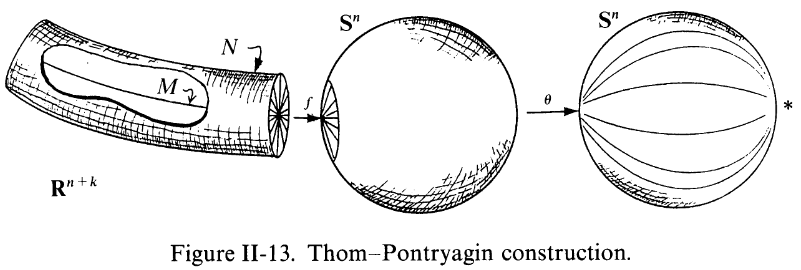
Glen Bredon, chapter II.16 of: Topology and Geometry, Graduate Texts in Mathematics 139, Springer (1993) [doi:10.1007/978-1-4757-6848-0, pdf]
-
Antoni Kosinski, chapter IX of: Differential manifolds, Academic Press (1993) [pdf, ISBN:978-0-12-421850-5]
-
John Milnor, Chapter 7 of: Topology from the differentiable viewpoint, Princeton University Press, 1997. (ISBN:9780691048338, pdf)
-
Mladen Bestvina (notes by Adam Keenan), Chapter 16 in: Differentiable Topology and Geometry, 2002 (pdf)
-
Michel Kervaire, La méthode de Pontryagin pour la classification des applications sur une sphère, in: E. Vesentini (ed.), Topologia Differenziale, CIME Summer Schools, vol. 26, Springer 2011 (doi:10.1007/978-3-642-10988-1_3)
-
Rustam Sadykov, Section 1 of: Elements of Surgery Theory, 2013 (pdf, pdf)
-
András Csépai, Stable Pontryagin-Thom construction for proper maps, Period Math Hung 80, 259–268 (2020) (arXiv:1905.07734, doi:10.1007/s10998-020-00327-0)
Discussion of the early history:
Twisted/equivariant generalizations
The (fairly straightforward) generalization of the Pontrjagin theorem to the twisted Pontrjagin theorem, identifying twisted Cohomotopy with cobordism classes of normally twisted-framed submanifolds, is made explicit in:
- James Cruickshank, Lemma 5.2 using Sec. 5.1 in: Twisted homotopy theory and the geometric equivariant 1-stem, Topology and its Applications Volume 129, Issue 3, 1 April 2003, Pages 251-271 (doi:10.1016/S0166-8641(02)00183-9)
A general equivariant Pontrjagin theorem – relating equivariant Cohomotopy to normal equivariant framed submanifolds – remains elusive, but on free G-manifolds it is again straightforward (and reduces to the twisted Pontrjagin theorem on the quotient space), made explicit in:
- James Cruickshank, Thm. 5.0.6, Cor. 6.0.13 in: Twisted Cobordism and its Relationship to Equivariant Homotopy Theory, 1999 (pdf, pdf)
In negative codimension
In negative codimension, the Cohomotopy charge map from the Pontrjagin theorem gives the May-Segal theorem, now identifying Cohomotopy cocycle spaces with configuration spaces of points:
-
Peter May, The geometry of iterated loop spaces, Springer 1972 (pdf)
-
Graeme Segal, Configuration-spaces and iterated loop-spaces, Invent. Math. 21 (1973), 213–221. MR 0331377 (pdf)
c Generalization of these constructions and results is due to
-
Dusa McDuff, Configuration spaces of positive and negative particles, Topology Volume 14, Issue 1, March 1975, Pages 91-107 (doi:10.1016/0040-9383(75)90038-5)
-
Carl-Friedrich Bödigheimer, Stable splittings of mapping spaces, Algebraic topology. Springer 1987. 174-187 (pdf, pdf)
Thom’s construction
Thom's theorem i.e. the unstable and oriented version of the Pontrjagin-Thom construction, identifying cobordism classes of normally oriented submanifolds with homotopy classes of maps to the universal special orthogonal Thom space , is due to:
- René Thom, Quelques propriétés globales des variétés différentiables, Comment. Math. Helv. 28, (1954). 17-86 (doi:10.1007/BF02566923, dml:139072, digiz:GDZPPN002056259, pdf)
Textbook accounts:
- Robert Stong, Notes on Cobordism theory, 1968 (toc pdf, publisher page)
Lashof’s construction
The joint generalization of Pontryagin 38a, 55 (framing structure) and Thom 54 (orientation structure) to any family of tangential structures (“(B,f)-structure”) is first made explicit in
- Richard Lashof, Poincaré duality and cobordism, Trans. AMS 109 (1963), 257-277 (doi:10.1090/S0002-9947-1963-0156357-4)
and the general statement that has come to be known as the Pontryagin-Thom isomorphism (identifying the stable cobordism classes of normally (B,f)-structured submanifolds with homotopy classes of maps to the Thom spectrum Mf) is really due to Lashof 63, Theorem C.
Textbook accounts:
-
Theodor Bröcker, Tammo tom Dieck, Satz 3.1 & 4.9 in: Kobordismentheorie, Lecture Notes in Mathematics 178, Springer (1970) [ISBN:9783540053415]
-
Stanley Kochman, section 1.5 of: Bordism, Stable Homotopy and Adams Spectral Sequences, AMS 1996
-
Yuli Rudyak, On Thom spectra, orientability and cobordism, Springer Monographs in Mathematics (1998) [doi:10.1007/978-3-540-77751-9, pdf]
Lecture notes:
-
John Francis, Topology of manifolds course notes (2010) (web), Lecture 3: Thom’s theorem (pdf), Lecture 4 Transversality (notes by I. Bobkova) (pdf)
-
Cary Malkiewich, Section 3 of: Unoriented cobordism and , 2011 (pdf)
-
Tom Weston, Part I of An introduction to cobordism theory (pdf)
See also:
Relation to divisors
Relation of complex cobordism cohomology with divisors, algebraic cycles and Chow groups:
-
Burt Totaro, Torsion algebraic cycles and complex cobordism, J. Amer. Math. Soc. 10 (1997), 467-493 (doi:10.1090/S0894-0347-97-00232-4)
Last revised on September 1, 2024 at 13:27:35. See the history of this page for a list of all contributions to it.