nLab twisted functorial field theory
Context
Functorial quantum field theory
Contents
Idea
When (classical or quantum field theory) field theory is expressed as extended functorial field theory, hence as (-)functors on some (-)category of cobordisms, there is the notion of natural transformation between such functors/field theories.
By the holographic principle of higher category theory the components of such natural transformations are themselves close to being higher functors on cobordisms themselves, but in one dimension lower, hence may be understood as a generalized form of (extended) functorial field theories themselves. But the lack of exact functoriality of these transformation components means that there is (in general) a “twist” or “anomaly”.
In the archetypal case one considers transformations
out of the tensor unit in the given (higher) category of field theories, in which case such twisted functorial field theories (twFFT) have also been called relative FFTs, relative to the given .
This is closely analogous and related to how sections of a vector bundle — hence twisted functions: twisted by the bundle — are equivalently morphism of vector bundles from the tensor unit bundle (the trivial line bundle).
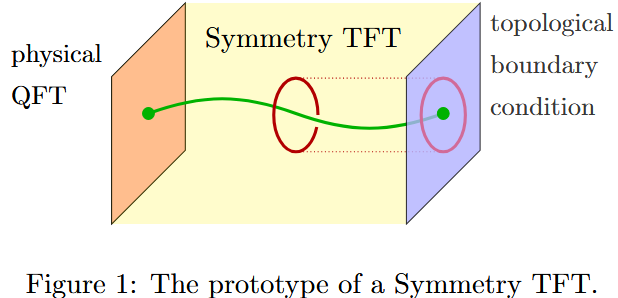
These days, also the term symmetry TFT (for the ) is popular.
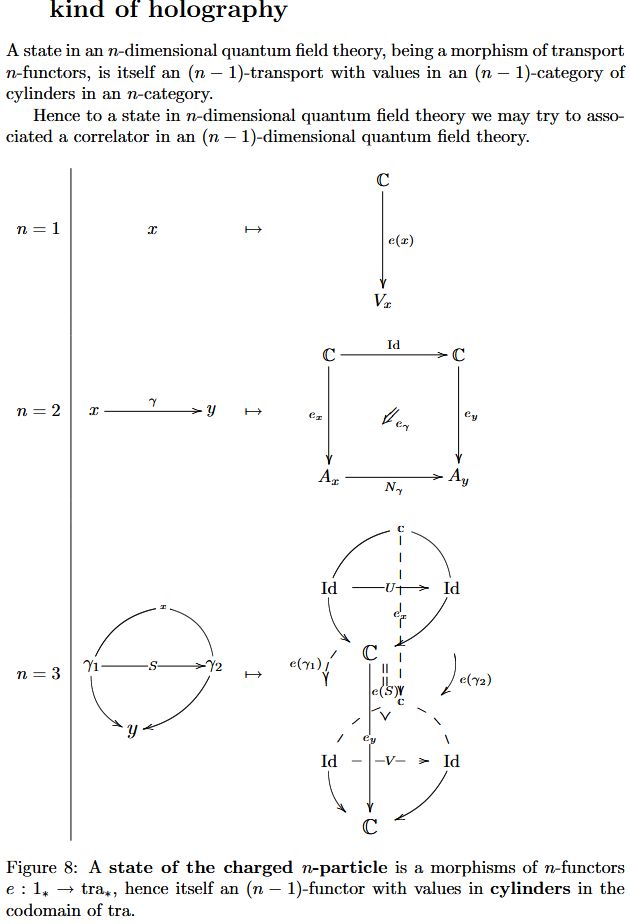
In the case , the components that natural transformations between TQFT 3-functors assign to surfaces are 3-morphisms between 2-morphisms making “tin-can diagrams” (vividly so when using globular shapes of higher morphisms, whence the original slogan: “D-branes from tin cans”) as shown in the last row of the following table (from Schreiber 2006):
More informal but more popular these days is a corresponding schematic diagram of the following form (from ABBGN24):
References
The notion of twisted or relative functorial field theory as natural transformations between FQFTs was popularized in:
-
Stephan Stolz, Peter Teichner: Twisted field theories, §5 in: Supersymmetric field theories and generalized cohomology, in: Hisham Sati, Urs Schreiber (eds.): Mathematical Foundations of Quantum Field and Perturbative String Theory, Proceedings of Symposia in Pure Mathematics 83, AMS (2011) [arXiv:1108.0189, ams:pspum-83]
-
Daniel Freed, Constantin Teleman: Relative quantum field theory, Commun. Math. Phys. 326 (2014) 459–476 [arXiv:1212.1692, doi:10.1007/s00220-013-1880-1]
but the observation of the phenomenon is already in
-
Urs Schreiber: “A kind of Holography”, section 4 of: On 2D QFT – from Arrows to Disks (2006) [pdf, pdf]
presented as:
Quantum 2-States: Sections of 2-vector bundles, talk at Higher categories and their applications, Fields Institute (Jan 2007) [pdf, pdf]
which was communicated to the above authors at:
Workshop on Elliptic Cohomology, Hamburg (June 2007) [poster: pdf, pdf]
and then in:
- Chris Schommer-Pries, pp. 65 in: Topological defects and classifying local topological field theories in low dimension, talk at Oberwolfach Workshop, June 2009 – Strings, Fields, Topology [pdf]
Review in view of encoding quantum anomalies:
- Daniel S. Freed; Anomalies in Field Theory, lecture 11 in: Lectures on Field Theory and Topology, CBMS Regional Conference Series in Mathematics 133, AMS (2019) [doi:10.1090/cbms/133, ams:cbms/133, pdf]
Further mathematical development:
-
Theo Johnson-Freyd, Claudia Scheimbauer: (Op)lax natural transformations, twisted quantum field theories, and “even higher” Morita categories, Advances in Mathematics 307 (2017) 147-223 [arXiv:1502.06526, doi:10.1016/j.aim.2016.11.014]
-
Claudia Scheimbauer, Thomas Stempfhuber: Relative field theories via relative dualizability, Lett. Math. Phys. 115 65 (2025) [arXiv:2312.05051, doi;10.1007/s11005-025-01948-7]
Meanwhile the perspective has become popular in theoretical physics under various names such as “anomaly field theory”, for instance:
- Samuel Monnier: A Modern Point of View on Anomalies, in: proceedings of Higher Structures in M-Theory 2018, Fortschritte der Physik 67 8-9 (2019) 1910012 [arXiv:1903.02828, doi:10.1002/prop.201910012, video:yt]
and “symmetry TFT”, for instance:
-
Fabio ApruzziFederico Bonetti, Iñaki García Etxebarria, Saghar S. Hosseini, Sakura Schäfer-Nameki: Symmetry TFTs from String Theory, Commun. Math. Phys. 402 (2023) 895–949 [arXiv:2112.02092 hep-th, doi:10.1007/s00220-023-04737-2]
-
Riccardo Argurio, Francesco Benini, Matteo Bertolini, Giovanni Galati, Pierluigi Niro: On the Symmetry TFT of Yang-Mills-Chern-Simons theory, J. High Energ. Phys. 2024 130 (2024) [doi:10.1007/JHEP07(2024)130, arXiv:2404.06601]
Last revised on July 23, 2026 at 14:57:44. See the history of this page for a list of all contributions to it.