nLab G₂
Context
Exceptional structures
exceptional structures, exceptional isomorphisms
Examples
-
exceptional finite rotation groups:
-
and Kac-Moody groups:
-
exceptional Jordan superalgebra,
Interrelations
Applications
Philosophy
Group Theory
- group, ∞-group
- group object, group object in an (∞,1)-category
- abelian group, spectrum
- super abelian group
- group action, ∞-action
- representation, ∞-representation
- progroup
- homogeneous space
Classical groups
Finite groups
Group schemes
Topological groups
Lie groups
Super-Lie groups
Higher groups
Cohomology and Extensions
Related concepts
Lie theory
∞-Lie theory (higher geometry)
Background
Smooth structure
Higher groupoids
Lie theory
∞-Lie groupoids
∞-Lie algebroids
Formal Lie groupoids
Cohomology
Homotopy
Related topics
Examples
-Lie groupoids
-Lie groups
-Lie algebroids
-Lie algebras
Contents
Idea
The Lie group is one (or rather: three) of the exceptional Lie groups. One way to characterize it is as the automorphism group of the octonions as a normed algebra:
Another way to characterize it is as the stabilizer subgroup inside the general linear group of the canonical differential 3-form on the Cartesian space
As such, the group is a higher analog of the symplectic group (which is the group that preserves a canonical 2-form on any ), obtained by passing from symplectic geometry to 2-plectic geometry.
Definition
Definition
On the Cartesian space consider the associative 3-form, the constant differential 3-form given on tangent vectors by
where
-
is the canonical bilinear form
-
is the cross product of vectors.
Then the group is the subgroup of the general linear group acting on which preserves the canonical orientation and preserves this 3-form . Equivalently, it is the subgroup preserving the orientation and the Hodge dual differential 4-form .
See for instance the introduction of Joyce 1996.
Properties
Orientation
The inclusion of def. factors through the special orthogonal group
Dimension
The dimension of (the manifold underlying) is
One way to see this is via octonionic basic triples and the fact (this proposition) that these form a torsor over , hence that the space of them has the same dimension as :
-
the space of choices for is the 6-sphere of imaginary unit octonions;
-
given that, the space of choices for is a 5-sphere of imaginary unit octonions orthogonal to ;
-
given that, then the space of choices for is the 3-sphere of imaginary unit octonions orthogonal to both and .
Hence
(e.g. Baez, 4.1)
Cohomology
The Dwyer-Wilkerson space (Dwyer-Wilkerson 93) is a 2-complete H-space, in fact a finite loop space/infinity-group, such that the mod 2 cohomology ring of its classifying space/delooping is the mod 2 Dickson invariants of rank 4. As such, it is the fourth and last space in a series of infinity-groups that starts with 3 compact Lie groups:
| 1 | 2 | 3 | 4 | |
|---|---|---|---|---|
| Z/2 | SO(3) | G2 | G3 | |
| = Aut(C) | = Aut(H) | = Aut(O) |
Subgroups
We discuss various subgroups of .
Definition
Write
-
, the automorphism group of the octonions as a normed alegbra,
-
, the stabilizer subgroup of the quaternions inside the octonions, i.e. of elements such that ;
-
for the further subgroup of elements that fix each quaternions (the “elementwise stabilizer group”), i.e. those with .
Proposition
The elementwise stabilizer group of the quaternions is SU(2):
Proof
Consider octonionic basic triples and the fact (this proposition) that these form a torsor over . The choice of is equivalently a choice of inclusion . Then the remaining space of choices for is the 3-sphere (the space of unit imaginary octonions orthogonal to both and ). This carries a unit group structure, and by the torsor property this is the required subgroup of .
Proposition
The subgroups in def. sit in a short exact sequence of the form
exhibiting SO(4) as a group extension of the special orthogonal group by the special unitary group .
(e.g. Ferolito, section 4, see also at SO(3) – Irreps)
Furthermore there is a subgroup whose intersection with is . The simple part of this intersection is a normal subgroup of .
(see e.g. Miyaoka 93)
The coset space G2/SU(3) is the 6-sphere. See there for more.
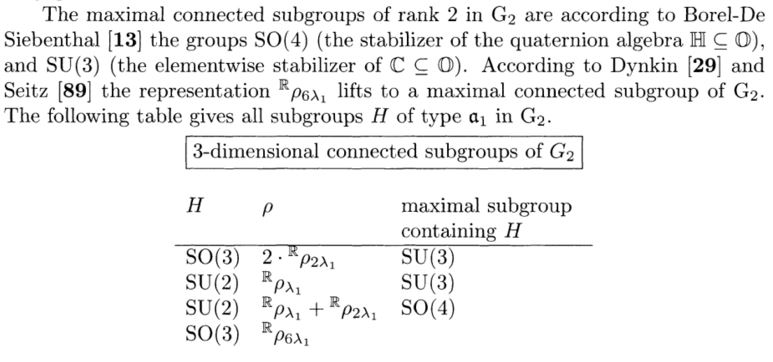
(from Kramer 02)
The Weyl group of is the dihedral group of order 12. (see e.g. Ishiguro, p. 3).
Supgroups
Proposition
(coset space of Spin(7) by G₂ is 7-sphere)
Consider the canonical action of Spin(7) on the unit sphere in (the 7-sphere),
-
This action is is transitive;
-
the stabilizer group of any point on is G₂;
-
all G₂-subgroups of Spin(7) arise this way, and are all conjugate to each other.
Hence the coset space of Spin(7) by G₂ is the 7-sphere
(e.g Varadarajan 01, Theorem 3)
Coset quotients
coset space-structures on n-spheres:
| standard: | |
|---|---|
| this Prop. | |
| this Prop. | |
| this Prop. | |
| exceptional: | |
| Spin(7)/G₂ is the 7-sphere | |
| since Spin(6) SU(4) | |
| since Sp(2) is Spin(5) and Sp(1) is SU(2), see Spin(5)/SU(2) is the 7-sphere | |
| G₂/SU(3) is the 6-sphere | |
| Spin(9)/Spin(7) is the 15-sphere |
see also Spin(8)-subgroups and reductions
homotopy fibers of homotopy pullbacks of classifying spaces:
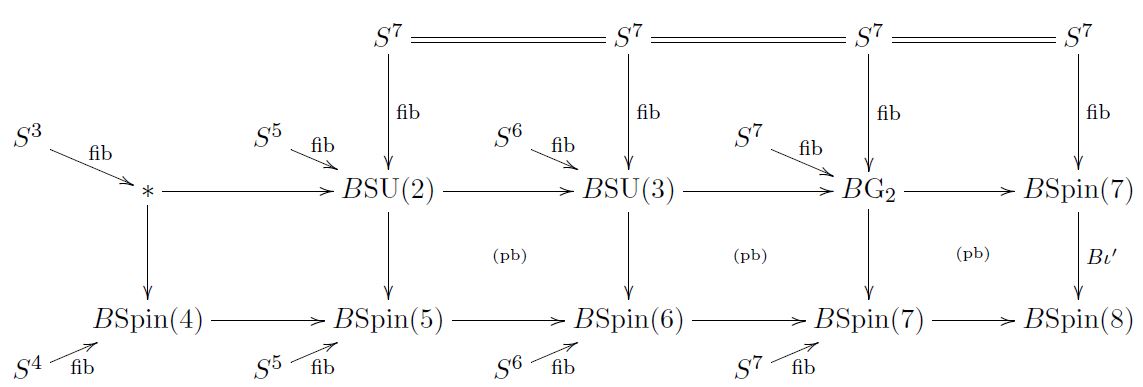
(from FSS 19, 3.4)
-Structure and exceptional geometry
Spin(8)-subgroups and reductions to exceptional geometry
see also: coset space structure on n-spheres
Relation to higher prequantum geometry
The 3-form from def. we may regard as equipping with 2-plectic structure. From this point of view is the linear subgroup of the 2-plectomorphism group, hence (up to the translations) the image of the Heisenberg group of in the symplectomorphism group.
Or, dually, we may regard the 4-form of def. as being a 3-plectic structure and correspondingly as the linear part in the 3-plectomorphism group of .
As zero-divisors of the sedenions
It is shown in Corollary 2.14 of Moreno (1997) that the unit-norm zero-divisors of the sedenions is isomorphic to . (More precisely, the smooth manifold is diffeomorphic to . This can also be improved to an isomorphism of -torsors.)
Related concepts
-
G₂, F₄,
classification of special holonomy manifolds by Berger's theorem:
References
General
- Tonny Springer, Ferdinand Veldkamp, chapter 2 of Octonions, Jordan Algebras, and Exceptional Groups, Springer Monographs in Mathematics, 2000
Surveys are in
-
Spiro Karigiannis, What is… a -manifold (pdf)
-
Simon Salamon, A tour of exceptional geometry, (pdf)
-
Wikipedia, G₂ .
The definitions are reviewed for instance in
-
Dominic Joyce, Compact Riemannian 7-manifolds with holonomy , Journal of Differential Geometry 43 2 (1996) [doi:10.4310/jdg/1214458109, pdf]
-
Ferolito The octonions and (pdf)
-
John Baez, section 4.1 G2 of: The Octonions (arXiv:math/0105155)
-
Ruben Arenas, Constructing a Matrix Representation of the Lie Group , 2005 (pdf)
Discussion in terms of the Heisenberg group in 2-plectic geometry is in
- Alberto Ibort, Multisymplectic geometry: generic and exceptional, Proceedings of the IX Fall workshop on geometry and physics (pdf)
A description of the root space decomposition of the Lie algebra is in
- Tathagata Basak, Root space decomposition of from octonions, arXiv:1708.02367
As the group of zero divisors of the sedenions
- Guillermo Moreno. The zero divisors of the Cayley-Dickson algebras over the real numbers. (1997) (doi)
Cohomological properties are discussed in
- Younggi Choi, Homology of the gauge group of exceptional Lie group , J. Korean Math. Soc. 45 (2008), No. 3, pp. 699–709
Discussion of subgroups includes
-
Reiko Miyaoka, The linear isotropy group of , the Hopf fibering and isoparametric hypersurfaces, Osaka J. Math. Volume 30, Number 2 (1993), 179-202. (Euclid)
-
Kenshi Ishiguro, Classifying spaces and a subgroup of the exceptional Lie group pdf
-
Linus Kramer, 4.27 of Homogeneous Spaces, Tits Buildings, and Isoparametric Hypersurfaces, AMS 2002
Discussion of as a subgroup of Spin(7):
- Veeravalli Varadarajan, Spin(7)-subgroups of SO(8) and Spin(8), Expositiones Mathematicae, 19 (2001): 163-177 (pdf)
Applications in physics
Discussion of Yang-Mills theory with as gauge group is in
- Ernst-Michael Ilgenfritz, Axel Maas, Topological aspects of Yang-Mills theory (arXiv:1210.5963)
Last revised on January 15, 2025 at 07:31:15. See the history of this page for a list of all contributions to it.