nLab
interval object

Contents

Idea

An interval object I in a category C is an object that behaves in C roughly like the unit interval I:=[0,1] with its two boundary point inclusions

*⨿*[0,1]I{*}\amalg {*} \stackrel{[0, 1]}{\to} I

in the category Top of topological spaces, where [0,1] is the copairing of the global elements 0:*I and 1:*I.

A bare interval object may be nothing more than such a diagram. If C admits sufficiently many limits and colimits, then from this alone a lot of structure derives. The precise definition of further structure and property imposed on an interval object varies with the intended context and applications.

Notably in a large class of applications the interval object in C supposed to be the right structure to ensure

  1. that there is an object I in C such that for every object X of C the internal hom object [I,X] exists and behaves like a path object for X;

  2. that there is a notion of composition on these path objects which induces on [I,X] a structure of a (higher) category internal to C: the fundamental category or fundamental groupoid of the object X, or rather its fundamental infinity-groupoid.

For instance the choice C= Top and I=[0,1] should be an instance of a category with interval object, and the fundamental algebraic n-groupoid Π n(X) obtained for any topological space X from this data should be the fundamental n-groupoid as a Trimble n-category.

We give two very similar definitions that differ only in some extra assumptions.

  • The first one was used by Berger and Moerdijk to generalize the Boardman–Vogt resolution of topological operad?s to more general operads.

  • The second is motivated from constructions appearing in the definitions of Trimble n-category and of generalized universal bundle. It includes the possibility that the interval is not weakly equivalent to the point, in which case it may be used nontrivially to test for undirected objects and probe directed objects.

Definitions

Plain definition

Definition (plain interval object)

A plain interval object in a category C is just a cospan diagram with equal feet

pt0I1ptpt \stackrel{0}{\to} I \stackrel{1}{\leftarrow} pt

in C, with I and pt any two objects and 0 and 1 any two morphisms.

In categories with finite limits

Definition (cartesian interval object)

If the category C has finite limits, then a plain interval object is a cartesian interval object if pt=* is the terminal object.

Examples for the use of this notion are below in the section on geometric models for path -categories.

In homotopical categories

If the ambient category C is a homotopical category, such as a model category, there are natural further conditions to put on an interval object

Berger–Moerdijk segment object

In section 4 of

  • Clemens Berger, Ieke Moerdijk, The Boardman-Vogt resolution of operads in monoidal model categories (arXiv)

the following definition is given:

Let V be a monoidal model category and write pt for the tensor unit in V (not necessarily the terminal object).

A segment object I in a monoidal model category V is

  • a factorization

    pt⨿pt[0,1]Iϵptpt \amalg pt \stackrel{[0 , 1]}{\to} I \stackrel{\epsilon}{\to} pt

    of the codiagonal morphism?

    pt⨿pt[Id,Id]ptpt \amalg pt \stackrel{[Id , Id]}{\to} pt

    from the coproduct of pt with itself that sends each component identically to pt.

  • together with an associative morphsim

    :III\vee : I \otimes I \to I

    which has 0 as its neutral and 1 as its absorbing element, and for which ϵ is a counit.

If V is equipped with the structure of a model category then a segment object is an interval in V if

[0,1]:pt⨿ptI[0, 1]\colon pt \amalg pt \to I

is a cofibration and ϵ:Ipt a weak equivalence.

Intervals for Trimble ω-categories

The following definition is tentative. It arose from the discussion reproduced further below.

Might there be two notions of interval object, one in a closed category such that [I,B] is a path object, and one in a monoidal category such that IB is a cylinder object? (And then a stronger notion, combining these, in a closed monoidal category.) —Toby

Urs: True, depending on application, one may be able to and want to drop some assumptions here. We might eventually give a layered definition, which adds assumptions step by step.

But, on the other hand, the main purpose of the interval object here, which goes beyond the idea for instance in a cylinder functor is that we want to induce for any object B on the internal hom-object (B 0[I,B]B 0) the structure of a (homotopy coherent- or A -) internal category. Namely the fundamental category Π 1(B). To get that we need both the closed and the monoidal and the homotopical structure.

Toby: Actually, I wasn't so much thinking about weakening the requirements on V (although admittedly I did phrase my question to include that). My main point that they are, naïvely, two concepts: one that uses the closed structure to give path objects, and one that uses the monoidal structure to give cylinder objects. So will we have interval objects, co-interval objects, and bi-interval objects?

The following definition of category with interval object aims to abstract this construction away from V= Top to other closed monoidal homotopical categories.

A category with interval object is

in V, with I called the interval object;

such that

  • the pushout

    I 2:=I⨿ ptI I I τ σ pt\array{ && I^{\vee 2} := I \amalg_{pt} I \\ & \nearrow && \nwarrow \\ I &&&& I \\ & {}_{\tau}\nwarrow && \nearrow_{\sigma} \\ && pt }

    exists in V, so that all compositions

    I n σ τ pt pt\array{ && I^{\vee n} \\ & {}^\sigma \nearrow && \nwarrow^{\tau} \\ pt &&&& pt }

    of n copies of the co-span I with itself by pushout over adjacent legs exist in V;

  • and all V-objects of morphisms pt[I,I n] pt of cospans (as described at co-span) are weakly equivalent to the point

    pt[I,I n] pt.{}_{pt}[I, I^{\vee n}]_{pt} \,.

Examples

  • The cube category is generated from a single interval object.

  • The standard interval object in Cat is the 1st oriental {01} (see co-span co-trace)

  • For V=C=Top with its standard model structure the standard topological closed interval I:=[0,1] with ptσ,τ the maps to 0 and 1, respectively. This is the case described in detail at Trimble n-category.

  • For V=ωCat the category of strict omega-categories the first oriental, the 1-globe I={ab} is an interval object. In this strict case in fact all hom objects are already equal to the point pt[I,I n] pt=pt and

    (X=[pt,X])s:=[σ,X][I,X]t:=[τ,X](X=[pt,X])(X = [pt,X]) \stackrel{s := [\sigma,X]}{\leftarrow} [I,X] \stackrel{t := [\tau, X]}{\to} (X = [pt,X])

    is a strict co-category internal to ωCat. In this case, for X any ω-category the A -category Π 1(X) is just an ordinary category, namely the 1-category obtained from truncation of X. Similarly, probably Π ω(X)=X in this case.

Fundamental -categories induced from intervals

The interest in interval objects is that various further structures of interest may be built up from them. In particular, since picking an interval object I is like picking a notion of path, in a category with interval object there is, under mild assumptions, for each object X an infinity-category Π I(X) – the fundamental -category of X with respect to I – whose k-morphisms are k-fold I-paths in X.

There are different ways to make this precise and realize it in detail. The main distinction is whether one uses

or

We describe an algebraic version in terms of Trimble omega-categories and then a geometric version in terms of cubical objects and simplicial objects.

Fundamental algebraic -categories

The collection of objects { pt[I,I n] pt} n in a category with interval object naturally comes equipped with the structure of an operad: this is the tautological co-endomorphism operad on the object I in the symmetric closed monoidal category of bi-pointed objects from pt to pt.

This induces in turn for all objects XV on the object [I,X] the structure of an operad, which is naturally interpreted as an internal A -category structure on

(X 0:=[pt,X])s:=[σ,X][I,X]t:=[τ,X](X 0:=[pt,X]).(X_0 := [pt,X]) \stackrel{s := [\sigma,X]}{\leftarrow} [I,X] \stackrel{t := [\tau, X]}{\to} (X_0 := [pt,X]) \,.

This internal A -category is denoted

Π 1(X)\Pi_1(X)

and interpreted as the fundamental groupoid or rather, in general, the fundamental category of the object B with respect to the interval object I – all internal to V.

Moreover, by iterating this process as described at Trimble n-category one should obtain, if everything goes through, on X the structure of a Trimble ω-category and indeed a functor

Π ω:V 0TrimbleωCat.\Pi_\omega : V_0 \to Trimble \omega Cat \,.

(… to be continued …)

Remarks
  • The condition that all pt[I,I n] pt are contractible is the coherence condition on all composition operations.

  • The above is not demanding that the interval object I itself is is weakly equivalent to the point. If it is, then Π 1(X) is indeed a fundamental groupoid. If it is not, then Π 1(X) may just be a fundamental category.

  • If X 0 has a notion of path object one may consider imposing the condition that [I,X] is a path object of X for all X. Similarly, if V 0 has a cylinder functor, one may consider imposing the condition that it is given by I.

Fundamental geometric -categories

Let C be a category

  • with finite limits

  • equipped with an interval object simply in the sense of a diagram

    *0I1*{*} \stackrel{0}{\to} I \stackrel{1}{\leftarrow} {*}

    in C, where * denotes the terminal object.

This may or may not come with further structures and properties as discussed in the definitions above. For the following however no more than that is neceesray.

In a tautological way, I induces a cocubical object in C, a functor

I:C\Box_I : \Box \to C

from the cube category to C. This sends the abstract interval object int that the cube category is freely generated from to the given I, and sends int n to the n-cuber I n:=I ×n.

For every object XC homming cubes into X thereby produces a cubical set

X I :int nC( I n,X).X^{\Box^\bullet_I} : int^n \mapsto C(\Box_I^n,X) \,.

One tends to want to regard this as the cubical incarnation of the fundamental -category of X with respect to the notion of path given by I.

However, while cubes are nice for many purposes, it is a sad fact of life that the homotopy theory for cubical structures (while certainly it does exist in full beauty in principle) is much less well developed to date (maybe that will change in the future) than that of simplicial structures. For many purposes in higher category theory, therefore, it will be useful to take a slightly different perspective on X , without essentially changing it.

In fact, there is also naturally the structure of a cosimplicial object of the collection I × of I-cubes. This differs from the cubical structure only in were precisely one injects the boundaries into an I ×n

Definition (cosimplicial object induced from interval object)

Given a cartesian interval object IC, define a cosimplicial object

Δ I:ΔC\Delta_I : \Delta \to C

as follows:

  • the object in degree n is the n-fold product of I with itself:

    Δ I n:=I ×n\Delta_I^n := I^{\times n}
  • the degeneracy map σ i:Δ I n+1Δ I n is given by projecting out the (i+1)-factor:

    σ i:=p 1×p 2××p i×p i+2×p i+3××p n+1\sigma_i := p_1 \times p_2 \times \cdots \times p_i \times p_{i+2} \times p_{i+3} \times \cdots \times p_{n+1}
  • the face map δ i:Δ I nΔ I n+1 is given

    • for i=n+1 by inserting 0 in the (n+1)-factor:

      δ n+1:=p 1××p n×0\delta_{n+1} := p_1 \times \cdots \times p_{n} \times 0
    • for i=0 by inserting 1 in the 0-factor:

      δ 0=1×p 1××p 2\delta_0 = 1 \times p_1 \times \cdots \times p_2
    • for 0<i<n+1 by duplicating the i-factor:

      δ i:=p 1×× p i1×p i×p i×p i+1××p n\delta_i := p_1 \times \cdots \times_{p_{i-1}} \times p_i \times p_i \times p_{i+1} \times \cdots \times p_n
Proposition

The maps defined this way indeed satisfy the simplicial identities.

Proof

This is straightforward to check, if a little tedious due to the many case distinctions.

Remark (unwrapping the definition)

It may be helpful to unpack the above definition a bit.

  • The two faces of Δ I 1 are just the “boundary points” of the interval itself.

    • (δ 0:*I)=(1:*I)

    • (δ 1:*I)=(0:*I)

  • The face maps of Δ I 2 may be depicted as follows:

    δ 2:I × I Id 0 I × *,δ 1:I × I Id×Id I,δ 0:I × I 1 Id * × I\delta_2 : \array{ I &\times& I \\ \uparrow^{Id} && \uparrow^{0} \\ I &\times& {*} } \,, \;\;\;\;\; \delta_1 : \array{ I &\times& I \\ & \uparrow^{Id \times Id} \\ & I } \,, \;\;\;\;\; \delta_0 : \array{ I &\times& I \\ \uparrow^{1} && \uparrow^{Id} \\ {*} &\times& I }

    Therefore δ 1, being a diagonal morphism (cartesian pairing of an identity with itself), literally identifies the diagonal in the “square” I×I as the 1st 1-dimensional boundary.

Remark (collars)

This construction gives “collared simplices” in much the same sense as in collared cobordism? and in A1-homotopy:

there is no condition that the morphisms 0,1:*I “hit a boundary point” – whatever that may mean in C – of I. For instance in a lined topos I is canonically chosen to be the given line object and will hence typically “extended indefinitely” beyond these points.

An example of this in practice is the A1-homotopy theory of schemes – there is no exact analogue of the interval (with boundary points) in an algebraic setting, but the affine line? A 1 together with the canonical points 0 and 1 is an interval object.

So I need not “look” much like a 1-simplex, but the choice of boundary points δ 1=0:*I and δ 0=1:*I allows us to regard it as an interval for all practical purposes.

Similarly and more generally what the above construction manifestly defines are cubes I n built from I. But then the simplicial choice of boundaries inside these cubes allows to think of them as just the simplices “sitting inside” these cubes.

All these statement become precise for specific typical choices of the ambient category C, discussed in the examples below.

An important aspect is that once the cosimplicial object of collared simplices Δ I is used to form simplicial objects Π(X):=[Δ I ,X] (discussed below) and when these are interpreted as models for ∞-groupoids, then the collars disappear: they are part of the model, but, roughly, don’t affect the equivalence class of the object that this model models.

For instance with *⨿*0,1 used as the interval in Top, a path in a topological space X is an entire curve γ:X, but two such paths γ 1,γ 2 are composable already when γ 1(1)=γ 2(0), irrsepctive of how γ 1 extends >1 and irrsepctive of how γ 2 extends <0.

Moreover, the composite-up-to-homotopy of these two paths is an entire surface 2X in X, but what only matters for this surface qualifying as a compositor of γ 1andγ 2 is that its δ 2-segment {(x,y) 20x1,y=0} and its δ 0segment {(x,y) 20y1,x=0} coincide with the corresponding segments in γ 1 and γ 2.

More on this in the following example section.

Example: standard intervals, cubes and simplices in Top and Diff

Let X= Top or C= Diff be the category of topological spaces or of manifolds.

A standard choice of interval object in C is I=[0,1] with the obvious two boundary inclusions 0,1:*[0,1].

But another possible choice is to let I= be the whole real line, but still equipped with the two maps 0,1:*, that hit the 0 and 1, respectively.

Either of these two examples will do in the following discussion. The second choice is to be thought of as obtained from the first choice by adding “infinitely wide collars” at both boundaries of [0,1]. While *0[0,1]1* may seem like a more natural choice for a representative of the idea of the “standard interval”, the choice *01* is actually more useful for many abstract nonsense constructions.

But since it is hard to draw the full real line, in the following we depict the situation for the choice I=[0,1].

Then for low n the above construction yields this

  • n=0 – here Δ I 0=I ×0=* is the point.

  • n=1 – here Δ I 1=I ×1=I is just the interval itself

    (0)(1)\array{ (0) \to (1) }

    The two face maps δ 1*I and δ 0:*I pick the boundary points in the obvious way. The unique degeneracy map σ 0:I* maps all points of the interval to the single point of the point.

  • n=2 – here Δ i 2=I ×2=I×I is the standard square

    (0,1) (1,1) (0,0) (1,0)\array{ (0,1) &\to& (1,1) \\ \uparrow && \uparrow \\ (0,0) &\to& (1,0) }

    But the three face maps δ i:II×I of the cosimplicial object Δ I constructed above don’t regard the full square here, but just a triangle sitting inside it, in that pictorially they identify (Δ I 1=I)-shaped boundaries in I×I as follows:

    (0,1) (1,1) =δ 1(I) =δ 0(I) (0,0) =δ 2(I) (1,0)\array{ (0,1) &\to& (1,1) \\ \uparrow &^{= \delta_1(I)}\nearrow& \uparrow^{ = \delta_0(I)} \\ (0,0) &\stackrel{= \delta_2(I)}{\to}& (1,0) }

    (here the arrows do not depict morphisms, but the standard topological interval, i don’t know how to typeset just lines without arrow heads in this fashion!)

  • n=3 – here Δ i 3=I ×3=I×I×I is the standard cube

    Exercise

    Insert the analog of the above discussion here and upload a nice graphics that shows the standard cube and how the cosimplicial object Δ I picks a solid tetrahedron inside it.

As a start, we can illustrate how there are 6 3-simplices sitting inside each 3-cube.
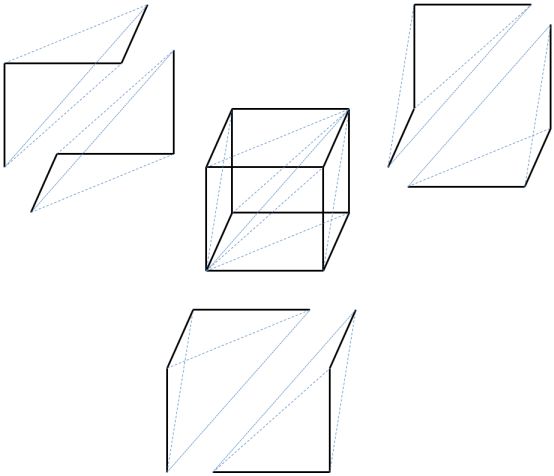
Once you see how the 3-simplices sit inside the 3-cube, the facemaps can be illustrated as follows:
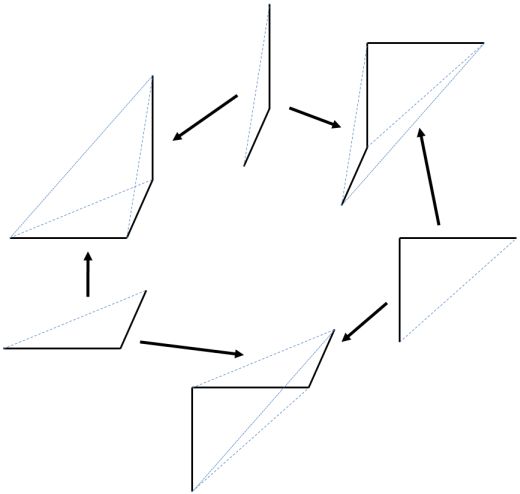
Note that these face maps are to be thought of as maps into 3-simplices sitting inside a 3-cube.

Fundamental little 1-cubes space induced from an interval

Urs Schreiber: something I am thinking about…

The following is supposed to give an (∞,1)-operadic incarnation of the notion of fundamental -groupoid induced from an interval object. It should resemble a geometric operadic version of the algebraic operadic version described further above.

Let Ω p be the category of planar trees, so that a presheaf on Ω p is a planar dendroidal set.

Given an interval object *0I1* in a category C, assume one isomorphism ϕ n[I,I n] for each n has been chosen.

Then there is a planar co-dendroidal object Ω C p:Ω pC in C given by:

  • a tree T with n leaves is sent to I n

    (we think of the k-th copy of I here as being associated to the kth leaf of the planar tree);

  • every degeneracy map is sent to the corresponding identity morphism

    (this corresponds to the fact that the co-dendroidal object encodes no nontrivial unary (co)operations, only the (n>1)-ary operations encoded nontrivial infomation);

  • an outer face map on an n-ary vertex is the identity on all copies of I corresponding to the unaffected leaves and is ϕ n on the affected leaf;

  • an inner face map that contracts a k 1-ary vertex with a k 2-ary one is the identity on all unaffected leaves and is on the affected leaves the composition

    I (k 1+k 2)ϕ k 1+k 2 1Iϕ k 1I k 1(Id,,Id,ϕ k 2,Id,,Id)I (k 1+k 2).I^{\vee (k_1+k_2)} \stackrel{\phi_{k_1+k_2}^{-1}}{\to} I \stackrel{\phi_{k_1}}{\to} I^{\vee k_1} \stackrel{(Id, \cdots, Id,\phi_{k_2},Id, \cdots, Id )}{\to} I^{\vee (k_1+k_2)} \,.

Example. In Top with I=[0,1] the standard interval, and I n=[0,n] let ϕ n:[0,1][0,n] be the map given by multiplication of real numbers by n.

Then for the planar tree T 1 given by

T 1=[ ]T_1 = \left[ \array{ \searrow && \swarrow \\ & \bullet \\ && \searrow && \swarrow \\ &&& \bullet \\ &&& \downarrow } \right]

the inclusion of the tree [] into T given by identifying it with its root is sent to the map f:[0,1][0,3] that is the composite of the map ()2:[0,1][0,2] wth the map h:[0,2][0,3] that is multiplication by two on [0,1] and addition by 1 on [1,2].

On the other hand the inner face map from

T 2=[ ]T_2 = \left[ \array{ \searrow & \downarrow & \swarrow \\ & \bullet \\ & \downarrow } \right]

to T 1 corresponds to the map [0,3][0,3] that is the composite of the map ()/3:[0,3][0,1] with the above map [0,1][0,3].

Now for XC any object, we obtain the planar dendroidal set

PathsX:THom C(Ω C p[T],X).Paths X : T \mapsto Hom_C( \Omega^p_C[T], X ) \,.

It assigns to any tree with n leaves the hom-set Hom(I n,X). This we can think of as the set of standard parameterized paths of parameter length n in X. The action of tree morphisms T 1T 2 on these sets is the reparameterization of these paths as encoded in the tree structure.

In particular, we have the dendroidal set Paths(I) of the interval object itself. This is something like the little 1-cubes operad as seen by I.

I think for every X there is an evident morphism of dendroidal sets

PathsXPathsI.Paths X \to Paths I \,.

The component over the tree T sends all of (PathsX)(T)=Hom C(I n,X) to ….

For X a pointed object, there is the sub-dendroidal set ΩXPathsX of paths whose endpoints map to the basepoint.

Homtopy localization induced from an interval

Given a suitable interval obect in a site C, one may ask for ∞-stacks on C that are invariant under the notion of homotopy induced by I. These are obtained by homotopy localization of a full (∞,1)-category of (∞,1)-sheaves on C.

Example: 𝔸 1-homotopy theory

See A1-homotopy theory.

Discussion

Urs Schreiber: this is really old discussion by now. We might want to start putting dates on discussions. In principle it can be seen from the entry history, but readers glancing at this here hardly will. Maybe discussions like this here are better had at the forum after all.

We had originally started discussing the notion of interval objects at homotopy but then moved it to this entry here. The above entry grew out of the following discussion we had, together with discussion at Trimble n-category.

Urs: Let me chat a bit about what I am looking for here. It seems very useful to have a good notion of what it means in a context like a closed category of fibrant objects to say that path objects are compatibly corepresented.

By this should be meant: there exists an object I such that

  • for B any other object, [I,B] is a path object;

  • and such that I has some structure and property which makes it “nice”.

In something I am thinking about the main point of I being nice is that it can model compositon: it must be possible to put two intervals end-to-end and get an interval of twice the length. In some private notes here I suggest that:

a “category with interval object” should be

I think there are a bunch of obvious examples: all familiar models of higher groupoids (Kan complexes, ω-groupoids etc.) with the interval object being the obvious cellular interval {ac}.

I also describe one class of applications which I think this is needed/useful for: recall how Kenneth Brown in section 4 of his article on category of fibrant objects (see theorems recalled there and reference given there) describes fiber bundles in the abstract homotopy theory of a pointed category of fibrant objects. This is pretty restrictive. In order to describe things like -vector bundles in an context of enriched homotopy theory one must drop this assumption of the ambient category being pointed. The structure of it being a category with an interval object is just the necessary extra structure to still allow to talk of (principal and associated) fiber bundles in abstract homotopy theory. It seems.

Comments are very welcome.

Todd: The original “Trimblean” definition for weak n-categories (I called them “flabby” n-categories) crucially used the fact that in a nice category Top, we have a highly nontrivial Top-operad where the components have the form hom Top(I,I n), where XY here denotes the cospan composite of two bipointed spaces (each seen as a cospan from the one-point space to itself), and the hom here is the internal hom between cospans.

My comment is that the only thing that stops one from generalizing this to general (monoidal closed) model categories is that “usually” I doesn’t seem to be “nice” in your sense here, and so one doesn’t get an interesting (nontrivial) operad when my machine is applied to the interval object. But I’m generally on the lookout for this sort of thing, and would be very interested in hearing from others if they have interesting examples of this.

Urs Schreiber: Thanks, Todd. I should have listed the examples I had in mind: I was thinking about strict omega-category here, where the 1st oriental G 1=I={ab} should naturally be an internal co-category, where co-composition is the functor which sends ab to the composite a 1(b 1=a 2)a 2.

More generally, there are, I think n different co-category structures on the standard n-globe, with co-source and co-target given by the two injections of the standard (k<n)-globe.

The composition operations in the internal hom ω-category hom(C,D) in strict ω-categories can, I’d think, then be thought of as coming from the image of these co-categories under Hom(C,D).

A description of what I just tried to say with the illuminating diagrams is on p. 35 here. Hope I got this right. Please let me know if I am mixed up.

Todd: It seems to me there might be some trickiness about which hom you want. The thing you’re proposing sounds like it would work to describe the hom for ω-Cat as a cartesian closed category, but I’m not sure off the bat how it will play out with respect to the Crans-Gray monoidal biclosed structure. I’d have to think about it more carefully, but there’s something a little “thin” about the strict co-category structure on say the category 2 (as an interval co-category in Cat) which makes me wonder.

(After an email from Urs:) I think Urs is right after all – this should work fine for either monoidal structure.

Urs: Also by email, Todd points out that of course more generally, we want our interval objects to form internal co-categories only up to coherent homotopy, because otherwise the example of G 1 in strict ω-categories is likely to be essentially the only good example. We want internal homotopy co-categories.

I need to learn more about how one would go about systematically defining concepts internal to a model category up to homotopy. What are the available tools for handling higher coherent homotopies in an arbitrary model category?

My understanding is that Todd is going to write an entry on the Trimble definition of -categories, and that this issue appears there in some guise. So maybe I’ll just wait for Todd’s entry to appear…