nLab large cardinal
Context
Foundations
The basis of it all
Set theory
- fundamentals of set theory
- material set theory
- presentations of set theory
- structuralism in set theory
- class-set theory
- constructive set theory
- algebraic set theory
Foundational axioms
-
basic constructions:
-
strong axioms
-
further
Removing axioms
Contents
Idea
A large cardinal is a cardinal number that is larger than can be proven to exist in the ambient set theory, usually ZF or ZFC. Large cardinals arrange themselves naturally into a more or less linear order of size and consistency strength, and provide a convenient yardstick to measure the consistency strength of various other assertions that are unprovable from ZFC.
Set theorists often adopt the existence of certain large cardinals as axioms in the foundation of mathematics.
List of large cardinal conditions
Large cardinals with replacement
-
axiom of infinity– a large cardinal axiom relative to finitist theories, but not relative to ZF
-
regular cardinal - a large cardinal in strongly predicative mathematics where function sets and power sets do not exist.
-
inaccessible cardinal– the smallest sort of large cardinal in ZF, equivalent to the existence of a Grothendieck universe.
-
weakly compact cardinal?
-
measurable cardinal– the boundary between “small” large cardinals and “large” large cardinals
-
real-valued-measurable cardinal, a “solution” to the Banach–Ulam problem.
-
strongly compact cardinal, whose existence controls properties images of accessible functors
-
elementary embedding– a tool used in the study of large large cardinals.
-
Vopěnka's principle– a large cardinal axiom with important implications for the behavior of locally presentable categories and accessible categories.
-
rank-to-rank axiom?
-
Reinhardt cardinal– a large cardinal axiom that inconsistent with ZFC due to Kunen's inconsistency theorem; one has to move either to ZF or ZC.
-
Berkeley cardinal– a large cardinal axiom larger than Reinhardt cardinals that is also inconsistent with ZF + countable choice. It is still consistent with ZF however.
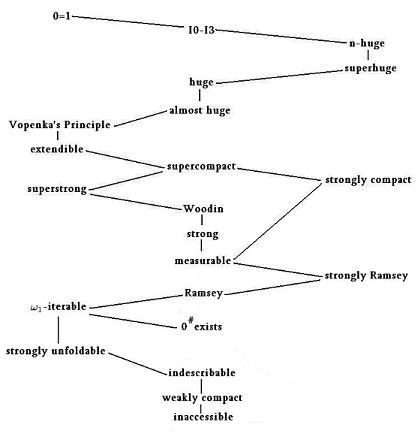
Here is a diagram showing the relation between these:
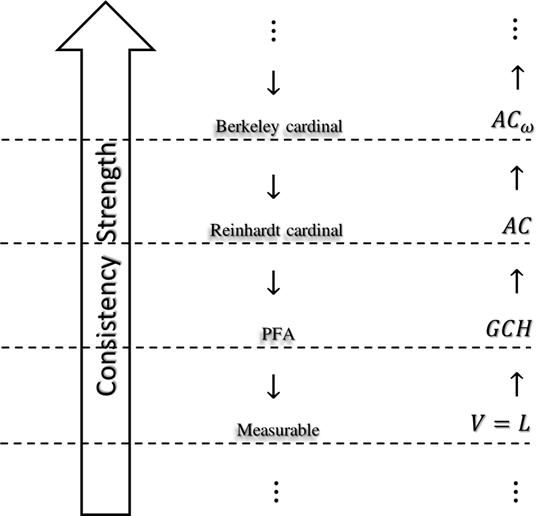
In the context of ZFC, certain axioms are inconsistent with large cardinal axioms:
Large cardinals without replacement
The axiom of replacement is an axiom schemata that states that certain families of sets or diagrams in the category of sets, which usually can be proven (for example, in Zermelo set theory or in a well-pointed topos) to be large or proper classes, are instead small.
In the absence of the axiom of replacement, there are certain cardinals which are now large. For example, a beth fixed point? is a cardinal which is small in the presence of the axiom of replacement and large in the absence of the axiom of replacement.
Furthermore Reinhardt cardinals are now consistent with the axiom of choice in the absence of the axiom of replacement.
Vopěnka's principle implies the axiom of replacement.
Large cardinals without full separation
In the absence of the axiom of full separation, such as in BZC or Mostowski set theory, most of the large cardinal axioms mentioned above traditionally stronger than Mahlo cardinals in ZFC are instead weaker than Mahlo cardinals. While the large cardinal axioms imply the existence of recursively Mahlo cardinals; they are not strong enough to imply the usual Mahlo cardinals. This spans the entire gamut of large cardinals from weakly compact cardinals to Ramsey cardinals to measurable cardinals to the wholeness axiom, and the through axioms all the way to Reinhardt cardinals.
Furthermore, many large cardinals can be defined in more than one way. In the absence of the axiom of full separation, these definitions no longer coincide with each other. Many large cardinals traditionally between Mahlo cardinals and measurable cardinals in ZFC have this property: they each have a combinatorial definition and a model-theoretic definition, and without full separation, the combinatorial definition of the cardinal does not coincide with the model-theoretic definition of the cardinal. Examples of such cardinals include weakly compact cardinals, subtle cardinals, ineffable cardinals, Erdős cardinals, Silver cardinals, Jónsson cardinals, Rowbottom cardinals, Ramsey cardinals, Magidor cardinals, and measurable cardinals. In addition, only the model-theoretic definition has sufficient power to prove the existence of recursively Mahlo cardinals, and none of the definitions has sufficient power to prove the existence of the usual Mahlo cardinals.
References
- Wikipedia has a list of large cardinal properties.
A general axiomatic framework for large cardinal axioms is proposed in
-
Arthur Apter, Carlos Diprisco, James Henle, William Swicker, Filter spaces: towards a unified theory of large cardinal and embedding axioms, Annals of Pure and Applied Logic Volume 41, Issue 2, 6 February 1989, Pages 93–106
-
Arthur Apter, Carlos Diprisco, James Henle, William Swicker, Filter spaces. II. Limit ultraproducts and iterated embeddings, Acta Cient. Venezolana 40 (1989), no. 5-6, 311–318.
An overview of large cardinal axioms:
- Rohan Srivastava, The Landscape of Large Cardinals [arXiv:2205.01787]
Some discussion on large cardinal axioms in the context of a polynomial function whose Lesbegue measurability is independent of ZFC occurs in:
- James E. Hanson, Any function I can actually write down is measurable, right? (arXiv:2501.02693)
On large set axioms in constructive set theory:
- Hanul Jeon, Richard Matthews, Very large set axioms over constructive set theories, The Bulletin of Symbolic Logic. 2024;30(4):455-535. [doi:10.1017/bsl.2024.8, arXiv:2204.05831]
On very large cardinal axioms:
- Joan Bagaria, Peter Koellner, W. Hugh Woodin: Large Cardinals Beyond Choice, The Bulletin of Symbolic Logic, Vol. 25, No. 3 (September 2019), pp. 283-318 (36 pages) [jstor:stable/26788522]
On large cardinal axioms without the axiom of replacement:
- Large cardinals without replacement, MathOverflow (web)
On large cardinal axioms in weak set theories
- Adrian Mathias: The strength of Mac Lane set theory, Annals of Pure and Applied Logic 110 (1-3):107-234 (2001) [doi:10.1016/S0168-0072(00)00031-2]
On realizability models for large cardinals:
- Laura Fontanella, Guillaume Geoffroy, Richard Matthews: Realizability Models for Large Cardinals, In 32nd EACSL Annual Conference on Computer Science Logic (CSL 2024). Leibniz International Proceedings in Informatics (LIPIcs), Volume 288, pp. 28:1-28:18, Schloss Dagstuhl – Leibniz-Zentrum für Informatik (2024) [10.4230/LIPIcs.CSL.2024.28]
Last revised on September 22, 2026 at 20:19:45. See the history of this page for a list of all contributions to it.