nLab central product of groups
Context
Group Theory
- group, ∞-group
- group object, group object in an (∞,1)-category
- abelian group, spectrum
- super abelian group
- group action, ∞-action
- representation, ∞-representation
- progroup
- homogeneous space
Classical groups
Finite groups
Group schemes
Topological groups
Lie groups
Super-Lie groups
Higher groups
Cohomology and Extensions
Related concepts
Contents
Definition
Definition
Given a pair of groups, and , and a joint subgroup
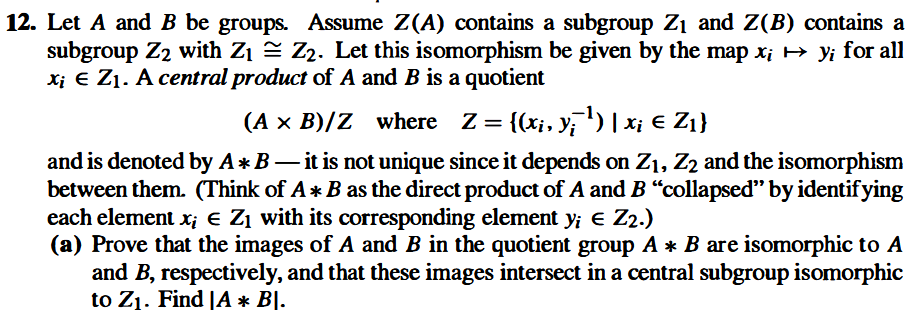
in each of their centers, then the corresponding (“external”) central product is the quotient group
of the direct product group by the diagonal subgroup .
Remark
(structural over material definition)
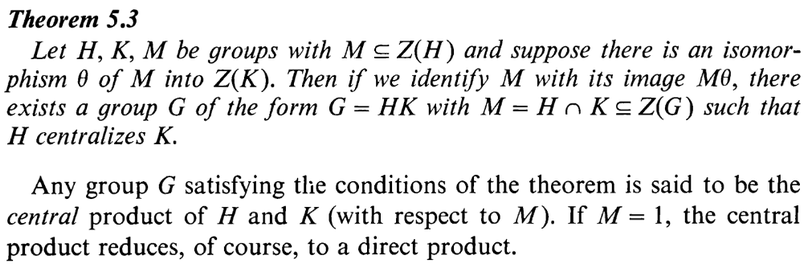
Beware that texts such as Gorenstein 1980 p. 29 insists on stating the choices in Def. as that of
-
two separate subgroups
-
an isomorphism between them
and insists that the second groups as via
These clauses matter if one thinks of the subgroup inclusions as in material set theory. But we speak structural set theory, which means that a subgroup inclusion as in (1) is really a choice of monic homomorphism, and this choice already absorbs the choice of and or of .
Remark
(notation)
Beware that there is no widely accepted convention for the notation of central products, and that most notational conventions suppress the choices of central subgroups involved. The “”-notation is popular in finite group-theory, while in Riemannian geometry people tend to use “” (see Sp(n).Sp(1)) or just plain juxtaposition, with no symbol for the central product at all.
Examples
In Riemannian geometry and spin geometry
In Riemannian geometry and spin geometry:
Example
A Spin^c-group is a central product of a spin group with the circle group.
Example
The groups Sp(n).Sp(1) and Spin(n).Spin(m) are central products of quaternionic unitary groups and of spin groups, respectively.
Related concepts
References
- Daniel Gorenstein; p. 29, Thm. 5.3 of: Finite Groups, New York (1980)
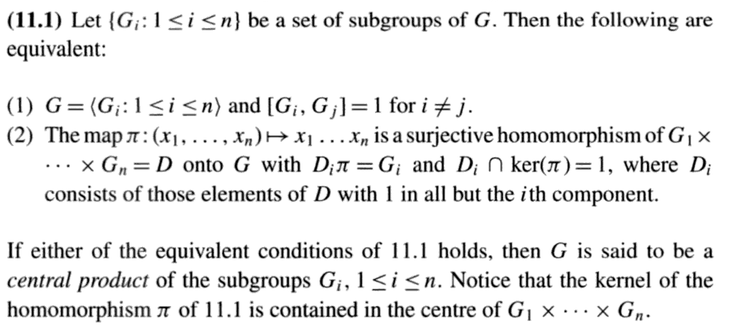
- M. Aschbacher; (11.1) in: Finite Group Theory, Cambridge University Press (2012) [ISBN:9781139175319, doi:10.1017/CBO9781139175319]
- David S. Dummit, Richard M. Foote; Ex. 12 on p. 157 of: Abstract Algebra, Wiley (2003) [ISBN:978-0-471-43334-7, pdf]
See also:
-
Wikipedia, Central product
-
GroupProps, External central product
For more references see at Sp(n).Sp(1).
Last revised on August 14, 2026 at 05:17:21. See the history of this page for a list of all contributions to it.