nLab generalized smooth space
Context
Higher geometry
higher geometry / derived geometry
Ingredients
Concepts
-
geometric little (∞,1)-toposes
-
geometric big (∞,1)-toposes
Constructions
Examples
-
derived smooth geometry
Theorems
Contents
Idea
Generalised smooth spaces are, roughly speaking, generalisations of smooth manifolds. Their raison d’etre is the following
Manifolds are fantastic spaces. It’s a pity that there aren’t more of them.
Many spaces that occur in mathematics aren’t manifolds but one would like to be able to treat them as if they were manifolds; in particular, they should have some smooth structure that goes beyond mere topology. By considering examples of these spaces and by considering what specifically one would like to do with or to them, it is possible to generalise the idea of a smooth manifold to encompass the new examples whilst preserving enough structure to retain the old tools. There have been several such generalisations in recent mathematical history. A (partial) list is below.
Often the examples of spaces that one would like to consider as manifolds are formed by applying a categorical construction to ordinary manifolds; such as limits, quotients, or function spaces. This leads one to ask for the categorical properties of each of the resulting categories of generalised smooth spaces.
Another obvious question to ask is what tools and techniques can be extrapolated from smooth manifolds to generalised smooth spaces. In addition, whilst some techniques have obvious generalisations there may be some hidden twists that are not apparent on just smooth manifolds.
Examples
According to the general nonsense of space and quantity, generalized smooth spaces may be determined by sheaves on smooth test spaces, in which case we call them smooth spaces here, or by co-(pre)sheaves on test spaces, in which case we call them structured generalized spaces here.
-
-
Chen spaces (called differentiable spaces in Chen’s works).
-
-
both
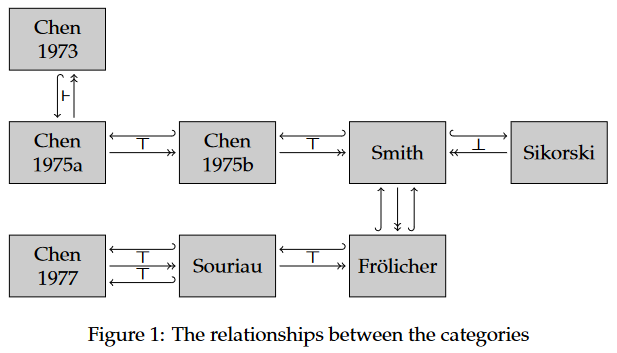
The relationships between (some) of the categories can be sumarised by the following diagram of adjoint functors:
Related concepts
- Under the duality between algebra and geometry, generalized smooth spaces correspond to generalized smooth algebras of functions on them.
Literature
The notion of diffeological spaces:
-
Jean-Marie Souriau: Groupes différentiels, in Differential Geometrical Methods in Mathematical Physics (Proc. Conf., Aix-en-Provence/Salamanca, 1979), Lecture Notes in Math. 836, Springer (1980) 91-128. [doi:10.1007/BFb0089728, mr:607688]
-
Kuo-Tsai Chen: On differentiable spaces, in: William Lawvere, Stephen Schanuel (eds.), Categories in Continuum Physics, Lectures given at a Workshop held at SUNY, Buffalo 1982, Lecture Notes in Mathematics 1174 (1986) [doi:10.1007/BFb0076928]
-
Patrick Iglesias-Zemmour, Diffeology, Mathematical Surveys and Monographs 185, AMS (2013) [doi:10.1090/surv/185, (book site]
Amplification that diffeological spaces form a quasi-topos and hence a fairly “convenient category” of smooth spaces:
-
Martin Laubinger: Differential Geometry in Cartesian Closed Categories of Smooth Spaces, LSU Doctoral Dissertations 3981 (2008) [lsu:3981]
-
Alexander Hoffnung: Smooth spaces: convenient categories for differential geometry, talk slides (2009) [pdf]
-
Alexander Hoffnung: From Smooth Spaces to Smooth Categories, talk slides (2009) [pdf]
-
John Baez, Alexander Hoffnung: Convenient Categories of Smooth Spaces, Trans. Amer. Math. Soc. 363 11 (2011) 5789-5825 [doi:10.1090/S0002-9947-2011-05107-X, arXiv:0807.1704 math.DG, blog]
-
Andrew Stacey: Comparative Smootheology, Theory and Applications of Categories, 25 4 (2011) 64-117, [tac:25-4), arXiv:0802.2225]
Discussion in the “more convenient” full topos theoretic context of synthetic differential geometry:
- William Lawvere: Taking categories seriously, Reprints in Theory and Applications of Categories 8 (2005) 1-24 [tac:tr8]
Specifically on the “well-adapted” Cahiers topos of formal smooth sets:
-
Eduardo Dubuc, Sur les modèles de la géométrie différentielle synthétique, Cahiers de Topologie et Géométrie Différentielle Catégoriques 20 3 (1979) 231-279 [numdam:CTGDC_1979__20_3_231_0]
-
Igor Khavkine, Urs Schreiber: Synthetic geometry of differential equations: I. Jets and comonad structure, J. Geom. Physics (2026) [arXiv:1701.06238]
-
Grigorios Giotopoulos, Hisham Sati: Field Theory via Higher Geometry II: Thickened Smooth Sets as Synthetic Foundations [arXiv:2512.22816]
extending the topos of smooth sets (which in turn subsumes the above diffeological spaces as its concrete objects and further extends to smooth -groupoids):
-
Urs Schreiber: Higher Topos Theory in Physics, Encyclopedia of Mathematical Physics 2nd ed4 (2025) 62-76 [doi:10.1016/B978-0-323-95703-8.00210-X, ISBN:9780323957038, arXiv:2311.11026]
-
Grigorios Giotopoulos, Hisham Sati: Field Theory via Higher Geometry I: Smooth Sets of Fields, Journal of Geometry and Physics 213 (2025) 105462 [arXiv:2312.16301, doi:10.1016/j.geomphys.2025.105462]
-
Alberto Ibort, Arnau Mas: Smooth sets of fields: A pedagogical introduction, Geometric Mechanics (2025) [arXiv:2510.20422, doi:10.1142/S2972458925400052, ResearchGate:394210704]
On stratifolds:
- Matthias Kreck: Differential Algebraic Topology: From Stratifolds to Exotic Spheres, Graduate Studies in Mathematics Volume 110, AMS (2010) (publisher page), (author pdf).
- David Spivak, Quasi-smooth derived manifolds, thesis (2010) [pdf]
There are also Hofer’s polyfolds.
Last revised on May 10, 2026 at 16:36:40. See the history of this page for a list of all contributions to it.