nLab spindle orbifold
Context
Higher geometry
higher geometry / derived geometry
Ingredients
Concepts
-
geometric little (∞,1)-toposes
-
geometric big (∞,1)-toposes
Constructions
Examples
-
derived smooth geometry
Theorems
Contents
Idea
For a pair of coprime natural numbers , , the -spindle is the 2-dimensional orbifold whose underlying coarse topological space is the 2-sphere/Riemann sphere , but where the poles are cone tips of order , respectively.
Hence with the open disk and the cone orbifold obtained by quotientint out the -fold rigid rotation action, then the -spindle is the result of gluing to along a joint collar of their ends.
This is also sometimes called the -football and is denoted “” or “” or sometimes just “”. It is the orbifold incarnation of the weighted projective space .
If either but then the spindle orbifold reduces to the orbifold known as the teardrop.
If both then the spindle orbifold reduces is a smooth manifold: the ordinary (Riemann) 2-sphere .
Definition
Via orbifold charts
(…)
As a proper étale Lie groupoid
We describe the spindle orbifold via proper étale Lie groupoids, following SS26 Ex. 2.58.
There are many Morita equivalent proper étale Lie groupoids that all describe the spindle orbifold. We describe a couple of useful models.
Minimal model
The following should be about the minimal and evident realization of the spindle as a proper étale Lie groupoids
-
the smooth manifold of objects is the disjoint union of two copies of the plane — which for notational purposes, at least, will be useful to think of as the complex line :
(1) -
the smooth manifold of morphisms is the disjoint union of
-
(these) two copies of times the underlying set of the cyclic group of order , respectively,
-
two copies of its punctured version (its complement of the origin), times the underlying set of the product cyclic group :
-
where the subscripts on the copies of only serve to index the direct summands.
Here the first pair of direct summands may be referred to as the “internal” morphisms (as they will operate within either chart, implementing here the actual orbi-singularities), and the second pair of summands as the “external” or “gluing” morphisms (as they operate between charts, implementing nothing but their gluing).
Concretely, with the abbreviation
the source and target maps for the internal morphisms and for the weightless gluing morphisms are:
and the composition map for the “internal” morphisms is that of the action groupoid :
Finally, the general gluing morphism is the unique composite
which defines either side by the other (meaning that the gluing morphisms are a groupoid torsor from either side over these action groupoids). Its source and target maps are
Dugger-cofibrant model
For computing derived functors and mapping stacks out of a spindle orbifold, it is useful to have a Dugger cofibrant model, namely a Lie groupoid whose simplicial nerve is in each degree diffeomorphic to a disjoint union of Cartesian spaces/open balls, such that the degeneracy maps are inclusions of disjoint summands.
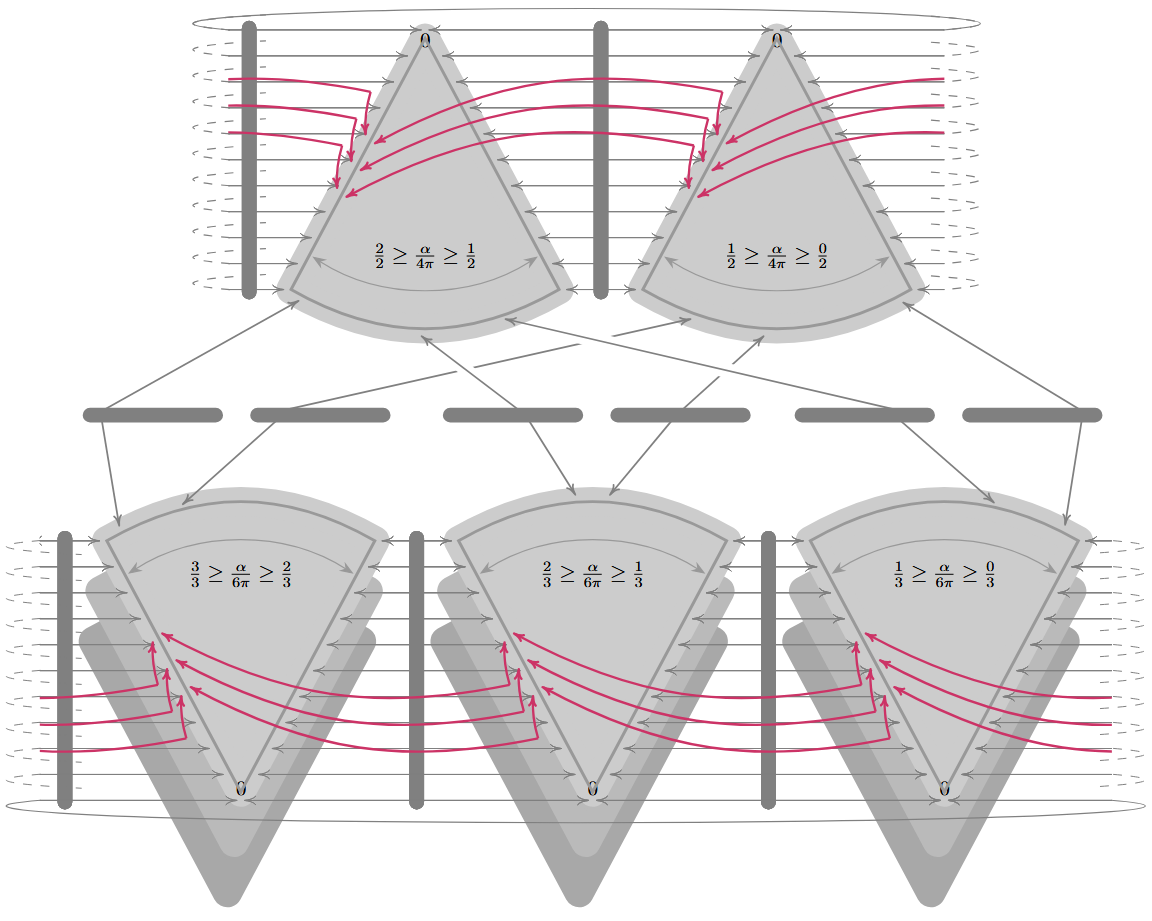
We describe this in pictures, which should make the actual definition obvious.
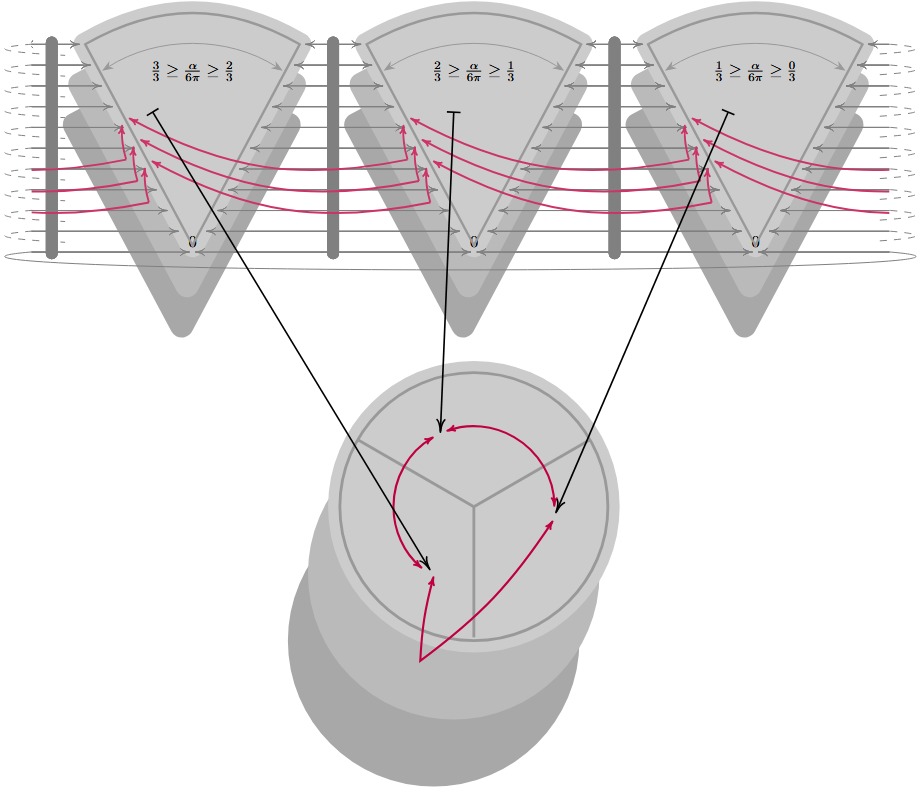
First consider the Dugger-cofibrant resolution of the action groupoid which is obtained from the equivariant good open cover of whose charts are tubular neighbourhoods of the sectors where the evident angle coordinate is within , for .
This is illustrated in the following graphic for (cf. the non-equivariant version here at Čech groupoid). Indicated in light gray is the space of objects, and indicated in darker shades of gray are the components of the space of non-trivial morphisms. The top shows the Čech groupoid resolution and the bottom the plain action groupoid:
We want to glue two such equivariant Čech groupoids by gluing the -collars of all the components of their object spaces. For that we introduce disk-shaped spaces of gluing morphisms indicated in the following graphics (again for the -case) by the horizontal bars in the middle:
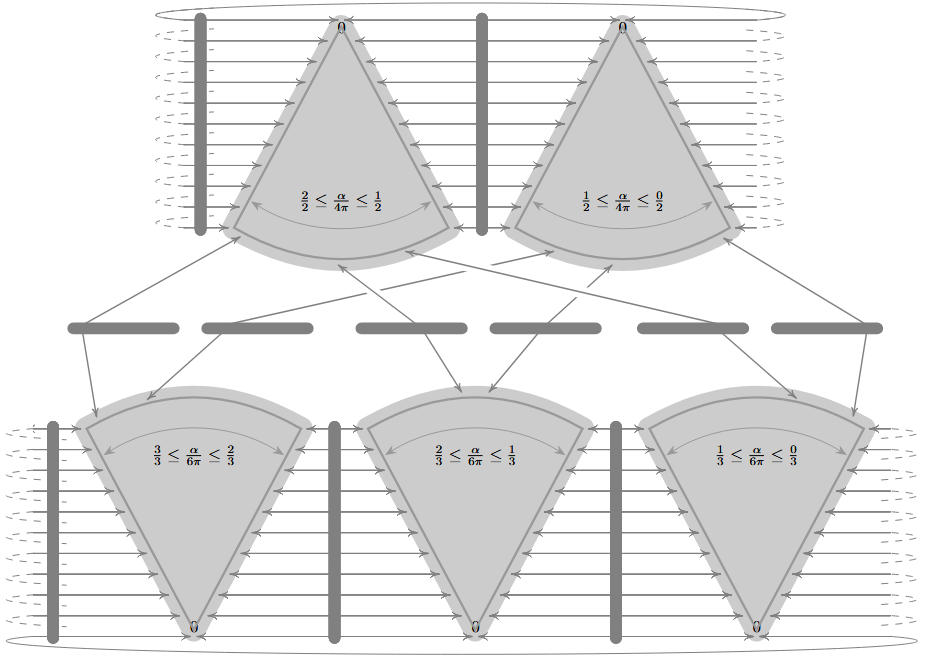
To note here that the composition of any two of these gluing morphisms is translation by one of the two group actions, hence may be identified with a morphism in one of the two action groupoids.
In total, the resulting Lie groupoid presentation of the spindle looks as indicated in the following graphics for :
Related entries
Literature
General
-
Alexander Amenta, Ex. 1.2.2 in: The Geometry of Orbifolds via Lie Groupoids, ANU (2012) [arXiv:1309.6367]
-
Vesta Coufal, Dorette Pronk, Carmen Rovi, Laura Scull, Courtney Thatcher, Ex. 2.6 in: Orbispaces and their Mapping Spaces via Groupoids: A Categorical Approach, in: Women in Topology: Collaborations in Homotopy Theory, Contemporary Mathematics 641 (2015) 135-166 [arXiv:1401.4772, doi:10.1090/conm/641]
-
Francisco C. Caramello Jr, Ex. 1.3.1 in: Introduction to orbifolds [arXiv:1909.08699]
The above text and graphics follow:
- Hisham Sati, Urs Schreiber: Ex. 2.58 in: Orientations of Orbi-K-Theory measuring Topological Phases and Brane Charges, Part I of: Geometric Orbifold Cohomology, CRC Press (2026)
In string theory
On supergravity KK-compactified (and branes wrapped) on spindle orbifolds:
-
Pietro Ferrero, Jerome P. Gauntlett, Juan Manuel Pérez Ipiña, Dario Martelli, James Sparks, D3-branes wrapped on a spindle, Phys. Rev. Lett. 126 111601 (2021) [arXiv:2204.02990, doi:10.1103/PhysRevLett.126.111601]
-
Pietro Ferrero, Jerome P. Gauntlett, Dario Martelli, James Sparks, M5-branes wrapped on a spindle, J. High Energ. Phys. 2021 2 (2021)
-
Federico Faedo, Dario Martelli, D4-branes wrapped on a spindle, J. High Energ. Phys. 2022 101 (2022) [arXiv:2111.13660, doi:10.1007/JHEP02(2022)10]
-
Christopher Couzens, A tale of (M)2 twists, J. High Energ. Phys. 2022 78 (2022) [arXiv:2112.04462, doi:10.1007/JHEP03(2022)078]
-
K. C. Matthew Cheung, Jacob H. T. Fry, Jerome P. Gauntlett, James Sparks, M5-branes wrapped on four-dimensional orbifolds, J. High Energ. Phys. 2022 82 (2022) [arXiv:2204.02990, doi:10.1007/JHEP08(2022)082]
-
Igal Arav, Jerome P. Gauntlett, Jaeha Park, Matthew M. Roberts, Christopher Rosen: Spindle solutions with hyperscalars in gauged supergravity [arXiv:2605.04140]
Last revised on May 7, 2026 at 04:33:03. See the history of this page for a list of all contributions to it.