Schreiber WIKO 2026
A public evening lecture that I have held (live version in German):
-
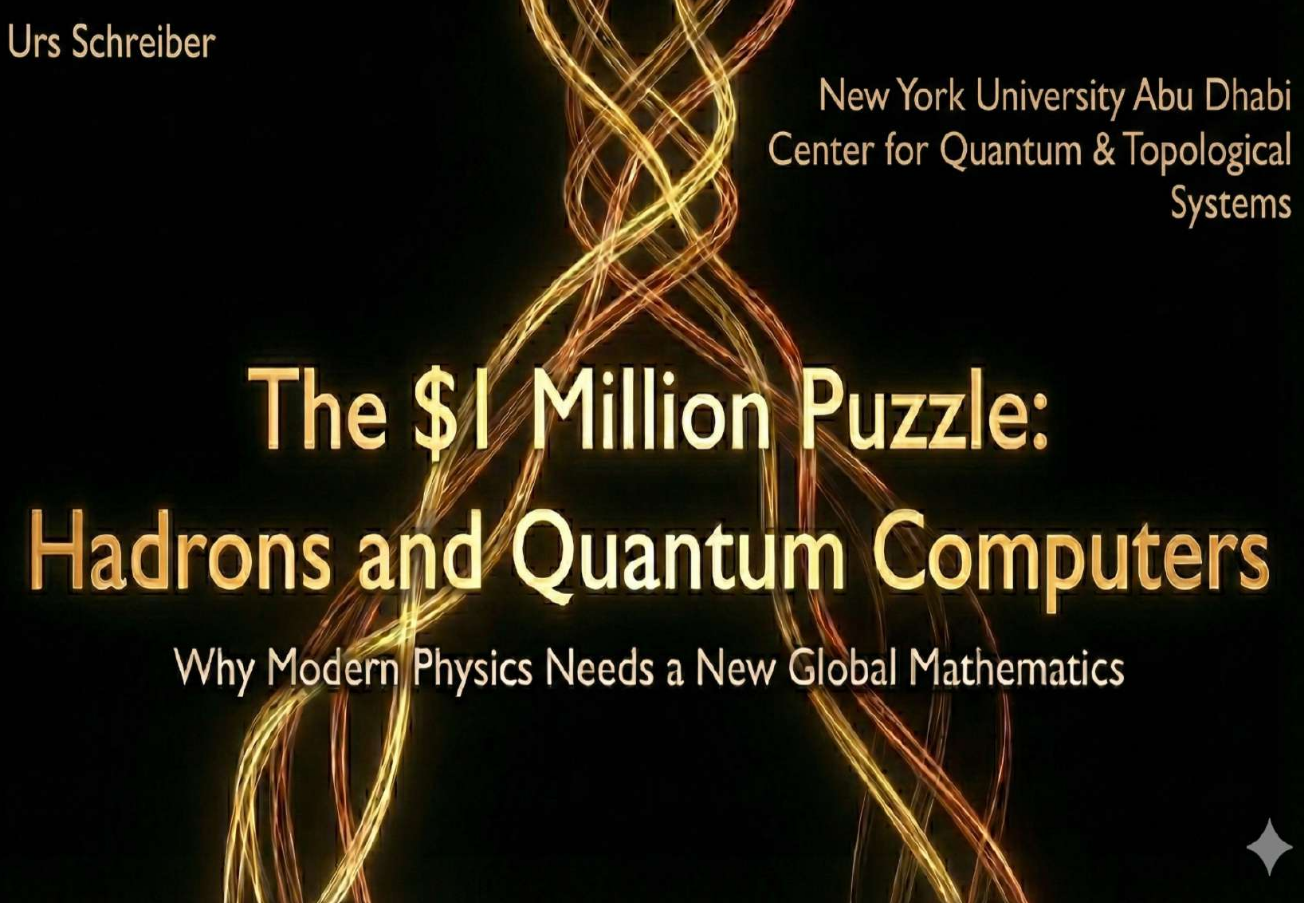
The $1 Million Puzzle: Hadrons and Quantum Computers
Why Modern Physics Needs a New Global Mathematics
public evening lecture (alt) at
Alfried Krupp Wissenschaftskolleg, Greifswald
alongside the conference Higher Differential Geometry,
video recording: WIKO Mediathek, yt
slides: pdf
video draft: yt, yt
Abstract. Popular accounts often celebrate the “Standard Model” of physics as a flawless success story. It appears that the only major problem remaining in modern physics is that experiments are failing to discover new, unknown particles. However, this image is misleading.
In reality, theoretical physics faces an “elephant in the room”: The existence and properties of strongly bound states — such as hadrons (e.g., protons), which make up our world — can barely be derived analytically. We rely mostly on computer simulations here rather than on genuine theoretical understanding. This deficit is so fundamental that the Clay Mathematics Institute has declared the global formulation of the theory of nuclear interaction a “Millennium Problem” and offered a prize of $1 million for its solution.
A strikingly similar problem is currently slowing down the development of quantum computers: To stabilize them, solid-state physics must understand so-called “strongly correlated electron gases”. All these phenomena lie beyond the reach of classical “perturbation theory”, which has dominated physics for a century.
In this talk, we will attempt to convey how a new “global mathematics” can help close these knowledge gaps. Using modern concepts such as Higher Topos Theory and Homotopy Type Theory, it becomes possible to truly grasp such complex physical phenomena for the first time. This leads not only to deeper theoretical insights but is also technologically relevant: It allows for a new understanding of those intrinsically robust quantum states (“Anyons”) that are likely necessary to advance from today’s “proof-of-principle” devices to meaningful quantum computers.
Lecture to be held in German, for a local audience. Here the original title and abstract:
-
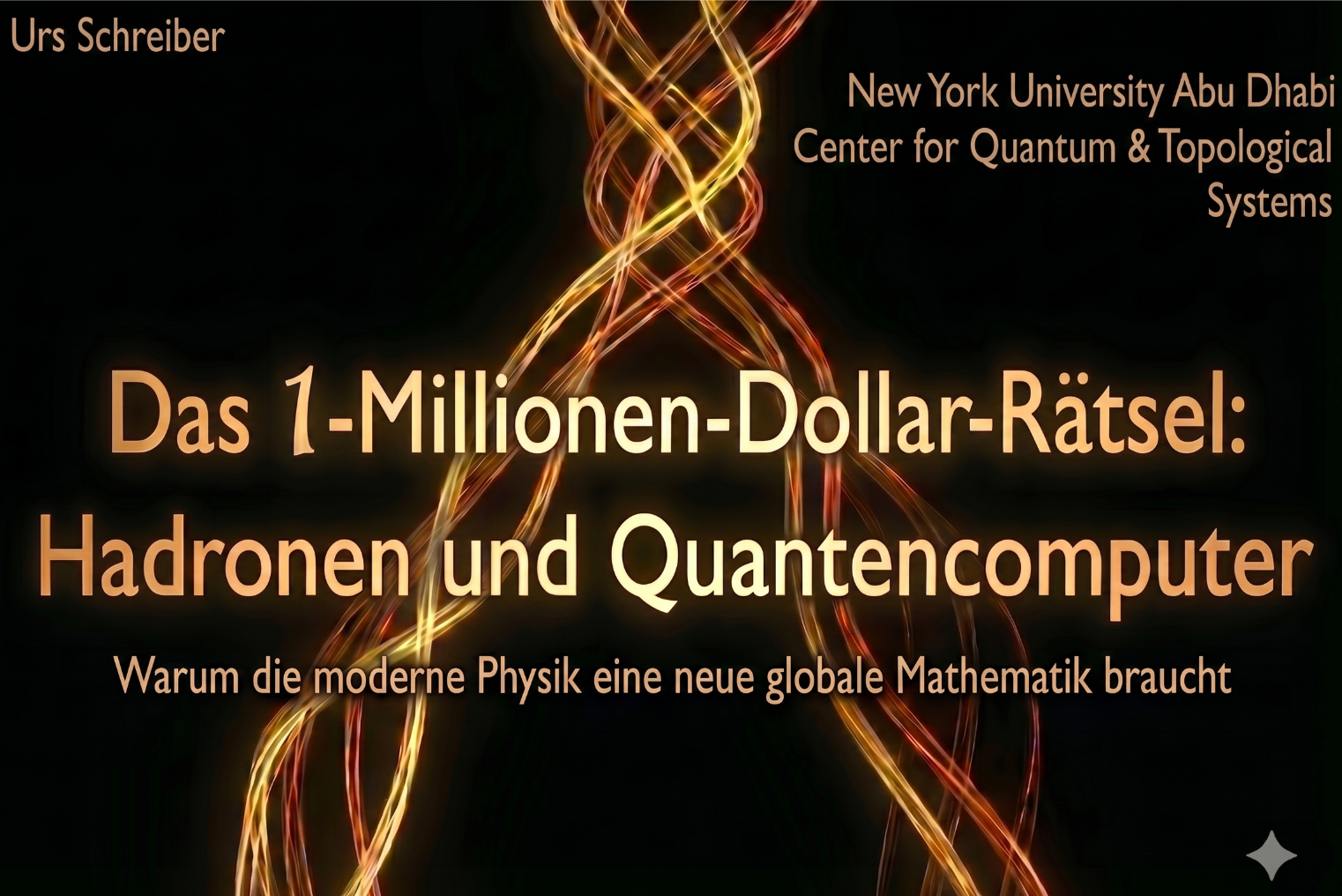
Das 1-Millionen-Dollar-Rätsel: Hadronen und Quantencomputer
Warum die moderne Physik eine neue globale Mathematik braucht
Abendvortrag (-) am
Alfried Krupp Wissenschaftskolleg, Greifswald
im Rahmen der Konferenz Higher Differential Geometry,
Dias: pdf
Zusammenfassung: Populäre Darstellungen feiern das “Standardmodell” der Physik oft als lückenlose Erfolgsgeschichte. Das größte Problem der modernen Physik scheine lediglich darin zu bestehen, dass Experimente keine neuen, unbekannten Teilchen finden. Doch dieses Bild ist irreführend.
Tatsächlich steht die theoretische Physik vor einem “Elefanten im Raum”: Die Existenz und die Eigenschaften von stark gebundenen Zuständen — wie den Hadronen (z.B. Protonen), aus denen unsere Welt besteht — lassen sich kaum analytisch herleiten. Wir verlassen uns hier meist auf Computer-Simulationen statt auf echtes theoretisches Verständnis. Dieses Defizit ist so fundamental, dass das Clay Mathematics Institute die globale Formulierung der Theorie der nuklearen Wechselwirkung zu einem “Jahrtausend-Problem” erklärt und ein Preisgeld von 1 Million Dollar ausgesetzt hat.
Ein verblüffend ähnliches Problem bremst derzeit die Entwicklung von Quantencomputern: Um diese zu stabilisieren, muss die Festkörperphysik sogenannte “stark korrelierte Elektronengase” verstehen. All diese Phänomene liegen jenseits der klassischen “Störungstheorie”, die die Physik seit einem Jahrhundert dominiert.
In diesem Vortrag versuchen wir einen Eindruck davon zu vermitteln, wie eine neue “globale Mathematik” helfen kann, diese Wissenslücken zu schließen. Mithilfe moderner Konzepte wie der Höheren Topostheorie und der Homotopie-Typentheorie wird es möglich, solch komplexe physikalische Phänomene erstmals wirklich zu fassen. Dies führt nicht nur zu tieferen theoretischen Einsichten, sondern ist auch technologisch relevant: So lassen sich jene intrinsisch robusten Quantenzustände (“Anyonen”) neu verstehen, die vermutlich notwendig sind, um von den heutigen “Proof-of-Principle”-Geräten zu sinnvollen Quantencomputern zu gelangen.
Related presentations:
-
Bulk-Edge Correspondence via Higher Gauge Theory, talk at
Higher Differential Geometry
Alfried Krupp Wissenschaftskolleg, Greifswald, 4-6 May 2026 -
Rethinking Topological Quantum, lightning talk at
AI & Evolution Gathering
organized by Softmax,
@ The Royal Institution
London (22 May 2025) -
Rethinking FQH Anyons, talk at
NYU-NYUAD Workshop on Quantum Matter and Quantum Computing
@ Center for Quantum Information Physics
NYU New York (19-20 May 2025)
Related expositions:
- Higher Topos Theory in Physics
Encyclopedia of Mathematical Physics 2nd ed
Volume 4, Academic Press (2025) 62-76
doi:10.1016/B978-0-323-95703-8.00210-X
ISBN:9780323957038
Last revised on August 18, 2026 at 14:10:53. See the history of this page for a list of all contributions to it.