Schreiber Bilkent2025
A talk that I have given:

-
Urs Schreiber (on work with H. Sati):
Fragile Topological Phases and Topological Order
of 2D Crystalline Chern InsulatorsZoom talk at Bilkent Topology Seminar,
Abstract: We apply methods of equivariant homotopy theory, that may not previously have found due attention in condensed matter physics, to classify first the fragile topological phases of 2D crystalline Chern insulator materials, and second the potential topological order of their fractional cousins. We highlight that the phases are given by the equivariant 2-Cohomotopy of the Brillouin torus of crystal momenta (with respect to wallpaper point group actions) — which, despite the attention devoted to crystalline Chern insulators, seems not to have been considered before. Arguing then that any topological order must be reflected in the adiabatic monodromy of gapped quantum ground states over the covariantized moduli space of these band topologies, we compute the latter in various examples where this group is non-abelian, showing that potential anyons must be localized in momentum space. We close with an outlook on the relevance for the search for topological quantum computing hardware.
Based on:
-
Identifying Anyonic Topological Order in Fractional Quantum Anomalous Hall Systems
Applied Physics Letters (2025, in press)
-
Fragile Topological Phases and Topological Order of 2D Crystalline Chern Insulators
(in preparation)
Related talks:
-
at QMATH16
-
at ISQS29
-
Rethinking Topological Quantum (lightning talk)
-
Homotopy Theory for Topological Quantum Computing (aimed at algebraic topologists)
Script:
Contents
Idea of Topological Quantum Gates
The quantum adiabatic theorem entails:
Given a quantum system (e.g., a quantum material)
depending on external parameters in a parameter space
with a gapped Hilbert space of quantum ground states
then sufficiently gentle (“adiabatic”) tuning of parameters
brings about unitary transformation of the quantum state
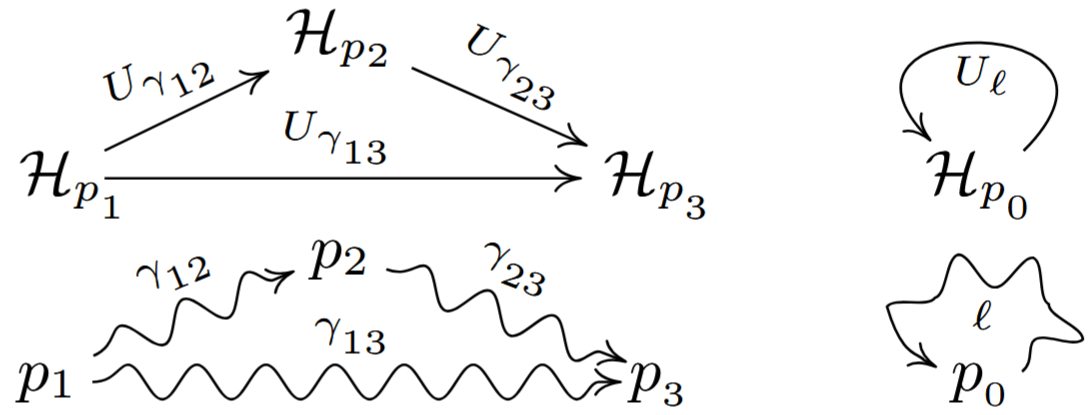
This is called “topological” (really: “homotopical”) if
depends only on the homotopy class of (rel. endpoints),
whence the form a local system of Hilbert spaces over ,
which over each connected component
is a unitary representation of the fundamental group
Regarded as quantum gates, these are “topologically protected”
in that they are undisturbed by noise in control parameter .
There are arguments that some such topological protection
is necessary for quantum computers to reach interesting scale.
Big question: How to find/build quantum systems with such
nontrivial (nonabelian) topological monodromy
(jargon: “topological order”) ??
Classical proposal by Kitaev 2003: If one could arrange that
is a configuration space of points in the plane, such as of
some kind of soliton/defect positions in a 2D material
then
is a braid representation of a braid group on strands
if non-trivial, the solitons/defects are called “anyons”
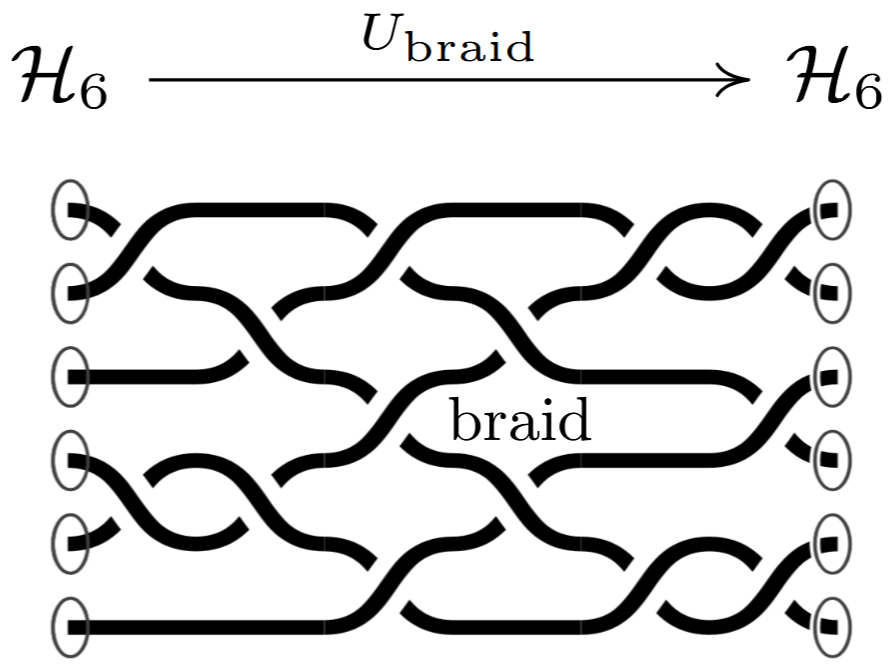
It remains underappreciated that: could be different.
Let’s have a closer look which actually arise in practice.
Idea of Topological Phases of Matter
The Bloch theorem entails that:
The Hamiltonians of electrons in a crystal are direct integrals
over the Brillouin torus of crystal momenta
of Bloch Hamiltonians, given by continuous maps
Here encodes the energy states available to electrons
with a well-defined (plane wave) momentum .
The graph of eigenvalues of are the energy bands.
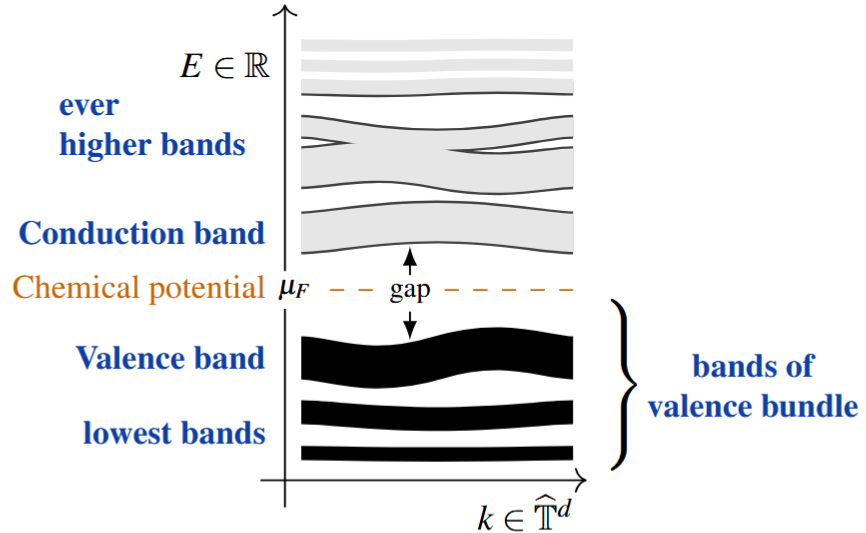
If all the are gapped, say at ,
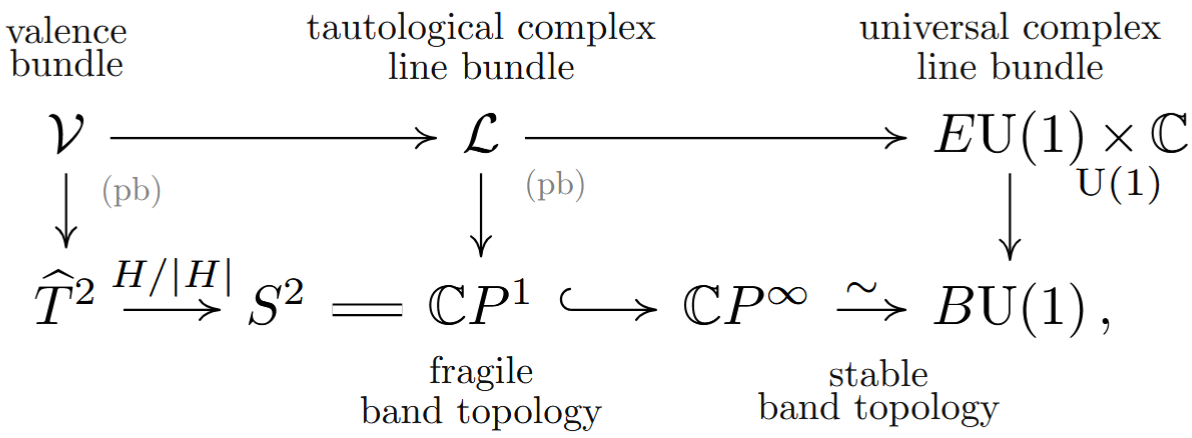
then the valence bundle is the negative eigenspace bundle
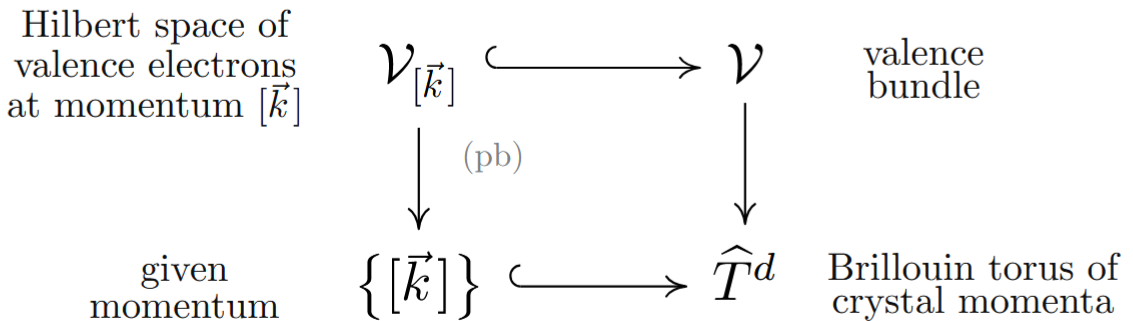
The relevant equivalence class of the valence bundle
depends on how fine/coarse the resolution is. Given a choice
then the class is the observed topological phase of matter.
For fragile topological phases one considers deformations
that explore only the given space of gapped Bloch Hamiltonians
which is homotopy equivalent to the Grassmannian
whence the parameter space of fragile topological couplings is
the mapping space
Whereas the coarser stable topological phases classify the
deformation classes where the system is allowed to explore
-
any of the higher conduction bands, where
-
moreover any number of valence bands, where
For
these phases are in ordinary cohomology:
while for these phases are
in (reduced) topological K-theory
but general fragile phases are
in extraordinary nonabelian cohomology (FSS23)
classified by any (pointed connected) topological space :
here specifically:
For example:
In the case of “2 accessible bands”, ,
where the classifying space is the 2-sphere,
the fragile topological phases are classified in 2-Cohomotopy:
For 2D Chern materials this coincides already with the stable phases
This integer class is the Chern class of the valence line bundle
whence one speaks of topological Chern insulators.
Fragile Crystalline Topological Phases
More precisely, in general a crystalline symmetry
is respected by the Bloch Hamiltonian and its deformations:
for unitary operators , in which case one speaks of
“symmetry protected topological phases”.
Observation: This means that
the classifying maps are equivariant maps
and the classification is in equivariant nonabelian cohomology
In particular:
Fragile crystalline 2-band phases are classified by equivariant 2-Cohomotopy.
Evident as this is, it has not been classified or even stated before.
While filling such gaps we also also point out that the topological
parameter space really ought to be the homotopy quotient
by the equivariant diffeomorphism group (acting by precomposition)
as befits the modular functor of a topological field theory.
Identifying Anyons in FQAH Materials
Hence if there is topological order/anyons
in crystalline fractional quantum Hall systems it ought to be
reflected in nontrivial parameter fundamental groups ,
in a given topological phase
Two examples (1.) solitonic and (2.) defect anyons:
Proposition 1 (potential solitonic FQAH anyons):
When all symmetry is broken ( the trivial group):
where is the integer Heisenberg group at level=2
with generators
and the only nontrivial group commutator being
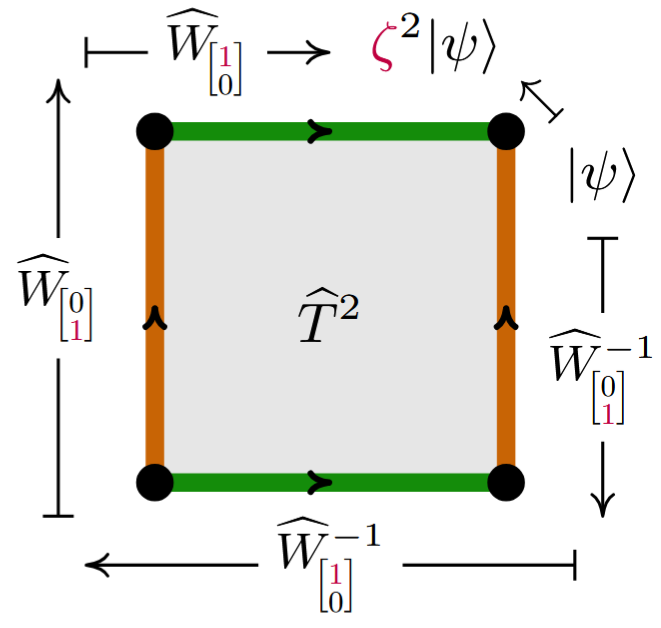
This is precisely the relation characterizing FQH anyons on the torus!
And imposes their expected modular data.
(SS25)
Proposition 2 (potential defect FQAH anyons):
For p3 symmetry
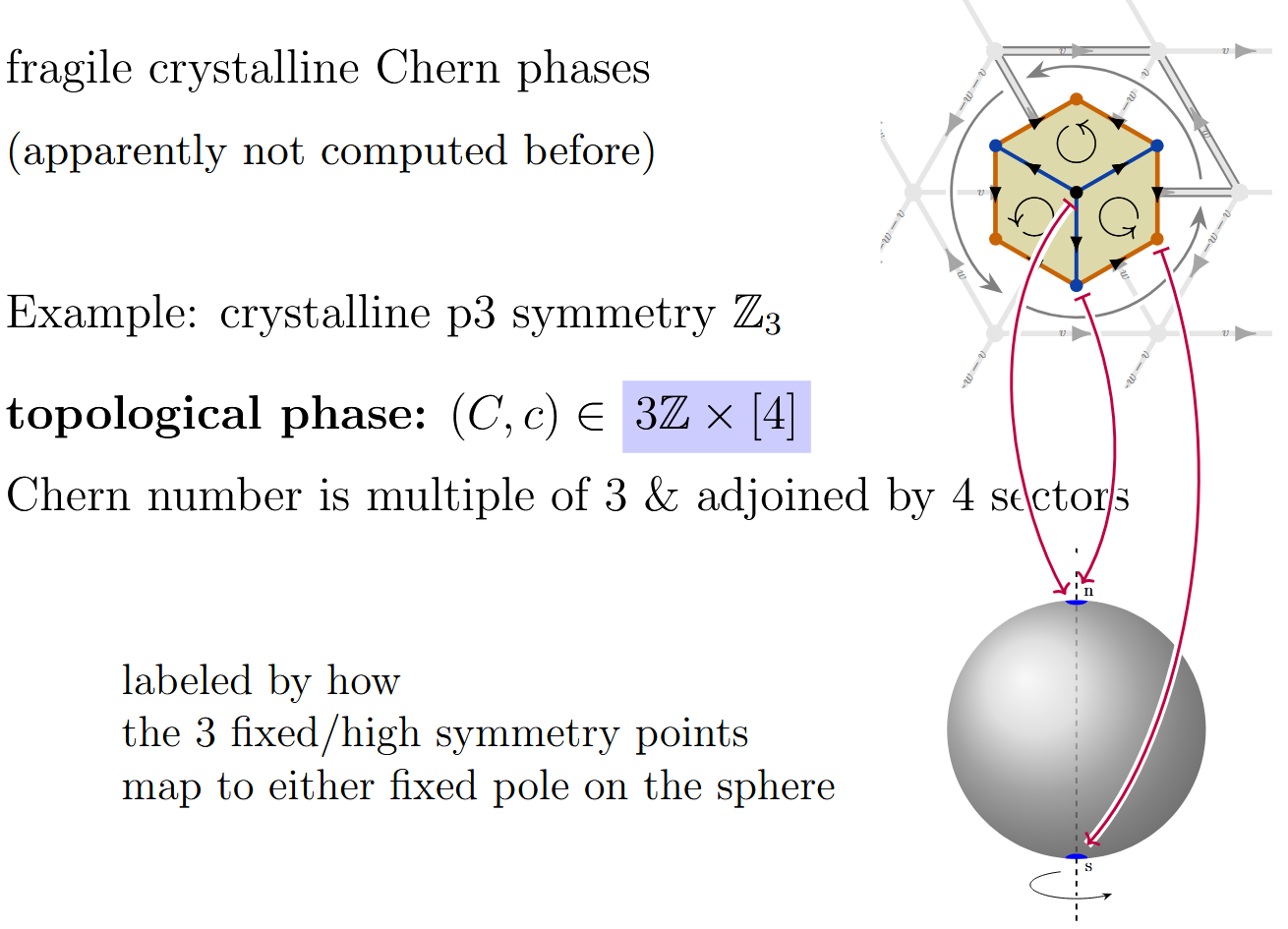
where the symmetric group acts by permutation of the high symmetry points.
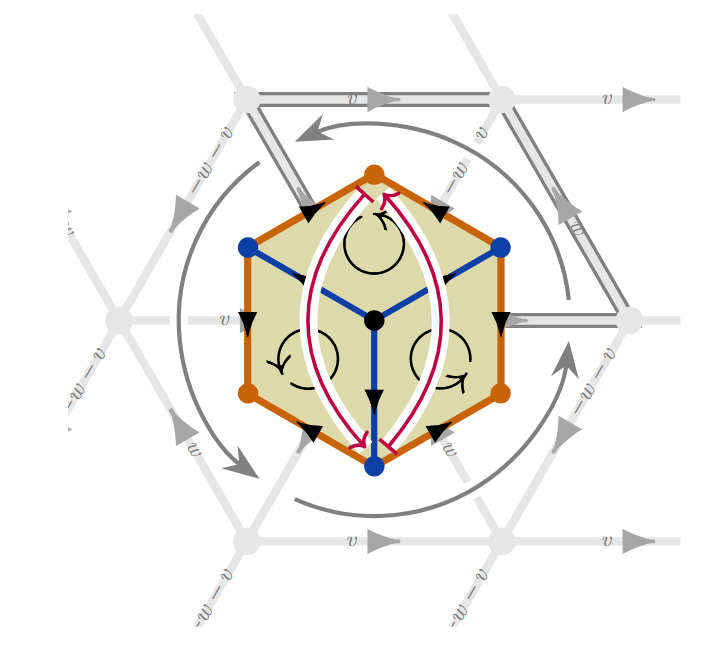
This implies that the high symmetry points themselves
may constitute para- defect anyons.
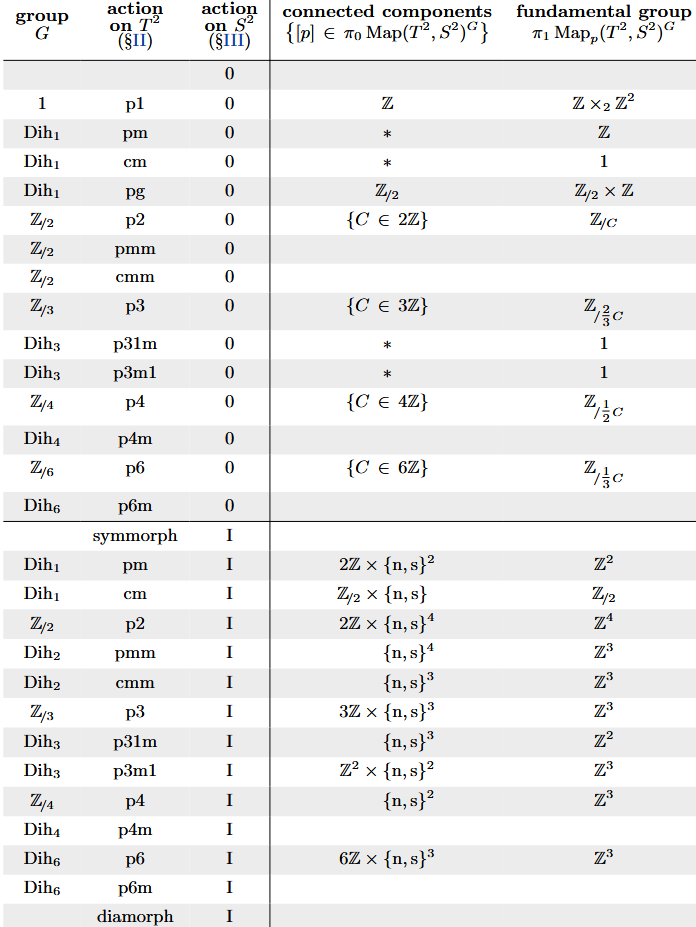
Computing Equivariant 2-Cohomotopy
of -tori is among the most basic questions
not just for the physics of crystalline fragile topological phases
but also in pure Cohomotopy theory as such
but seems not to have found any attention before.
One approach:
For point group-symmetries of wallpaper groups.
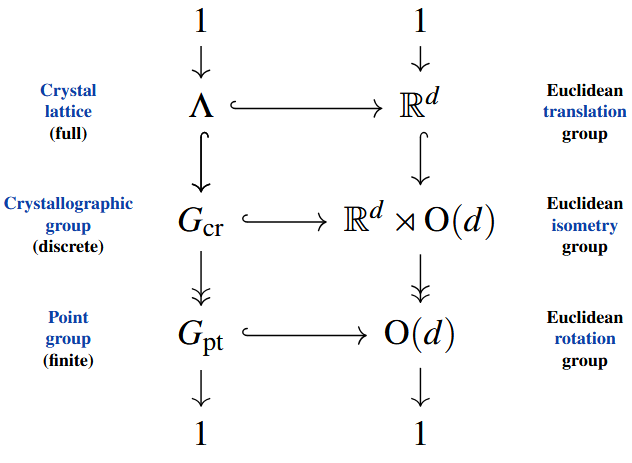
Determine minimal G-CW complex-structure on -torus
(worked out here.)
Observe that filtering the equivariant mapping space into
by the skeleta of this G-CW complex gives homotopy fiber
realizations from which the homotopy groups may be deduced.
The example of p3 symmetry:
Classification so far:
Last revised on December 16, 2025 at 16:15:45. See the history of this page for a list of all contributions to it.