nLab quantum anomalous Hall effect
Context
Quantum systems
-
quantum algorithms:
Topological physics
Topological Physics – Phenomena in physics controlled by the topology (often: the homotopy theory) of the physical system.
General theory:
In metamaterials:
For quantum computation:
Contents
Idea
The quantum anomalous Hall effect (QAHE) is a joint variant of the quantum Hall effect and the anomalous Hall effect: Where a quantum Hall effect is induced by a strong external magnetic field, in the “anomalous” version — realized in crystalline topological phases of matter called Chern insulators — the effect of the external magnetic field on the electrons is instead mimicked by the latter’s spin-orbit coupling in the presence of magnetization, jointly reflected in a non-vanishing Berry curvature over the Brillouin torus which now plays the role of the external field’s flux density.
In analogy to how the ordinary quantum Hall effect has a fractional version, there is even a fractional version of the QAHE: the fractional quantum anomalous Hall effect (FQAHE).
Details

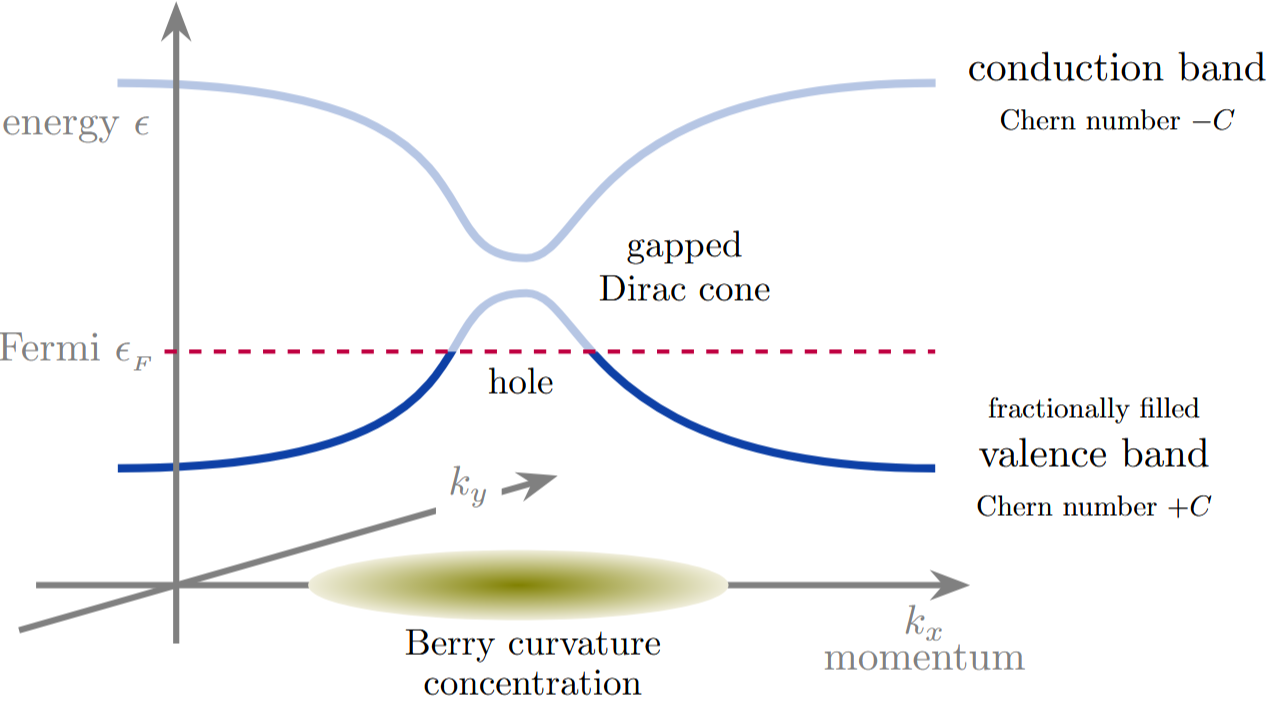
[Chang, Liu & MacDonald 2023 §II.A:] A common feature of all the QAH systems that are established as of this writing — magnetically doped TI films, films of the intrinsic magnetic TI , magic-angle TBG, ABC trilayer graphene on , and TMD moirés — is adiabatic connection to a limit in which the band states close to the Fermi level can be described by 2D massive Dirac equations. […] The 2D Dirac model is not periodic in momentum and is therefore not a crystal Hamiltonian. When applied to crystalline electronic degrees of freedom, it is intended to apply only in small isolated portions of the Brillouin zone (BZ) with large Berry curvatures […] the Berry curvature in the 2D Dirac equation is concentrated within a momentum-space area proportional to (where ), and that it decays as for large . […] Each 2D Dirac Hamiltonian therefore contributes to the Hall conductivity
Moreover, for fractional quantum Hall systems the valence band:
-
is “almost flat”, meaning that its energy gradient with respect to momentum is small, so that the kinetic energy of electrons is small (“quenched”) and the electron-interaction/correlation is dominant
-
overlaps the Fermi energy, so that it is only partially (fractionally) filled, with holes at the peaks of the Dirac domes:
Related entries
Types of Hall effects
References
Integer QAHE
The theoretical prediction of Hall conductance proportional to the first Chern number (integrated Berry curvature) of the valence band in a topological insulator:
- D. J. Thouless, M. Kohmoto, M. P. Nightingale, M. den Nijs: Quantized Hall Conductance in a Two-Dimensional Periodic Potential, Phys. Rev. Lett. 49 (1982) 405 [doi:10.1103/PhysRevLett.49.405]
The first theoretical lattice model, which came to be called the Haldane model:
- Duncan Haldane: Model for a Quantum Hall Effect without Landau Levels: Condensed-Matter Realization of the “Parity Anomaly”, Phys. Rev. Lett. 61 (1988) 2015 [doi:10.1103/PhysRevLett.61.2015]
Experimental realization of QAH systems:
- Cui-Zu Chang et al.: Experimental Observation of the Quantum Anomalous Hall Effect in a Magnetic Topological Insulator, Science 340 (2013) 167 [doi:10.1126/science.1234414, arXiv:1605.08829]
Review:
-
Jing Wang, Biao Lian, Shou-Cheng Zhang: Quantum anomalous Hall effect in magnetic topological insulators, Physica Scripta 2015 T164 (2015) 014003 [arXiv:1409.6715, doi:10.1088/0031-8949/2015/T164/014003]
-
Chao-Xing Liu, Shou-Cheng Zhang, Xiao-Liang Qi: The Quantum Anomalous Hall Effect: Theory and Experiment, Annual Review of Condensed Matter Physics 7 (2016) [arXiv:1508.07106, doi:10.1146/annurev-conmatphys-031115-011417]
-
Cui-Zu Chang, Chao-Xing Liu, Allan H. MacDonald: Colloquium: Quantum anomalous Hall effect, Rev. Mod. Phys. 95 (2023) 011002 [arXiv:2202.13902, doi:10.1103/RevModPhys.95.011002]
See also:
- Wikipedia: Quantum anomalous Hall effect
Fractional QAHE
General
The original theoretical prediction (published back-to-back in the same volume) of the fractional quantum anomalous Hall in fractional Chern insulators:
-
Evelyn Tang, Jia-Wei Mei, Xiao-Gang Wen: High-Temperature Fractional Quantum Hall States, Phys. Rev. Lett. 106 (2011) 236802 [arXiv:1101.1942, doi:10.1103/PhysRevLett.106.236802]
-
Kai Sun, Zheng-Cheng Gu, Hosho Katsura, Sankar Das Sarma: Nearly Flatbands with Nontrivial Topology, Phys. Rev. Lett. 106 (2011) 236803 [arXiv:1012.5864, doi:10.1103/PhysRevLett.106.236803]
-
Titus Neupert, Luiz Santos, Claudio Chamon, Christopher Mudry: Fractional quantum Hall states at zero magnetic field, Phys. Rev. Lett. 106 (2011) 236804 [arXiv:1012.4723, doi:10.1103/PhysRevLett.106.236804]
and further early theoretical development:
-
Siddharth A. Parameswaran, Rahul Roy, Shivaji L. Sondhi: Fractional Quantum Hall Physics in Topological Flat Bands, Comptes Rendus. Physique, Topological insulators / Isolants topologiques, 14 9-10 (2013) 816-839 [arXiv:1302.6606, doi:10.1016/j.crhy.2013.04.003]
“The possibility of stabilizing exotic topological phases outside of a dilution fridge and without a superconducting magnet, and the avenues it opens for further experimental probes of these phases, is among the primary motivations of the activity in this field”
-
Rahul Roy: Band geometry of fractional topological insulators, Phys. Rev. B 90 (2014) 165139 [arXiv:1208.2055, doi:10.1103/PhysRevB.90.165139]
-
Nicolas Regnault, B. Andrei Bernevig: Fractional Chern Insulator, Phys. Rev. X 1 (2011) 021014 [arXiv:1105.4867, doi:10.1103/PhysRevX.1.021014]
Relation to W-infinity algebra:
- Siddharth A. Parameswaran, Rahul Roy, Shivaji L. Sondhi: Fractional Chern Insulators and the W-Infinity Algebra, Phys. Rev. B 85 (2012) 241308(R) [arXiv:1106.4025, doi:10.1103/PhysRevB.85.241308]
See also:
- Peleg Emanuel, Anna Keselman, Yuval Oreg: A Unifying Framework for Fractional Chern Insulator Stabilization, Phys. Rev. B 112 (2025) 235133 [arXiv:2505.07950, doi:10.1103/9hpw-kz7g]
Experimental realization of FQAH systems:
-
Jiaqi Cai et al.: Signatures of Fractional Quantum Anomalous Hall States in Twisted Bilayer, Nature 622 (2023) 63–68 [arXiv:2304.08470, doi:10.1038/s41586-023-06289-w]
(in twisted bilayer molybdenum ditelluride, )
-
Yihang Zeng et al.: Thermodynamic evidence of fractional Chern insulator in moiré , Nature 622 (2023) 69–73 [doi:10.1038/s41586-023-06452-3]
-
Heonjoon Park et al.: Observation of fractionally quantized anomalous Hall effect, Nature 622 (2023) 74–79 [doi:10.1038/s41586-023-06536-0]
-
Boran Zhou, Hui Yang, and Ya-Hui Zhang: Fractional Quantum Anomalous Hall Effect in Rhombohedral Multilayer Graphene in the Moiréless Limit, Phys. Rev. Lett. 133 (2024) 206504 [doi:10.1103/PhysRevLett.133.206504, arXiv:2311.04217]
-
Zhengguang Lu et al.: Fractional quantum anomalous Hall effect in multilayer graphene, Nature 626 (2024) 759–764 [doi:10.1038/s41586-023-07010-7, arXiv:2309.17436]
-
Jingwei Dong, et al.: Observation of Integer and Fractional Chern insulators in high Chern number flatbands [arXiv:2507.09908]
-
Naitian Liu et al.: Diverse high-Chern-number quantum anomalous Hall insulators in twisted rhombohedral graphene [arXiv:2507.11347]
-
Hongyun Zhang et al.: Moiré enhanced flat band in rhombohedral graphene, Nat. Mater. (2025) [arXiv:2504.06251, doi:10.1038/s41563-025-02416-2]
-
Yiping Wang et al.: Magnetic Signatures of a Putative Fractional Topological Insulator in Twisted [arXiv:2601.18508]
-
Jackson P. Butler: 1/3 Fractional and Gapless Integer Quantum Anomalous Hall States in Rhombohedral Graphene [arXiv:2606.06450]
-
Zexu Li et al.: Fractional high-Chern insulator in twisted rhombohedral graphene, Nature (2026) [arXiv:2512.21612, https://doi.org/10.1038/s41586-026-10762-7]
Review:
-
Rahul Roy, Shivaji L. Sondhi: Fractional quantum Hall effect without Landau levels, Physics 4 46 (June 2011) [physics.aps:v4/46]
-
Emil J. Bergholtz, Zhao Liu: Topological Flat Band Models and Fractional Chern Insulators, Int. J. Mod. Phys. B 27 (2013) 1330017 [doi:10.1142/S021797921330017X, arXiv:1308.0343]
-
Titus Neupert, Claudio Chamon, Thomas Iadecola, Luiz H. Santos, Christopher Mudry: Fractional (Chern and topological) insulators Physica Scripta 2015 (2015) 014005 [arXiv:1410.5828, doi:10.1088/0031-8949/2015/T164/014005]
-
Long Yu, Allan H. MacDonald, Kin Fai Mak, Jie Shan, Xiaodong Xu: The fractional quantum anomalous Hall effect, Nature Reviews Materials 9 (2024) 455–-459 [doi:10.1038/s41578-024-00694-x]
-
Nicolás Morales-Durán, Jingtian Shi, Allan H. MacDonald: Fractionalized electrons in moiré materials, Nature Reviews Physics 6 (2024) 349–351 [doi:10.1038/s42254-024-00718-z]
-
Jian Zhao et al.: Exploring the Fractional Quantum Anomalous Hall Effect in Moiré Materials: Advances and Future Perspectives, ACS Nano (2025) [doi:10.1021/acsnano.5c01598]
See also:
-
Nicolas Regnault: Fractional Topogical Insulators: numerical evidences [pdf, pdf]
-
Wikipedia: Fractional Chern insulator
Further discussion:
-
Adolfo G. Grushin, Titus Neupert, Claudio Chamon, Christopher Mudry: Enhancing the stability of a fractional Chern insulator against competing phases, Phys. Rev. B 86, 205125 (2012) [doi:10.1103/PhysRevB.86.205125, arXiv:1207.4097 cond-mat.str-el]
-
Ahmed Abouelkomsan, Zhao Liu, Emil J. Bergholtz: Particle-Hole Duality, Emergent Fermi Liquids and Fractional Chern Insulators in Moiré Flatbands, Phys. Rev. Lett. 124 (2020) 106803 [doi:10.1103/PhysRevLett.124.106803, arXiv:1912.04907]
-
V. Yu. Irkhin, Yu. N. Skryabin: Electronic States and Anomalous Hall Effect in Strongly Correlated Topological Systems, Journal of Experimental and Theoretical Physics, 133 1 (2021) 116–123 [doi:10.1134/S1063776121060030, arXiv:2108.13851 cond-mat.str-el]
-
Valentin Crépel, Liang Fu: Anomalous Hall metal and fractional Chern insulator in twisted transition metal dichalcogenides, Phys. Rev. B 107 (2023) L201109 [arXiv:2207.08895, doi:10.1103/PhysRevB.107.L201109]
-
Gal Shavit, Yuval Oreg: Quantum Geometry and Stabilization of Fractional Chern Insulators Far from the Ideal Limit, Phys. Rev. Lett. 133 (2024) 156504 [doi:10.1103/PhysRevLett.133.156504, arXiv:2405.09627]
-
Nicolas Regnault et al.: Fractional topological states in rhombohedral multilayer graphene modulated by kagome superlattice [arXiv:2502.17320]
-
Sen Niu, Jason Alicea, D. N. Sheng, Yang Peng: Quantum anomalous Hall effects and Hall crystals at fractional filling of helical trilayer graphene [arXiv:2505.24146]
-
Hongyu Lu, Han-Qing Wu, Bin-Bin Chen, Wang Yao, Zi Yang Meng: Generic (fractional) quantum anomalous Hall crystals from interaction-driven band folding [arXiv:2505.04138]
-
Raul Perea-Causin, Hui Liu, Emil J. Bergholtz: Quantum anomalous Hall crystals in moiré bands with higher Chern number, Nature Communications 16 6875 (2025) [doi:10.1038/s41467-025-62224-9]
-
Zhengyan Darius Shi, T. Senthil: Doping a fractional quantum anomalous Hall insulator [arXiv:2409.20567]
-
Zhengyan Darius Shi, T. Senthil: Non-Abelian topological superconductivity from melting Abelian fractional Chern insulators [arXiv:2512.17996]
-
Xi-Hang Feng et al.: Fractional Chern insulators in alternating twisted multilayer [arXiv:2607.13807]
The case of crystalline topological insulators and symmetry protected topological order:
-
Yuan-Ming Lu, Ying Ran: Symmetry protected fractional Chern insulators and fractional topological insulators, Phys. Rev. B 85 (2012) 165134 [arXiv:1109.0226, doi:10.1103/PhysRevB.85.165134]
“In fact, the recently discovered FCI states preserve all the lattice point group symmetry as well as translational symmetry. Here in this paper, we point out that as a consequence of the lattice symmetry, there exist many different quantum FCI phases, all respecting the full lattice symmetry, even at the same filling fraction with the same quantum Hall conductance […] These distinct FCI phases cannot be adiabatically connected with each other without a phase transition while the lattice symmetry is respected”
-
Ke Huang, Xiao Li, Sankar Das Sarma, Fan Zhang: Self-consistent theory of fractional quantum anomalous Hall states in rhombohedral graphene Phys. Rev. B 110 (2024) 115146 [doi:10.1103/PhysRevB.110.115146, arXiv:2407.08661]
-
Yuxuan Zhang, Maissam Barkeshli: Fractionally Quantized Electric Polarization and Discrete Shift of Crystalline Fractional Chern Insulators, Phys. Rev. B [arXiv:2411.04171, doi:10.1103/qslx-ybf6]
-
Naren Manjunath: Crystalline invariants of integer and fractional Chern insulators, talk at Recent Developments and Challenges in Topological Phases, Kyoto University (2024) [pdf, pdf]
See also:
- Kryštof Kolář, Kang Yang, Felix von Oppen, Christophe Mora: Robustness of real-space topology in moiré systems [arXiv:2507.00130]
On the corresponding Wannier functions:
-
Xiao-Liang Qi: Generic Wavefunction Description of Fractional Quantum Anomalous Hall States and Fractional Topological Insulators, Phys. Rev. Lett. 107 (2011) 126803 [doi:10.1103/PhysRevLett.107.126803", arXiv:1105.4298]
-
Maissam Barkeshli, Xiao-Liang Qi: Topological Nematic States and Non-Abelian Lattice Dislocations, Phys. Rev. X 2 (2012) 031013 [doi:10.1103/PhysRevX.2.031013, arXiv:1112.3311]
-
Chao-Ming Jian, Xiao-Liang Qi: Crystal-symmetry preserving Wannier states for fractional chern insulators, Phys. Rev. B 88 (2013) 165134 [arXiv:1303.1787, doi:10.1103/PhysRevB.88.165134]
Relation to superconductors:
- Taige Wang, Michael P. Zaletel: Chiral superconductivity near a fractional Chern insulator [arXiv:2507.07921]
Derivation from a Hubbard model?:
- Fabian J. Pauw, Ulrich Schollwöck, Nathan Goldman, Sebastian Paeckel, Felix A. Palm: From hidden order to skyrmions: Quantum Hall states in an extended Hofstadter-Fermi-Hubbard model, Phys. Rev. B 113 (2026) 035142 [arXiv:2509.12184, doi:10.1103/cqt2-b327]
See also:
-
Taige Wang: Topological superconductivity from Abelian fractional Chern insulators [arXiv:2605.29034]
-
Jennifer Cano, Jie Wang: Ideal Quantum Geometry for Fractional Chern Insulators [arXiv:2606.05496]
-
Siddhartha Sarkar, Yitong Zhang, Kai Sun: How Similar Can Fractional Chern Insulators Be to Fractional Quantum Hall States? Moiré-Enhanced Gaps and Excitation-Spectrum Correspondence [arXiv:2606.07323]
-
Haoyu Hu, Lei Chen: Quantum-Geometry-Induced Superconductivity near a Fractional Chern Insulator [arXiv:2606.21166]
-
Julian May-Mann, Tixuan Tan, Patrick J. Ledwith, Zhengyan Darius Shi, Trithep Devakul: Skyrmion Fractional Chern Insulator: An Intrinsically Multiband Route to Fractionalization in Rhombohedral Graphene [arXiv:2608.14535]
Anyonic states
On topological order and anyons in FQAH systems:
-
Fabian J. Pauw, Felix A. Palm, Ulrich Schollwöck, Annabelle Bohrdt, Sebastian Paeckel, Fabian Grusdt: Detecting Hidden Order in Fractional Chern Insulators, Phys. Rev. Research 6 (2024) 023180 [doi:10.1103/physrevresearch.6.023180, arXiv:2309.03666]
-
Aidan P. Reddy, Nisarga Paul, Ahmed Abouelkomsan, Liang Fu: Non-Abelian fractionalization in topological minibands, Phys. Rev. Lett. 133 (2024) 166503 [arXiv:2403.00059, doi:10.1103/PhysRevLett.133.166503 ]
-
Hui Liu, Zhao Liu, Emil J. Bergholtz: Non-Abelian Fractional Chern Insulators and Competing States in Flat Moiré Bands, Phys. Rev. Lett. 135 (2025) 106604 [arXiv:2405.08887, doi:10.1103/43nq-ntqm]
-
Ryohei Kobayashi, Yuxuan Zhang, Naren Manjunath, Maissam Barkeshli: Crystalline invariants of fractional Chern insulators, Phys. Rev. B (2025) [arXiv:2405.17431, doi:10.1103/8bpm-qbzp]
-
Hui Liu, Raul Perea-Causin, Emil J. Bergholtz: Parafermions in moiré minibands, Nature Communications 16 (2025) 1770 [doi:10.1038/s41467-025-57035-x]
-
Zhengyan Darius Shi, T. Senthil: Anyon delocalization transitions out of a disordered FQAH insulator, PNAS 122 51 (2025) e2520608122 [arXiv:2506.02128, doi:10.1073/pnas.2520608122]
-
Hisham Sati, Urs Schreiber: Identifying Anyonic Topological Order in Fractional Quantum Anomalous Hall Systems, Applied Physics Letters 128 023101 (2026) [arXiv:2507.00138, doi:10.1063/5.0305441]
-
Felix A. Palm, Nader Mostaan, Nathan Goldman, Fabian Grusdt: Interferometric Braiding of Anyons in Chern insulators [arXiv:2511.09445]
-
Chuyi Tuo, Ming-Rui Li, Hong Yao: Fractional quantum anomalous Hall and anyon density-wave halo in a minimal interacting lattice model of twisted bilayer [arXiv:2512.23608]
-
Hisham Sati, Urs Schreiber: Fragile Topological Phases and Topological Order of 2D Crystalline Chern Insulators [arXiv:2512.24709]
-
Tianhong Lu, Luiz H. Santos: Exciton-Anyon Binding in Fractional Chern Insulators: Spectral Fingerprints [arXiv:2601.14365]
-
Kishore Iyer, Andreas Feuerpfeil, Valentin Crépel, Nicolas Regnault, Christophe Mora: Dispersion of Anyon Bloch Bands [arXiv:2604.24859]
-
Zhengyan Darius Shi, T. Senthil: Superconductivity and non-Fermi liquid metals in a charge- anyon fluid [arXiv:2606.20403]
-
Umang Mehta, Yuto Nakajima, Hart Goldman: Coloring in anyon superconductivity [arXiv:2607.19470]
(relation to superconductivity)
-
Botao Wang, Amit Vashisht, Felix A. Palm, Fabian Grusdt, Laurens Vanderstraeten, Nathan Goldman: Anyon-Impurity Bound States in Quantum-Engineered Fractional Chern Insulators [arXiv:2608.06233]
-
Weijie Li et al.: Signatures of fractional charges via anyon–trions in twisted , Nature 651 (2026) 48–53 [doi:10.1038/s41586-026-10101-w]
In view of TQC
In view of potential topological quantum computing hardware:
- James Urton: Researchers make a quantum computing leap with a magnetic twist, UW News (June 2023)
Collective excitations
On the chiral graviton mode in FCIs:
-
Min Long, Zeno Bacciconi, Hongyu Lu, Hernan B. Xavier, Zi Yang Meng, Marcello Dalmonte: Chiral Graviton Modes in Fermionic Fractional Chern Insulators [arXiv:2601.05196]
-
Yi-Hsien Du: Controlled Theory of Skyrmion Chern Bands in Moiré Quantum Materials: Quantum Geometry and Collective Dynamics [arXiv:2602.15016]
Last revised on October 4, 2026 at 09:22:09. See the history of this page for a list of all contributions to it.