nLab comonoid
Context
Monoid theory
monoid theory in algebra:
Algebra
Algebraic theories
Algebras and modules
Higher algebras
-
symmetric monoidal (∞,1)-category of spectra
Model category presentations
Geometry on formal duals of algebras
Theorems
Category theory
Concepts
Universal constructions
Theorems
Extensions
Applications
Contents
Definition
A comonoid (or comonoid object) in a monoidal category is a monoid object in the opposite category (which canonically becomes a monoidal category via the same tensor product operation as in ).
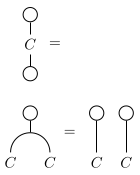
With the usual definition of monoids as having a unit, this means that a comonoid is equipped with a counit, which in string diagram-notation for is of this form:
One speaks of a unital comonoid (or unital comonoid object; internal to Vect also called an augmented coalgebra) if is in addition equipped with a morphism
which verifies the properties that the unit would verify if was a bimonoid, ie. in string diagrams:
Examples
Example
(coassociative coalgebras) A comonoid object in VectorSpaces (with its usual tensor product of vector spaces) is called a coalgebra.
(Beware though that the term “coalgebra” is overused in many ways, for instance in coalgebras for endofunctor?. To be more specific to the linear-algebraic context one can say coassociative coalgebra.)
Example
(cartesian comonoids)
Every set carries a unique structure of a comonoid in the category of Sets with respect to the usual cartesian product.
Generally, every object in a cartesian monoidal category becomes (see also there) a (cocommutative) comonoid by taking the
-
counit to be the terminal morphism
-
coproduct to be the diagonal morphism .
The analogous statement remains true for cartesian monoidal (infinity,1)-categories (see there).
Obvious as Exp. may be, it plays a somewhat profound role in various contexts:
Example
(suspension coring spectra)
In the case of topological spaces or other models of classical homotopy types, and using that the suspension spectrum-construction is a strong monoidal functor, Exp. implies the remarkable fact that suspension spectra carry coring spectrum-structure via smash-monoidal diagonals.
Example
The frame of opens of any monoid internal to the category of locales is a comonoid with respect to the coproduct of frames, since the category of locales is the opposite category of the category of frames.
Example
In particular, the frame of opens of the locale of real numbers is a cocommutative comonoid with respect to the coproduct of frames in two different ways, since addition and multiplication on the Dedekind real numbers can both be extended to the locale of real numbers.
Related concepts
| (co)monad name | underlying endofunctor | (co)monad structure induced by |
|---|---|---|
| reader monad | on cartesian types | unique comonoid structure on |
| coreader comonad | on cartesian types | unique comonoid structure on |
| writer monad | on monoidal types | chosen monoid structure on |
| cowriter comonad | on monoidal types | chosen monoid structure on chosen comonoid structure on |
| Frobenius (co)writer | on monoidal types | chosen Frobenius monoid structure |
Last revised on May 31, 2026 at 19:14:26. See the history of this page for a list of all contributions to it.