nLab Atiyah-Jänich theorem
Context
Cohomology
Special and general types
-
group cohomology, nonabelian group cohomology, Lie group cohomology
-
-
cohomology with constant coefficients / with a local system of coefficients
Special notions
Variants
-
differential cohomology
Extra structure
Operations
Theorems
Functional analysis
Overview diagrams
Basic concepts
Theorems
Topics in Functional Analysis
Index theory
noncommutative topology, noncommutative geometry
noncommutative stable homotopy theory
genus, orientation in generalized cohomology
Definitions
Index theorems
Higher genera
Contents
Idea
The Atiyah-Jänich theorem (Jänich 1965, Atiyah 1967 Thm A1) states that the space of Fredholm operators on a (countably infinite-dimensional separable, complex) Hilbert space is a classifying space for topological K-theory :
For a compact Hausdorff space, the homotopy classes of continuous maps from (hence the connected components of the mapping space) to are in natural bijection with
where forms the index bundle, an -parameterized enhancement of the Fredholm index (see Prop. below).
This statement generalizes:
-
to any degrees and to KO-theory (Atiyah & Singer 1969 Thm. B, Karoubi 1970 Lem 1.4 & Prop. 1.5), given by maps to Fredholm operators satisfying further (anticommutation) conditions,
-
to a definition of twisted K-theory and of equivariant K-theory (hence of twisted equivariant K-theory), given by homotopy classes of sections of -fiber bundles (Atiyah & Segal 2004).
Statement
The original Atiyah-Jänich theorem theorem concerns complex topological K-theory, in degree 0 (and hence in any even degree), see:
Generalization to KO-theory and KSp-theory in degree 0 is fairly straightforward by just replacing the ground field of complex numbers by the real numbers or quaternions, respectively, see:
Generalization to any degree over any ground field is due to Atiyah & Singer 1969, Karoubi 1970, see below:
In stating these, we mostly review results from Karoubi 1970 §I, but we reformulate these (in a straightforward though consequential manner) to bring out (following Sati & Schreiber 2023 §2.2) how they exhibit the 10-fold way of quantum symmetries as known from the K-theory classification of topological phases of matter.
For
Let denote the space of Fredholm operators, equipped with the norm topology, on the countably infinite-dimensional complex Hilbert space .
(A more ambitious construction modifies up to homotopy equivalence to have it carry a continuous action of the PU(ℋ) with the operator topology, cf. Atiyah & Segal 2004-theory#AtiyahSegal04).)
Proposition
If is such that the dimension of the kernels of is locally constant, hence that they form a continuous map to the integers
then the collection of kernels and cokernels themselves, as subspaces of , form topological vector bundles
Proposition
Every continuous map is homotopic to a map for which is continuous.
Proposition
The index (1) is given by
where is any representative of the class according to Prop. , and are its (co)kernel bundles according to Prop. , and is their their virtual difference bundle.
Remark
The construction of the index map (1) by Atiyah 1967 Lem A3, Cor A4 is a little different (though the result, of course, is the same). Exposition is in Sheth §2.
Remark
(Graded Fredholm operators)
It turns out to be useful (such as for the discussion of twisted equivariant K-theory and of the K-theory classification of topological phases of matter) to reformulate, here and in the following, the space of Fredholm operators in the following more structured way (due to Atiyah & Segal 2004 Def. 3.2, following Atiyah & Singer 1969 p 7, see also here at Fredholm operator):
Given any -graded infinite-dimensional (separable complex) Hilbert space
write
for the set of bounded linear operators which are
-
self-adjoint: ,
-
odd-graded: ,
-
Fredholm in that there exists such which is a parametrix,
equipped with the norm topology.
This just means that is of the form
for an ordinary Fredholm operator.
Therefore this space is homeomorphic to the standard space of Fredholm operators:
but the way it is presented by graded operators makes manifest that there is “charge conjugation” quantum symmetry acting on this space, namely by swapping the two homogeneously graded Hilbert space summands. This is useful in the following for neatly expressing (anti-)self-adjointness conditions on Fredholm operators.
(The point of Atiyah & Segal 2004 §4 is to further modify this space so that it carries a non-contractible compact-open topology which allows for more general PU(ℋ) actions on it. The commutation relations discussed in the following immediately apply also to this modified space and constrain the components of its elements in the same way. It seems plausible that the correspondingly constrained modified spaces are accordingly classifying spaces for the various flavors of K-theory as is the case for the unmodified space — as summarized below — but this is not actually obvious.)
For
Proposition
The space of complex self-adjoint Fredholm operators
has three connected components
corresponding to those Fredholm operators whose essential spectrum (which is real, by self-adjointness) is, respectively:
Moreover,
-
the first two components are contractible
-
the last component is homotoppy equivalent to the stable unitary group, hence to the classifying space for complex topological K-theory in odd degree:
Up to some straightforward re-identifications (for instance one may equivalently use skew self-adjoint operators whose spectrum is then purely imaginary), this is the statement of Atiyah & Singer 1969 Thm. B and Karoubi 1970 Lem 1.4 & Prop. 1.5.
Remark
In terms of the graded Fredholm operators (2) from Rem. , the self-adjoint Fredholm operators (8) are equivalently those that commute with the operator
For and
The directly analogous discussion as for complex K-theory in degree 0 (above) applies when replacing the underlying complex Hilbert space with a real or quaternionic Hilbert space, where it yields real K-theory (KO-theory) and quaternionic K-theory (KSp-theory) in degree=0, respectively.
It is useful to express this in terms of complex Hilbert spaces but equipped with real structure or quaternionic structure, respectively, namely with a complex antilinear map
which squares to , respectively, whence the statement reads as follows:
Proposition
Let be an antilinear map on the complex Hilbert space such that
then the space of real-Fredholm operators
is homotopy equivalent to the classifying space/delooping of the stable orthogonal group and hence is a classifying space for KO-theory.
(Jänich 1965 p. 132; Atiyah 1969 §2 p. 102; Karoubi 1970 Prop. 1.3 p. 78)
Proposition
Let be an antilinear map on the complex Hilbert space such that
then the space of quaternionic-Fredholm operators
is homotopy equivalent to the classifying space/delooping of the stable quaternionic unitary group and hence is a classifying space for KSp-theory.
(Atiyah & Singer 1969 p. 323; Karoubi 1970 Prop. 1.12 p. 81)
For
First some basic preliminaries:
Lemma
For a complex anti-linear operator on a Hilbert space , the following are equivalent:
-
is Hermitian self-adjoint, , as an anti-linear operator (cf. there) with respect to the Hermitian inner product ,
-
is self-adjoint, , as a real linear operator with respect to the underlying real inner product, , given by the real part of the Hermitian inner product.
Proof
One direction is immediate:
In the other direction: Assuming that
we need to show that then
For that we compute as follows (where we use the convention that is anti-linear in the first and linear in the second argument, but the same conclusion holds of course with the other convention):
Now:
Proposition
The space of Fredholm operators on the complex Hilbert space which are
-
(skew) self-adjoint (cf. Lem. ):
is a classifying space for (where ).
It is useful to reformulate Prop. as follows:
Proposition
On the complex Hilbert space consider a real/quaternionic structure , in that
-
is anti-linear,
-
,
On the -graded Hilbert space (cf. Rem. ) consider
Then the space
is a classifying space for .
Proof
The fact that in our space is odd and self-adjoint implies that it is of the form
From this, the further condition that it commutes with ,
means equivalently that
and hence our space is equivalently given by
For of this form, notice that is (anti-linear and) self-adjoint/anti-self-adjoint:
Therefore this space is homeomorphic to the space from Prop. , via the map
For
Proposition
The space of real self-adjoint Fredholm operators
has three connected components
corresponding to those Fredholm operators whose essential spectrum is, respectively:
Moreover,
-
the first two components are contractible
-
the last component is homotoppy equivalent to the stable orthogonal group, hence to the classifying space for real topological K-theory (KO-theory) in degree=1:
(Atiyah & Singer 1969 Theorem A, Karoubi 1970 Lem 1.6, Cor. 1.7)
Remark
In terms of graded Fredholm operators (Rem. ), these real (skew) self-adjoint operators are equivalently those which commute both with a real structure anti-linear map , , and with the operator (4).
For
Proposition
The space of quaternionic self-adjoint Fredholm operators
has three connected components
corresponding to those Fredholm operators whose essential spectrum (which is real, due to self-adjointness) is, respectively:
Moreover,
-
the first two components are contractible
-
the last component is homotoppy equivalent to the stable quaternionic unitary group, hence to the classifying space for quaternionic K-theory in degree 1, hence of real topological K-theory (KO-theory) in degree=5:
Proposition
The space of quaternionic anti-self-adjoint Fredholm operators
is a classifying space for .
Remark
In terms of graded Fredholm operators (Rem. ), these quaternionic (skew) self-adjoint operators are equivalently those which commute both with a quaternionic structure anti-linear map , , and with the operator (4).
Summary
In terms of plain Fredholm operators
In terms of ordinary Fredholm operators (on a countably infinite dimensional Hilbert space) we have (Karoubi 1970 Thm. 1.16):
| The space of such Fredholm operators | classifies |
|---|---|
| complex | |
| complex self-adjoint | |
| real | |
| real self-adjoint | |
| real anti-self-adjoint | |
| quaternionic | |
| quaternionic self-adjoint | |
| quaternionic anti-self-adjoint | |
| complex anti-linear self-adjoint | |
| complex anti-linear anti-self-adjoint |
hence, conversely:
| this K-theory | is classified by such Fredholm operators |
|---|---|
| complex | |
| complex self-adjoint | |
| real | |
| real self-adjoint | |
| complex anti-linear self-adjoint | |
| quaternionic anti-self-adjoint | |
| quaternionic | |
| quaternionic self-adjoint | |
| complex anti-linear anti-self-adjoint | |
| real anti-self-adjoint, |
except that, in the cases of
-
with
-
with ,
the given space of Fredholm operators is actually the disjoint union with two contractible components of or , respectively. To discard these spurious contractible components
-
read “self-adjoint” in the above tables as short for:
“self-adjoint with essential spectrum both positive and negative”.
In terms of graded Fredholm operators
Equivalently, the classifying spaces for topological K-theory in its various degrees (including those contractible components) are those of graded self-adjoint complex Fredholm operators (Rem. ) that in addition commute with some PCT quantum symmetries from this list:
-
an odd-graded complex linear operator with (enforcing self-adjointness),
-
an even complex anti-linear operator with (a real structure or quaternionic structure, respectively),
-
an odd complex anti-linear operator with ,
according to the following table, where
is the subgroup of the Klein 4-group which has generators , (with product ) depending on whether commutation with , or appears as a constraint, respectively:
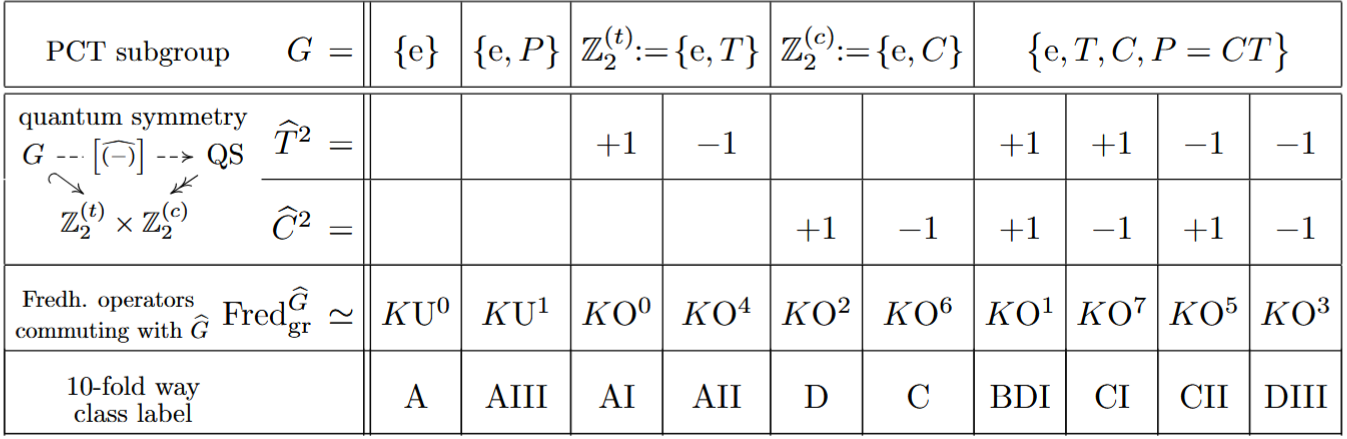
Here the group of “graded quantum symmetries” is the semidirect product
of
- the graded version of the stable projective unitary group PU(ℋ) (with the norm topology)
with
- the group generated by and acting by complex conjugation and in addition by swapping of the two Hilbert space summands, respectively.
Hence a lift of or or to this group is represented by an (anti-)linear operator or or , respectively, and homomorphy of the lift requires that . Asking the graded Fredholm operators to commute with such lifts of subgroups is equivalent, by the above discussion, to one of the ten constrains that lead to the 10 possible classifying spaces for K-theory, as shown in the above table.
Tables of related or analogous structures are well-known in the discussion of the “10-fold way” of topological phases of matter (cf. Schnyder, Ryu, Furusaki & Ludwig 2008 Table 1, Kitaev 2009 Table 1, Freed & Moore 2013 Prop. B.4 & 6.4), which follow the classication of PCT quantum symmetries (see there); the concrete relation to the Atiyah-Jänich theorem as per the above table was made more explicit by Sati & Schreiber 2023 around Table 3.
Examples
Example
For discussion of the basic complex line bundle on the 2-sphere realized as a Fredholm index bundle see there.
References
General
The original articles:
-
Klaus Jänich: Vektorraumbündel und der Raum der Fredholm-Operatoren, Mathematische Annalen 161 (1965) 129–142 [doi:10.1007/BF01360851]
-
Michael Atiyah, Thm. A.1 in: K-theory, Harvard Lecture 1964 (notes by D. W. Anderson), Benjamin (1967) [pdf, pdf]
-
Michael Atiyah, §2 in: Algebraic Topology and Operators in Hilbert Space, in: Lectures in Modern Analysis and Applications I, Lecture Notes in Mathematics 103, Springer (1969) 101-121 [doi:10.1007/BFb0099987, pdf, pdf]
Generalization to general degree and to KO-theory/KSp-theory:
-
Michael F. Atiyah, Isadore M. Singer: Index theory for skew-adjoint Fredholm operators, Publications Mathématiques de l’IHÉS 37 (1969) 5-26 [doi:10.1007/BF02684885, numdam:PMIHES_1969__37__5_0, pdf]
-
Max Karoubi: Espaces Classifiants en K-Théorie, Trans. Amer. Math. Soc. 147 (1970) 75-115 [doi:10.2307/1995218, jstor:1995218, Engl. transl: pdf]
In monographs:
- Max Karoubi, §I.7.10 in: K-Theory – An Introduction, Grundlehren der mathematischen Wissenschaften 226, Springer (1978) [pdf, doi:10.1007%2F978-3-540-79890-3]
(related discussion)
Lecture notes:
As the basis of a definition of twisted K-theory and equivariant K-theory and twisted equivariant K-theory:
- Michael Atiyah, Graeme Segal, Twisted K-theory, Ukrainian Math. Bull. 1 3 (2004) [arXiv:math/0407054, journal page, published pdf]
See also:
- Byungdo Park: The Atiyah-Jänich theorem and its twisted refinement – An introduction to category theory for freshmen, talk notes (2018) [pdf, pdf]
Further development:
- Kamran Sharifi: Atiyah-Jänich theorem for --algebras [arXiv:1612.03287]
In topological quantum physics
Identifying the tachyon field in the argument for D-brane charge quantization in topological K-theory with the Fredholm operator in the Atiyah-Jänich presentation of topological K-theory:
-
Edward Witten, p. 7 in: Overview Of K-Theory Applied To Strings, Int. J. Mod. Phys. A 16 (2001) 693-706 [doi:10.1142/S0217751X01003822, arXiv:hep-th/0007175]
-
Richard Szabo, §3.1 in: D-Branes, Tachyons and K-Homology, Mod. Phys. Lett. A 17 (2002) 2297-2316 [doi:10.1142/S0217732302009015, arXiv:hep-th/0209210]
-
Dongfeng Gao, Kentaro Hori, §8 of: On The Structure Of The Chan-Paton Factors For D-Branes In Type II Orientifolds [arXiv:1004.3972]
Discussion in the context of the 10-fold way of quantum symmetries and the K-theory classification of topological phases of matter:
- Hisham Sati, Urs Schreiber, §2.2 in: Anyonic topological order in TED K-theory, Reviews in Mathematical Physics 35 03 (2023) 2350001 [doi:10.1142/S0129055X23500010, arXiv:2206.13563]
Last revised on November 9, 2025 at 10:14:25. See the history of this page for a list of all contributions to it.