nLab spin bordism
Context
Manifolds and cobordisms
manifolds and cobordisms
cobordism theory, Introduction
Definitions
Genera and invariants
Classification
Theorems
Contents
Idea
A spin bordism is a B-bordism for the tangential structure ((B,f)-structure) being the spin structure. Its bordism homology theory and cobordism cohomology theory are described by the Thom spectrum MSpin.
Definition
Let and be -dimensional spin manifolds with respective spin structures and . A -dimensional spin manifold with spin structure together with inclusions and so that:
with the canonical inclusion is a spin bordism between and . It is fully denoted by , but usually is sufficient from context.
Spin bordism groups
Under the equivalence relation of spin bordism, all -dimensional closed spin manifolds form the spin bordism group , which has the disjoint union as composition, the empty manifold as neutral element and the inversion of orientation as inversion. According to Thom's theorem, spin bordism groups are exactly the stable homotopy groups of the Thom spectrum MSpin:
Since is -connected, the first three spin bordism groups () coincide with the framed bordism groups?:
-
, generated by the point space,
-
,
-
.
Further spin bordism groups include:
-
,
-
, generated by the Kummer surface,
-
,
-
, generated by the quaternionic projective plane and an 8-manifold obtained from the Kummer surface,
-
, which plays a role in the discussion of 11D supergravity (“M-theory”).
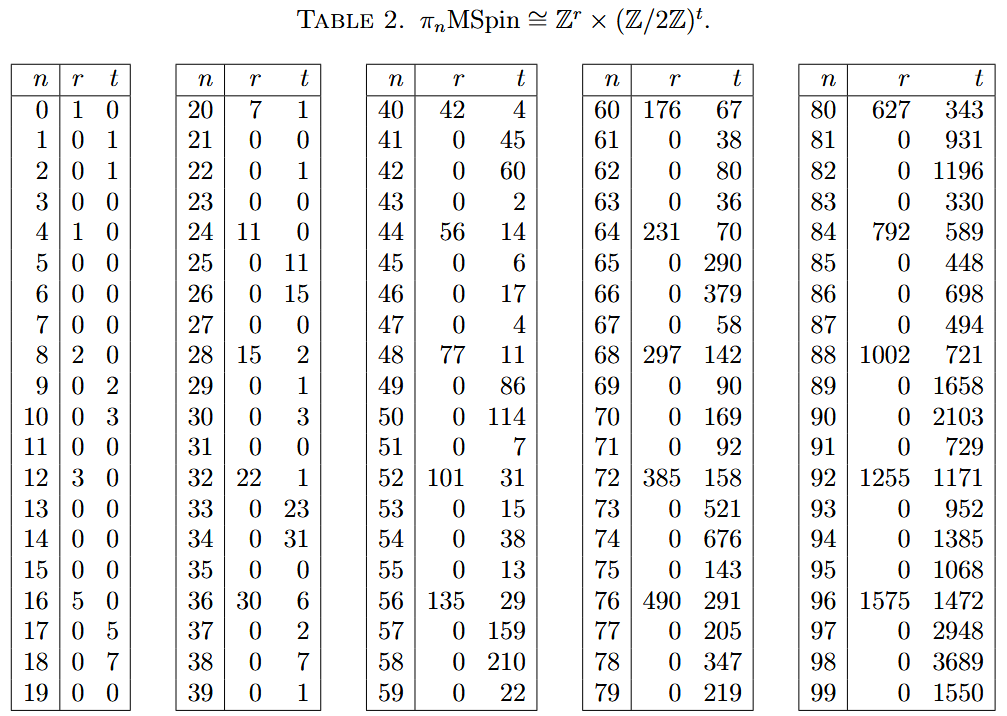
Here is a table of the first 100 spin (co)bordism groups:
Spin bordism ring
All spin bordism groups in a direct sum form the spin bordism ring:
which has the cartesian product as additional composition and the singleton as an additional neutral element.
Properties
Proposition
Every -dimensional spin manifold is spin bordant to a -connected spin manifold, equivalently meaning that every spin bordism homology class in can be represented by such a spin manifold. (For , the result stabilizes at a 3-connected spin manifold.)
(Botvinnik & Labbi 14, Lem. 3.2 (1))
Proposition
For -dimensional -connected spin manifolds and , a spin bordism exists with also -connected.
(Botvinnik & Labbi 14, Lem. 3.2 (2))
Proposition
If a -dimensional -connected compact spin manifold with and is spin bordant to another compact spin manifold , then can be obtained from by surgery of codimension at least .
(Botvinnik & Labbi 14, Prop. 3.4)
Related concepts
flavors of bordism homology theories/cobordism cohomology theories, their representing Thom spectra and cobordism rings:
bordism theoryM(B,f) (B-bordism):
-
MO, MSO, MSpin, MSpinc, MSpinh MString, MFivebrane, M2-Orient, M2-Spin, MNinebrane (see also pin⁻ bordism, pin⁺ bordism, pinᶜ bordism, spin bordism, spinᶜ bordism, spinʰ bordism, string bordism, fivebrane bordism, 2-oriented bordism, 2-spin bordism, ninebrane bordism)
-
equivariant bordism theory: equivariant MFr, equivariant MO, equivariant MU
-
global equivariant bordism theory: global equivariant mO, global equivariant mU
-
algebraic: algebraic cobordism
References
About general bordisms:
-
Boris Botvinnik, Mohammed Labbi, Highly connected manifolds of positive -curvature, Transactions of the AMS, Trans. Amer. Math. Soc. 366 (2014), 3405-3424 [arXiv:1201.1849, doi:10.1090/S0002-9947-2014-05939-4]
-
Jonathan Buchanan, Stephen McKean: KSp-characteristic classes determine Spin cobordism, Algebr. Geom. Topol. 26 (2026) 485-551 [arXiv:2312.08209, doi:10.2140/agt.2026.26.485]
See also:
Last revised on March 18, 2026 at 09:14:28. See the history of this page for a list of all contributions to it.