nLab SU(3)
Context
Group Theory
- group, ∞-group
- group object, group object in an (∞,1)-category
- abelian group, spectrum
- super abelian group
- group action, ∞-action
- representation, ∞-representation
- progroup
- homogeneous space
Classical groups
Finite groups
Group schemes
Topological groups
Lie groups
Super-Lie groups
Higher groups
Cohomology and Extensions
Related concepts
Contents
Idea
The special unitary group in 3 complex dimensions.
Properties
Subgroups and Supgroups
Proposition
We have the following commuting diagram of subgroup inclusions, where each square exhibits a pullback/fiber product, hence an intersection of subgroups:
Here in the bottom row we have the Lie groups
Spin(5) Spin(6) Spin(7) Spin(8)
and in the top row we have
This is a re-statement of Onishchik 93, Table 2, p. 144:
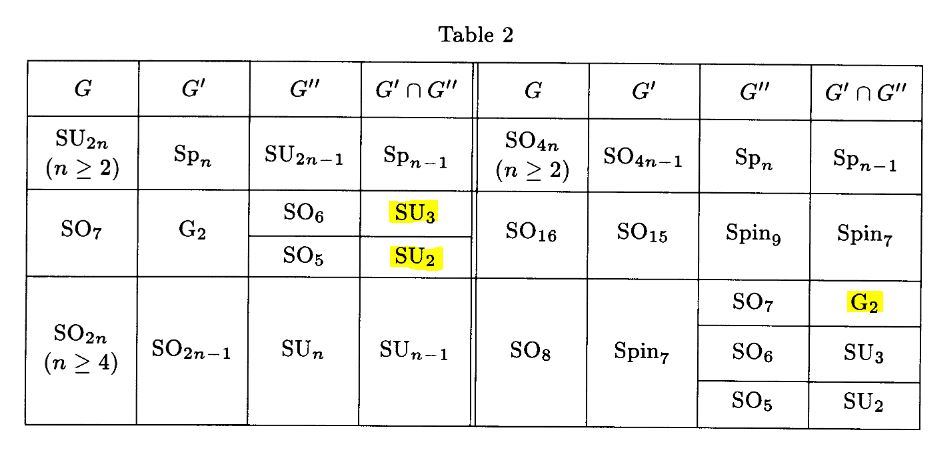
coset space-structures on n-spheres:
| standard: | |
|---|---|
| this Prop. | |
| this Prop. | |
| this Prop. | |
| exceptional: | |
| Spin(7)/G₂ is the 7-sphere | |
| since Spin(6) SU(4) | |
| since Sp(2) is Spin(5) and Sp(1) is SU(2), see Spin(5)/SU(2) is the 7-sphere | |
| G₂/SU(3) is the 6-sphere | |
| Spin(9)/Spin(7) is the 15-sphere |
see also Spin(8)-subgroups and reductions
homotopy fibers of homotopy pullbacks of classifying spaces:
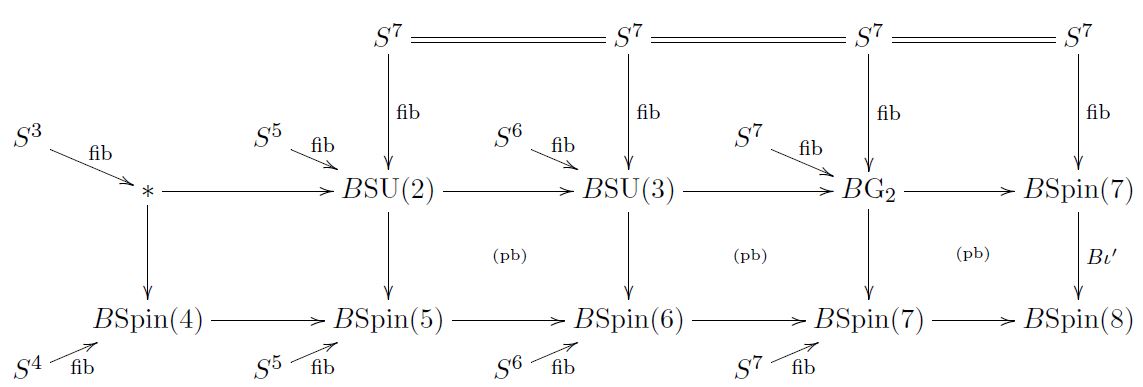
(from FSS 19, 3.4)
-Structure and exceptional geometry
Spin(8)-subgroups and reductions to exceptional geometry
see also: coset space structure on n-spheres
Homotopy groups
Related concepts
References
-
Mamoru Mimura and Hiroshi Toda, Homotopy Groups of SU(3), SU(4) and Sp(2) (1963), Journal of Mathematics of Kyoto University 3 (2), p. 217–250, doi:10.1215/kjm/1250524818
-
A. L. Onishchik (ed.) Lie Groups and Lie Algebras
-
I. A. L. Onishchik, E. B. Vinberg, Foundations of Lie Theory,
-
II. V. V. Gorbatsevich, A. L. Onishchik, Lie Transformation Groups
Encyclopaedia of Mathematical Sciences, Volume 20, Springer 1993
-
-
Howard Georgi, §7 & §9 in: Lie Algebras In Particle Physics, Westview Press (1999), CRC Press (2019) [doi:10.1201/9780429499210]
with an eye towards application to (the standard model of) particle physics
Last revised on November 11, 2025 at 06:28:09. See the history of this page for a list of all contributions to it.