nLab Bloch's theorem
Context
Solid state physics
-
basics
-
Examples
Harmonic analysis
Contents
Idea
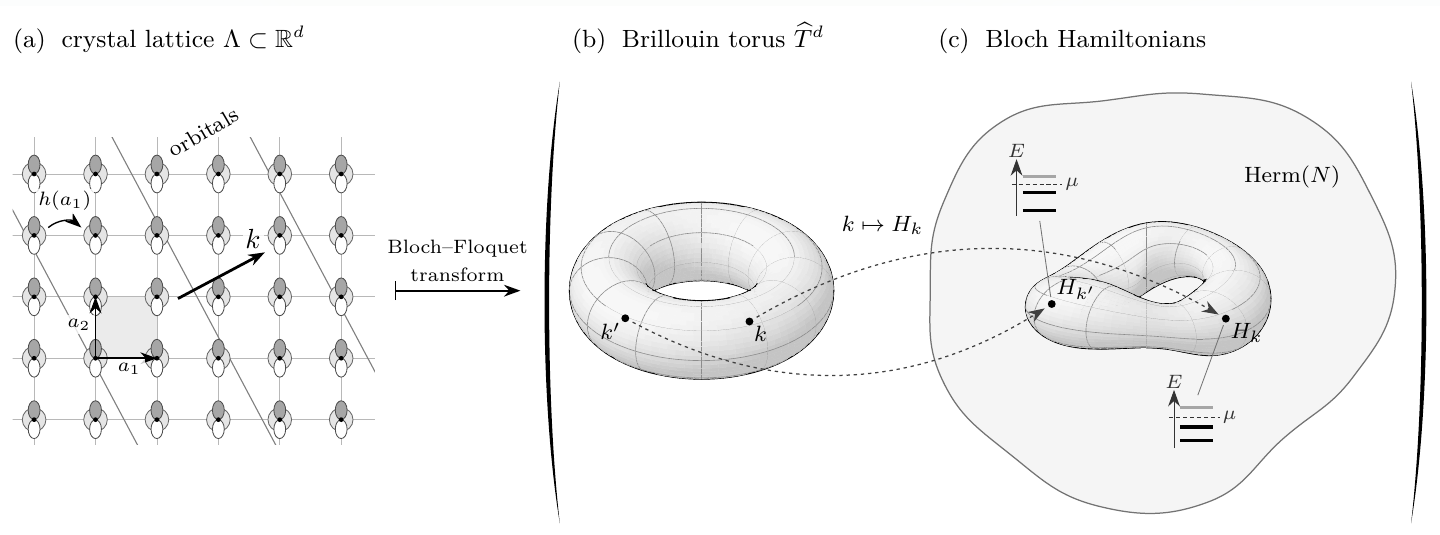
In solid state physics, Bloch’s theorem (Bloch 1929) says that the energy eigenstates of a single electron in a crystal — hence of a Schrödinger operator with periodic potential — may be chosen to be Bloch waves (Bloch states): plane waves modulated by a function which is periodic with respect to the crystal lattice :
The wave vector here is called the crystal momentum or quasi-momentum. Since is itself lattice-periodic when is in the reciprocal lattice (Def. ), the crystal momentum is well-defined only modulo , and hence ranges over a torus: the Brillouin torus.
Conceptually, Bloch’s theorem is an instance of harmonic analysis on the abelian group of lattice translations: Since these commute with the Hamiltonian, the Hilbert space of states decomposes as a direct integral over the irreducible unitary representations of , hence over its characters, which form the Pontrjagin dual group of — this is the Brillouin torus. Accordingly, the Hamiltonian decomposes into a family of Bloch Hamiltonians parametrized by points of the Brillouin torus, whose eigenvalues, as functions of , are the energy bands of electron band theory.
For tight-binding models with orbitals per unit cell (Def. , Rem. ) the Bloch Hamiltonian is simply a map from the Brillouin torus to the space of Hermitian matrices (Prop. ), which is the more regular the more local the hopping is (Prop. ). The condition that the crystal is a band insulator means that these maps take values in the subspace of Hermitian matrices with a spectral gap at the Fermi energy, which is homotopy equivalent to a disjoint union of Grassmannians (Prop. ). Therefore deformation classes of gapped Bloch Hamiltonians are classified by the topological K-theory of the Brillouin torus, which is the starting point of the K-theory classification of topological phases of matter (Rem. ).
The tight-binding case captures the general situation of a Schrödinger operator with periodic potential (Prop. ) restricted to an isolated family of bands, at least whenever the corresponding Bloch bundle over the Brillouin torus is trivializable, as is automatic in the presence of time-reversal symmetry in dimension (Prop. , Prop. , Rem. ).
The analogous statement with spatial t0ranslations replaced by time translations, hence for Hamiltonians periodic in time, is the theorem of Floquet theory (Floquet 1883), which historically predates Bloch’s theorem; hence one also speaks of Bloch-Floquet theory.
Statement
Setup
Definition
(crystal lattice and Brillouin torus)
Let (the spatial dimension, typically ).
-
A crystal lattice is a lattice in -dimensional Euclidean space, hence a discrete subgroup of the form for a linear basis of . A fundamental domain for the action of on is called a unit cell.
-
Its reciprocal lattice is
-
Its Brillouin torus is the Pontrjagin dual group of , hence the group of its characters, which is identified with the quotient group of by the reciprocal lattice:
via . A fundamental domain for this quotient (traditionally the Voronoi cell of ) is called a Brillouin zone.
We write for the Haar measure on normalized to total volume 1, hence for the Lebesgue measure on divided by .
For tight-binding models
Definition
(tight-binding Hamiltonians)
For , a tight-binding Hamiltonian with orbitals per unit cell is a bounded self-adjoint operator on the Hilbert space
which commutes with all lattice translations , .
Equivalently, is a convolution operator
with hopping matrices given by
(the amplitude for an electron to hop from orbital in cell to orbital in cell ), which satisfy .
We say that the hopping is:
-
of finite range if for all but finitely many ;
-
exponentially decaying if for some ;
-
rapidly decaying if is bounded, for all ;
-
summable if .
Remark
(terminology: “tight binding” and “Bloch Hamiltonian”)
-
The term tight binding refers to the original motivation for such models (Bloch 1929, Slater & Koster 1954, see Ashcroft & Mermin 1976, Ch. 10): If the electrons of interest are tightly bound to the atoms (ions) of the crystal, then their wave functions are well approximated by linear combinations of finitely many localized atomic orbitals? (the LCAO method: “linear combination of atomic orbitals”). This means that the single-electron Hilbert space may be truncated to the span of these orbitals, which (after orthonormalization) is if there are relevant orbitals per unit cell. The matrix elements of the Hamiltonian between orbitals in different cells involve the overlap of their wave functions, which decays rapidly with distance; hence the hopping matrices are dominated by small , and are typically truncated to finite range (often to “nearest neighbours”).
-
What this reflects in modern understanding is not so much tight binding as the isolation of a family of bands (typically those near the Fermi energy) from the rest of the spectrum by spectral gaps: In this situation, the band-projected continuum Hamiltonian is exactly (not just approximately) unitarily equivalent to a tight-binding Hamiltonian with exponentially decaying hopping, provided that the corresponding Bloch bundle is trivializable, in which case the role of the “orbitals” is played by exponentially localized Wannier functions (Prop. below). In this sense, “tight-binding model” is used today essentially synonymously with “lattice model with finitely many degrees of freedom per unit cell”, irrespective of how tightly the electrons are actually bound.
-
Accordingly, the term Bloch Hamiltonian for the operators (Def. below, and similarly for the fiber operators in Prop. ) reflects that these are what remains of the Hamiltonian after diagonalizing the lattice translation symmetry, following Bloch: one Hamiltonian for each value of the crystal momentum, acting only on the internal (orbital, or intra-cell) degrees of freedom.
Proposition
(Bloch’s theorem for tight-binding models)
Given a tight-binding Hamiltonian (Def. ), the Fourier transform
is a unitary operator which transforms into the operator of multiplication by the matrix-valued function
in that
(For non-summable hopping the sum defining is understood as an -limit, so that is an essentially bounded measurable function.)
If the hopping is summable, then furthermore:
-
(Bloch waves) For every and every eigenvector of with eigenvalue , the bounded function
is a generalized eigenvector of , , and is quasi-periodic: .
-
(band structure) is continuous, and so are its ordered eigenvalues , the band functions. The spectrum of is the union of the energy bands:
which is a union of at most closed intervals.
Proof
Unitarity of is the Plancherel theorem? for the Pontrjagin duality between and , and the transformation of is the convolution theorem. Self-adjointness follows from .
For the Bloch waves, compute:
For summable hopping, is a uniform limit of continuous functions, hence continuous, and continuity of the ordered eigenvalues follows by Weyl’s inequality . Finally, the spectrum of a multiplication operator by a continuous function on a compact space is the union of the pointwise spectra.
Definition
(Bloch Hamiltonian)
The function in Prop. is called the Bloch Hamiltonian of the tight-binding Hamiltonian .
Conversely, the hopping matrices are recovered from the Bloch Hamiltonian as its Fourier coefficients
so that tight-binding Hamiltonians are in bijection with (essentially bounded, measurable) Bloch Hamiltonians.
Proposition
(locality of hopping is regularity of the Bloch Hamiltonian)
Under the bijection of Def. , the hopping (Def. ) is:
-
of finite range the Bloch Hamiltonian is a trigonometric polynomial (in particular real analytic);
-
exponentially decaying the Bloch Hamiltonian is real analytic (and then it extends holomorphically to a strip );
-
rapidly decaying the Bloch Hamiltonian is smooth;
-
summable the Bloch Hamiltonian is continuous.
Proof
These are standard facts about Fourier series on the torus : smoothness corresponds to rapid decay of Fourier coefficients via integration by parts; and real analyticity corresponds to exponential decay via the holomorphic extension of the Fourier series to a complex strip and shifting the integration contour in the formula for (Def. ) into that strip.
In practice, physically admissible Bloch Hamiltonians are thus real-analytic, if not trigonometric polynomials. For deformation-theoretic questions, however, this regularity is immaterial (Prop. below).
Remark
(periodic vs. non-periodic convention)
If the orbital sits at position within the unit cell, part of the physics literature uses instead of (Prop. ) the matrices
which have the same spectrum but are not periodic in (see Bena & Montambaux 2009 for discussion in the example of graphene): instead for .
So is not a function on the Brillouin torus but a section of a (here: trivialized) bundle of matrix algebras over it. Only the periodic convention of Prop. exhibits the Bloch Hamiltonian as a map out of the Brillouin torus. The same issue reappears for continuum models in Rem. below.
Gapped Bloch Hamiltonians
Definition
(gapped Bloch Hamiltonians)
For (the Fermi energy) and write
for the open subspace of Hermitian matrices with a spectral gap at , decomposed according to the number of eigenvalues below (counted with multiplicity).
A continuous Bloch Hamiltonian (Def. ) is gapped at if it takes values in , hence, by connectedness of , in for a fixed . In this case is the number of valence bands (filled bands) and the number of conduction bands.
By compactness of and Prop. , is gapped at iff , i.e. iff the crystal is a band insulator at Fermi energy .
Proposition
(space of gapped Hamiltonians is a union of Grassmannians)
The map
which sends a gapped Hermitian matrix to the image of its spectral projection? onto the eigenvalues below , regarded as a point in the Grassmannian , is a homotopy equivalence. In fact it exhibits a deformation retraction onto the subspace of flattened Hamiltonians , via the homotopy
Accordingly, a gapped Bloch Hamiltonian is, up to homotopy, equivalently a map , hence a rank subbundle of the trivial vector bundle : the valence bundle with fibers .
Proof
Since the spectrum of stays away from under small perturbations, the spectral projection is given locally by the Riesz projection formula
for a fixed contour enclosing the eigenvalues below , and is hence continuous (even real analytic) in . The matrix commutes with and has eigenvalues for each eigenvalue (resp. ) of , which remain on the same side of for all . Hence , with and with the flattened Hamiltonian corresponding to , which is fixed throughout if is already flat.
Proposition
(regularity is immaterial for deformation classes)
-
Every continuous gapped Bloch Hamiltonian is homotopic, through gapped Bloch Hamiltonians, to one that is a trigonometric polynomial (hence comes from finite-range hopping, Prop. ).
-
If two trigonometric-polynomial gapped Bloch Hamiltonians are continuously homotopic through gapped Bloch Hamiltonians, then they are so through trigonometric-polynomial gapped Bloch Hamiltonians.
Hence (with Prop. ) the deformation classes of gapped tight-binding Hamiltonians — whether of finite-range, exponentially decaying, rapidly decaying or just summable hopping — are the homotopy classes of maps
Proof
Since is open, every compact subset has positive distance from its complement; so any two maps into at uniform distance are connected by the straight-line homotopy within . Now the Fejér means (convolution with the -fold product of Fejér kernels) of a continuous function on are trigonometric polynomials, preserve Hermiticity, and converge uniformly; and for a homotopy they do so uniformly also in the homotopy parameter, by equicontinuity. Applying this to a given map or homotopy, and then joining endpoints by straight-line homotopies (which preserve the property of being a trigonometric polynomial) yields the claim.
Remark
(K-theory classification and symmetries)
-
By Prop. , the deformation class of a gapped Bloch Hamiltonian determines the isomorphism class of its valence bundle. Allowing to add further bands far below or above (“stable equivalence”), hence passing to the limit , the classifying space becomes and stable deformation classes of gapped Bloch Hamiltonians are classified by the topological K-theory of the Brillouin torus:
This is the case of “class A” in the K-theory classification of topological phases of matter (Kitaev 2009, Freed & Moore 2013, Thiang 2016).
-
For , complex vector bundles over are classified by their rank and their first Chern class . For this is a single integer, the Chern number, which is proportional to the quantized Hall conductance of the insulator (TKNN 1982). Insulators with non-vanishing Chern number are called Chern insulators.
-
In the presence of further symmetries the Bloch Hamiltonian is constrained to be equivariant. For example, an anti-unitary time-reversal symmetry (with complex conjugation) requires , so that becomes equivariant with respect to the involution on the Brillouin torus. Accordingly, deformation classes are then classified by variants of KR-theory, giving the “tenfold way” (Kitaev 2009, Chiu, Teo, Schnyder & Ryu 2016), and, in the presence of crystallographic point group symmetries, by twisted equivariant K-theory (Freed & Moore 2013, Thiang 2016).
For Schrödinger operators with periodic potential
Proposition
(Bloch-Floquet decomposition)
Let be a -periodic potential, for , which is bounded (or more generally suitably locally integrable, see Reed & Simon 1978, §XIII.16), and consider the Schrödinger operator
on . Then:
-
The Bloch-Floquet transform (also: Zak transform), given on Schwartz functions by
produces functions which are -periodic in and satisfy for . It extends to a unitary operator onto a direct integral of Hilbert spaces
with inverse .
-
This transform decomposes into fiber operators:
where acts on (i.e. with periodic boundary conditions on the unit cell), being self-adjoint on the Sobolev space .
-
Each is bounded below and has compact resolvent, hence purely discrete spectrum (eigenvalues ordered and counted with multiplicity).
-
The family extends to an entire analytic family of type (A) (in the sense of Kato) on , and satisfies
Hence the band functions are continuous and -periodic, thus descend to continuous functions on the Brillouin torus (and they are real analytic wherever is a simple eigenvalue).
-
The spectrum of is the union of the energy bands:
a union of closed intervals, possibly separated by band gaps.
See Reed & Simon 1978, §XIII.16 and Kuchment 2016. Moreover, under mild conditions on , the spectrum of is purely absolutely continuous, i.e. there are no flat bands (Thomas 1973, see Kuchment 2016 for the general situation).
Corollary
(Bloch’s theorem)
In the situation of Prop. , for every and , let be an eigenfunction of for the eigenvalue . Then the Bloch wave
is a generalized eigenfunction of ,
and every is a superposition of Bloch waves:
Remark
(twisted periodicity)
In contrast to the tight-binding case (Prop. ), the fiber operators in Prop. are not periodic in , but only up to unitary conjugation by . One may instead use the functions , which are -periodic in , but these are quasi-periodic in , so that the fiber Hilbert spaces now depend on . Either way, decomposes not into a function on the Brillouin torus but into a section of an operator bundle over the Brillouin torus. (This is the continuum analog of Rem. .)
A function on the Brillouin torus is obtained only after choosing a trivialization, which for isolated families of bands is the content of the following.
Definition
(isolated bands and Bloch bundle)
In the situation of Prop. , a family of consecutive bands is called isolated if for all we have (if ) and ; by compactness of the corresponding gaps are then bounded away from zero. In this case the spectral projections
(for a contour enclosing exactly , which may be held fixed locally in ) form a real analytic family of rank projections with .
The Bloch bundle of the isolated family is the resulting rank real analytic Hermitian vector bundle over the Brillouin torus:
Proposition
(triviality of Bloch bundles)
If and is time-reversal symmetric (as is the case for as in Prop. , with real potential and no magnetic field), then the Bloch bundle (Def. ) of every isolated family of bands is trivializable, even real-analytically.
This is due to Panati 2007, building on Nenciu 1983, see also Brouder et al. 2007. The idea is that time-reversal symmetry implies , hence , while for the first Chern class is the only obstruction to triviality (cf. Rem. ).
Proposition
(isolated bands are tight-binding models)
Given an isolated family of bands (Def. ) with real-analytically trivializable Bloch bundle, choose a real-analytic orthonormal frame, i.e. real-analytic maps such that is an orthonormal basis of and . Then:
-
The matrices
are -periodic in and hence constitute a real-analytic Bloch Hamiltonian
-
for and , form an orthonormal basis of the band subspace , where . They are lattice translates of each other, , and are exponentially localized.
-
The unitary isomorphism
identifies the band-projected Hamiltonian with the tight-binding Hamiltonian (Def. ) whose Bloch Hamiltonian is , hence with exponentially decaying hopping matrices
Proof
Periodicity of follows since is unitary and intertwines with (Prop. ). From (with ) one gets and
and similarly for the matrix elements of . Exponential localization of the follows from real analyticity of the frame as in Prop. .
Remark
(Bloch Hamiltonians of electrons in crystals)
In summary, the Hamiltonian of a single electron in a crystal, restricted to any isolated family of bands with trivializable Bloch bundle — such as any isolated family of bands in a time-reversal symmetric crystal in (Prop. ) — is equivalently a real-analytic Bloch Hamiltonian
(Prop. ), unique up to “gauge transformations” by real-analytic , corresponding to the choice of frame (which do not change the isomorphism class of the valence bundle). If the Fermi energy lies in a gap within this family of bands, then takes values in the space of gapped Hamiltonians (Prop. ), and its deformation class, which may be represented by finite-range hopping (Prop. ), is classified by topological K-theory (Rem. ).
On the other hand, if the Bloch bundle of the family of bands under consideration is non-trivial (which requires broken time-reversal symmetry if , e.g. by magnetic fields), then this family admits no basis of exponentially localized Wannier functions (Brouder et al. 2007). But a larger isolated family containing it (e.g. valence and conduction bands together) may have trivial Bloch bundle, in which case the original family appears as a non-trivial valence bundle of a tight-binding model as above. This is how Chern insulators are realized by tight-binding models.
Wannier functions
The functions in Prop. are called Wannier functions (Wannier 1937). Under the Bloch-Floquet transform, they are dual to frames of the Bloch bundle, and their spatial localization is dual to the regularity of the frame in : Wannier functions are exponentially localized iff the frame is real analytic (Prop. ). The existence of exponentially localized Wannier functions was established by Kohn 1959 for , by des Cloizeaux 1964 and Nenciu 1983 for single isolated bands, and by Brouder et al. 2007 and Panati 2007 for composite families of bands (in , under time-reversal symmetry).
Since the frame is unique only up to gauge transformations , so are the Wannier functions, and choosing them “maximally localized” is a standard problem in computational solid state physics (Marzari & Vanderbilt 1997, Marzari et al. 2012).
Variants and generalizations
-
Time-periodic Hamiltonians. The analog of Bloch theory for Hamiltonians periodic in time is Floquet theory (Floquet 1883).
-
Magnetic fields. In the presence of a uniform magnetic field the lattice translations commute with the Hamiltonian only up to phases, i.e. they form a projective representation of , the magnetic translations (Zak 1964). For rational magnetic flux per unit cell, Bloch theory applies to a correspondingly enlarged magnetic unit cell. For effective Hamiltonians of Bloch electrons in electric and magnetic fields see Kohn 1959, Wannier 1960, Panati, Spohn & Teufel 2003.
-
Hyperbolic lattices. For lattices in hyperbolic space the translation group is a non-abelian Fuchsian group. Its 1-dimensional unitary representations form a torus of dimension (with the genus of the compactified unit cell), on which an abelian Bloch theory applies, while the higher-dimensional representations lead to “non-abelian Bloch states” (Maciejko & Rayan 2021, 2022, Attar & Boettcher 2022).
-
Interacting electrons. For multi-electron systems the simultaneous translation of all electrons by lattice vectors still commutes with the Hamiltonian, so that many-body eigenstates may be labeled by their total crystal momentum (see the references below).
Related concepts
References
Original articles
The analogous theorem for ordinary differential equations with time-periodic coefficients:
- Gaston Floquet: Sur les équations différentielles linéaires à coefficients périodiques, Annales scientifiques de l’École Normale Supérieure, Série 2, 12 (1883) 47-88 [doi:10.24033/asens.220]
The original article on Bloch’s theorem, including the tight-binding approximation:
- Felix Bloch: Über die Quantenmechanik der Elektronen in Kristallgittern, Zeitschrift für Physik 52 7-8 (1929) 555-600 [doi:10.1007/BF01339455]
Introducing Brillouin zones:
- Léon Brillouin: Les électrons libres dans les métaux et le role des réflexions de Bragg, J. Phys. Radium 1 (1930) 377-400 [doi:10.1051/jphysrad:01930001011037700]
Textbook accounts
-
Neil W. Ashcroft, N. David Mermin: Ch. 8 (and Ch. 10 for the tight-binding method) of: Solid State Physics, Holt, Rinehart and Winston (1976)
-
Charles Kittel: Ch. 7 of: Introduction to Solid State Physics, Wiley (8th ed. 2005)
-
Sheng San Li: Section 4.3 of: Semiconductor Physical Electronics, Springer (2006) [doi:10.1007/0-387-37766-2_4]
-
David Vanderbilt: Ch. 2 of: Berry Phases in Electronic Structure Theory – Electric Polarization, Orbital Magnetization and Topological Insulators, Cambridge University Press (2018) [doi:10.1017/9781316662205]
-
Michael Reed, Barry Simon: Sec. XIII.16 Schrödinger operators with periodic potentials, of: Methods of Modern Mathematical Physics – IV: Analysis of Operators, Academic Press (1978) [ISBN:9780080570457, §XIII.16: pdf]
-
M. S. P. Eastham: The Spectral Theory of Periodic Differential Equations, Scottish Academic Press (1973)
-
Peter Kuchment: Floquet Theory for Partial Differential Equations, Operator Theory: Advances and Applications 60, Birkhäuser (1993) [doi:10.1007/978-3-0348-8573-7]
-
Peter Kuchment: An overview of periodic elliptic operators, Bull. Amer. Math. Soc. 53 (2016) 343-414 [arXiv:1510.00971, doi:10.1090/bull/1528]
On absolute continuity of the spectrum:
- Lawrence E. Thomas: Time dependent approach to scattering from impurities in a crystal, Commun. Math. Phys. 33 (1973) 335-343 [doi:10.1007/BF01646745]
See also:
-
Wikipedia: Bloch’s theorem
-
Wikipedia: Crystal momentum
-
Wikipedia: Tight binding
Tight-binding models
Besides Bloch 1929 and Ashcroft & Mermin 1976, Ch. 10:
- John C. Slater, George F. Koster: Simplified LCAO Method for the Periodic Potential Problem, Phys. Rev. 94 (1954) 1498 [doi:10.1103/PhysRev.94.1498]
On the periodic vs. non-periodic convention for Bloch Hamiltonians (Rem. ):
- Cristina Bena, Gilles Montambaux: Remarks on the tight-binding model of graphene, New J. Phys. 11 (2009) 095003 [arXiv:0712.0765, doi:10.1088/1367-2630/11/9/095003]
Analyticity and the Bloch bundle
On analytic dependence of Bloch waves on the crystal momentum, triviality of the Bloch bundle and existence of exponentially localized Wannier functions:
-
Walter Kohn?: Analytic Properties of Bloch Waves and Wannier Functions, Phys. Rev. 115 (1959) 809 [doi:10.1103/PhysRev.115.809]
-
Jacques des Cloizeaux: Energy Bands and Projection Operators in a Crystal: Analytic and Asymptotic Properties, Phys. Rev. 135 (1964) A685 [doi:10.1103/PhysRev.135.A685]
-
Jacques des Cloizeaux: Analytical Properties of n-Dimensional Energy Bands and Wannier Functions, Phys. Rev. 135 (1964) A698 [doi:10.1103/PhysRev.135.A698]
-
Gheorghe Nenciu: Existence of the exponentially localised Wannier functions, Commun. Math. Phys. 91 (1983) 81-85 [doi:10.1007/BF01206052]
-
Gianluca Panati: Triviality of Bloch and Bloch-Dirac bundles, Ann. Henri Poincaré 8 (2007) 995-1011 [arXiv:math-ph/0601034, doi:10.1007/s00023-007-0326-8]
-
Christian Brouder, Gianluca Panati, Matteo Calandra, Christophe Mourougane, Nicola Marzari: Exponential localization of Wannier functions in insulators, Phys. Rev. Lett. 98 (2007) 046402 [arXiv:cond-mat/0606726, doi:10.1103/PhysRevLett.98.046402]
Effective dynamics of Bloch electrons
-
Walter Kohn?: Theory of Bloch Electrons in a Magnetic Field: The Effective Hamiltonian, Phys. Rev. 115 (1959) 1460 [doi:10.1103/PhysRev.115.1460]
-
Gregory H. Wannier: Wave Functions and Effective Hamiltonian for Bloch Electrons in an Electric Field, Phys. Rev. 117 (1960) 432 [doi:10.1103/PhysRev.117.432]
-
Joshua Zak: Magnetic Translation Group, Phys. Rev. 134 (1964) A1602 [doi:10.1103/PhysRev.134.A1602]
-
Gianluca Panati, Herbert Spohn, Stefan Teufel: Effective dynamics for Bloch electrons: Peierls substitution and beyond, Commun. Math. Phys. 242 (2003) 547-578 [arXiv:math-ph/0212041, doi:10.1007/s00220-003-0950-1]
Bloch Hamiltonians and topological phases
On Bloch Hamiltonians in the context of topological phases of matter (see also at K-theory classification of topological phases of matter):
-
David J. Thouless?, Mahito Kohmoto, M. P. Nightingale, M. den Nijs: Quantized Hall Conductance in a Two-Dimensional Periodic Potential, Phys. Rev. Lett. 49 (1982) 405 [doi:10.1103/PhysRevLett.49.405]
-
Alexei Kitaev: Periodic table for topological insulators and superconductors, AIP Conf. Proc. 1134 (2009) 22-30 [arXiv:0901.2686, doi:10.1063/1.3149495]
-
Daniel Freed, Gregory Moore: Twisted equivariant matter, Ann. Henri Poincaré 14 (2013) 1927-2023 [arXiv:1208.5055, doi:10.1007/s00023-013-0236-x]
-
B. Andrei Bernevig, Taylor L. Hughes: Topological Insulators and Topological Superconductors, Princeton University Press (2013) [doi:10.1515/9781400846733]
-
Guo Chuan Thiang: On the K-theoretic classification of topological phases of matter, Ann. Henri Poincaré 17 (2016) 757-794 [arXiv:1406.7366, doi:10.1007/s00023-015-0418-9]
-
Ching-Kai Chiu, Jeffrey C. Y. Teo, Andreas P. Schnyder, Shinsei Ryu: Classification of topological quantum matter with symmetries, Rev. Mod. Phys. 88 (2016) 035005 [arXiv:1505.03535, doi:10.1103/RevModPhys.88.035005]
-
Jérôme Cayssol, Jean-Noël Fuchs: Section IV.B of: Topological and geometrical aspects of band theory, J. Phys. Mater. 4 (2021) 034007 [arXiv:2012.11941, doi:10.1088/2515-7639/abf0b5]
-
Alexander S. Sergeev: Section 5.1.3 in: Topological insulators and geometry of vector bundles, SciPost Physics Lecture Notes 67 (2023) [arXiv:2011.05004, doi:10.21468/SciPostPhysLectNotes.67]
-
Hisham Sati, Urs Schreiber: Anyonic topological order in twisted equivariant differential (TED) K-theory, Rev. Math. Phys. 35 (2023) 2350001 [arXiv:2206.13563, doi:10.1142/S0129055X23500010]
Generalizations
Further discussion
- E. Dobardžić, M. Dimitrijević, M. V. Milovanović: Generalized Bloch theorem and topological characterization, Phys. Rev. B 91 (2015) 125424 [arXiv:1411.4920, doi:10.1103/PhysRevB.91.125424]
For hyperbolic lattices
Variant for lattices in hyperbolic spaces:
-
Joseph Maciejko, Steven Rayan: Hyperbolic band theory, Science Advances 7 36 (2021) eabe9170 [arXiv:2008.05489, doi:10.1126/sciadv.abe9170]
-
Joseph Maciejko, Steven Rayan: Automorphic Bloch theorems for hyperbolic lattices, Proc. Natl. Acad. Sci. 119 9 (2022) e2116869119 [arXiv:2108.09314, doi:10.1073/pnas.2116869119]
-
Adil Attar, Igor Boettcher: Selberg trace formula in hyperbolic band theory, Phys. Rev. E 106 (2022) 034114 [arXiv:2201.06587, doi:10.1103/PhysRevE.106.034114]
For interacting electrons
-
Yuejin Guo, Jean-Marc Langlois, William A. Goddard: Electronic Structure and Valence-Bond Band Structure of Cuprate Superconducting Materials, Science 239 4842 (1988) 896-899 [doi:10.1126/science.239.4842.896, jstor:1700316]
-
Jingsan Hu, Jianfei Gu, Weiyi Zhang: Bloch’s band structures of a pair of interacting electrons in simple one- and two-dimensional lattices, Physics Letters A 414 (2021) 127634 [doi:10.1016/j.physleta.2021.127634]
Wannier functions
The original article:
- Gregory H. Wannier: The Structure of Electronic Excitation Levels in Insulating Crystals, Phys. Rev. 52 (1937) 191 [doi:10.1103/PhysRev.52.191]
On their exponential localization see the references above.
On maximally localized Wannier functions:
-
Nicola Marzari, David Vanderbilt: Maximally-localized generalized Wannier functions for composite energy bands, Phys. Rev. B 56 (1997) 12847 [arXiv:cond-mat/9707145, doi:10.1103/PhysRevB.56.12847]
-
Nicola Marzari, Arash A. Mostofi, Jonathan R. Yates, Ivo Souza, David Vanderbilt: Maximally localized Wannier functions: Theory and applications, Rev. Mod. Phys. 84 (2012) 1419 [arXiv:1112.5411, doi:10.1103/RevModPhys.84.1419]
In the context of fractional Chern insulators exhibiting a fractional quantum anomalous Hall effect:
-
Xiao-Liang Qi: Generic Wavefunction Description of Fractional Quantum Anomalous Hall States and Fractional Topological Insulators, Phys. Rev. Lett. 107 (2011) 126803 [arXiv:1105.4298, doi:10.1103/PhysRevLett.107.126803]
-
Maissam Barkeshli, Xiao-Liang Qi: Topological Nematic States and Non-Abelian Lattice Dislocations, Phys. Rev. X 2 (2012) 031013 [arXiv:1112.3311, doi:10.1103/PhysRevX.2.031013]
-
Chao-Ming Jian, Xiao-Liang Qi: Crystal-symmetry preserving Wannier states for fractional Chern insulators, Phys. Rev. B 88 (2013) 165134 [arXiv:1303.1787, doi:10.1103/PhysRevB.88.165134]
Last revised on November 15, 2026 at 15:30:54. See the history of this page for a list of all contributions to it.