nLab first stable homotopy group of spheres
Context
Stable Homotopy theory
Ingredients
Contents
Cobordism theory
cobordism theory = manifolds and cobordisms + stable homotopy theory/higher category theory
Concepts of cobordism theory
-
homotopy classes of maps to Thom space MO
-
complex cobordism cohomology theory
flavors of bordism homology theories/cobordism cohomology theories, their representing Thom spectra and cobordism rings:
bordism theoryM(B,f) (B-bordism):
-
MO, MSO, MSpin, MSpinc, MSpinh MString, MFivebrane, M2-Orient, M2-Spin, MNinebrane (see also pin⁻ bordism, pin⁺ bordism, pinᶜ bordism, spin bordism, spinᶜ bordism, spinʰ bordism, string bordism, fivebrane bordism, 2-oriented bordism, 2-spin bordism, ninebrane bordism)
-
equivariant bordism theory: equivariant MFr, equivariant MO, equivariant MU
-
global equivariant bordism theory: global equivariant mO, global equivariant mU
-
algebraic: algebraic cobordism
Contents
Idea
The first stable homotopy group of spheres (the first stable stem) is the cyclic group of order 2:
where the generator is represented by the complex Hopf fibration (cf. Prop. below).
Properties
Generator
Proposition
A generator of , is represented by the suspension of the complex Hopf fibration.
Proof
Assuming we know the relevant homotopy groups of spheres, and that generates , then (the boundary case of) the Freudenthal suspension theorem implies that
is surjective, hence that the generator is sent to a generator .
As the first framed bordism group
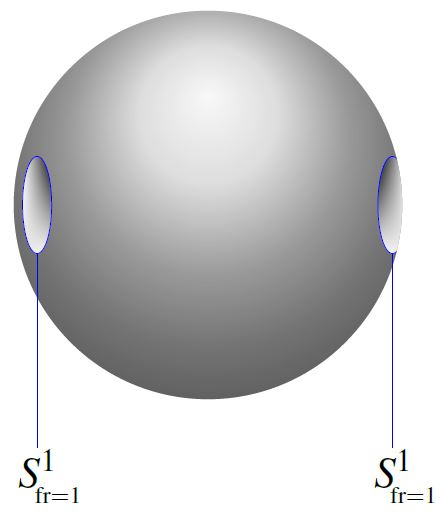
Under the Pontrjagin-Thom isomorphism, identifying the stable homotopy groups of spheres with the bordism ring of stably framed manifolds (see at MFr), the generator (1) is represented by the 1-sphere (with its left-invariant framing induced from the identification with the Lie group U(1))
Moreover, the relation is represented by the bordism which is the complement of 2 open balls inside the 2-sphere.
Related concepts
References
The original computation via Pontryagin's theorem in cobordism theory:
- Lev Pontrjagin, Classification of continuous maps of a complex into a sphere, Communication I, Doklady Akademii Nauk SSSR 19(3) (1938), 147-149
with a more comprehensive account in:
- Lev Pontrjagin, Section 14 of: Smooth manifolds and their applications in homotopy theory, Trudy Mat. Inst. im Steklov, No 45, Izdat. Akad. Nauk. USSR, Moscow, 1955 (AMS Translation Series 2, Vol. 11, 1959) (doi:10.1142/9789812772107_0001)
Early comprehensive discussion:
- Hirosi Toda; p. 186 of: Composition Methods in Homotopy Groups of Spheres, Annals of Mathematics Studies 49, Princeton University Press (1962) [doi:10.1515/9781400882625, jstor:j.ctt1bgzb5t]
See also:
- Mehmet Kirdar, On the First, the Second and the Third Stems of the Stable Homotopy Groups of Spheres [arXiv:2107.06103]
Review:
-
Daniel Freed, Karen Uhlenbeck, Appendix B of: Instantons and Four-Manifolds, Mathematical Sciences Research Institute Publications, Springer 1991 (doi:10.1007/978-1-4613-9703-8)
-
Guozhen Wang, Zhouli Xu, Section 2.3 of: A survey of computations of homotopy groups of Spheres and Cobordisms, 2010 (pdf)
-
Andrew Putman, Section 5 of: Homotopy groups of spheres and low-dimensional topology (pdf, pdf)
Discussion in homotopy type theory:
and on the implementation of the computation in cubical Agda:
-
Axel Ljungström, The Brunerie Number Is -2 (June 2022) [blog entry]
-
Anders Mörtberg: Computational Proofs in Synthetic Homotopy Theory, talk at Running HoTT 2024, CQTS@NYUAD (April 2024) [video:kt]
-
András Kovács: Efficient Evaluation for Cubical Type Theories, talk at Running HoTT 2024, CQTS@NYUAD (April 2024) [video:kt, slides:pdf]
Last revised on August 11, 2026 at 10:58:54. See the history of this page for a list of all contributions to it.