nLab third stable homotopy group of spheres
Context
Stable Homotopy theory
Ingredients
Contents
Cobordism theory
cobordism theory = manifolds and cobordisms + stable homotopy theory/higher category theory
Concepts of cobordism theory
-
homotopy classes of maps to Thom space MO
-
complex cobordism cohomology theory
flavors of bordism homology theories/cobordism cohomology theories, their representing Thom spectra and cobordism rings:
bordism theoryM(B,f) (B-bordism):
-
MO, MSO, MSpin, MSpinc, MSpinh MString, MFivebrane, M2-Orient, M2-Spin, MNinebrane (see also pin⁻ bordism, pin⁺ bordism, pinᶜ bordism, spin bordism, spinᶜ bordism, spinʰ bordism, string bordism, fivebrane bordism, 2-oriented bordism, 2-spin bordism, ninebrane bordism)
-
equivariant bordism theory: equivariant MFr, equivariant MO, equivariant MU
-
global equivariant bordism theory: global equivariant mO, global equivariant mU
-
algebraic: algebraic cobordism
Contents
Idea
The third stable homotopy group of spheres (the third stable stem) is the cyclic group of order 24 (cf. Toda 1961 p. 186):
where the generator is represented by (the suspensions of) the quaternionic Hopf fibration (cf. Prop. below).
Properties
Generator
Proposition
A generator of , is represented by the suspension of the quaternionic Hopf fibration.
Proof
From Toda 1962 p. 186 we know that . With this, Adams 1966 Thm. 1.5 implies that the J-homomorphism is surjective onto . (Use here that, in Adams’s notation, , and then that the Bernoulli number so that .) Finally, Adams 1966 §10 observes (stated more explicitly in Ravenel 2004 Thm. 1.13), that the image of the J-homomorphism in degree 3 is generated by the (suspensions of) the quaternionic Hopf fibration.
See also Kirdar 2021 §4.
As the third framed bordism group
Under the Pontrjagin-Thom isomorphism, identifying the stable homotopy groups of spheres with the bordism ring of stably framed manifolds (see at MFr), the generator (1) is represented by the 3-sphere (with its left-invariant framing induced from the identification with the Lie group SU(2) Sp(1) )
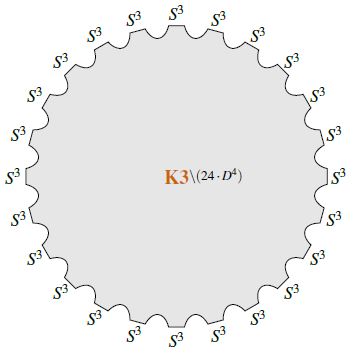
Moreover, the relation is represented by the bordism which is the complement of 24 open balls inside the K3-manifold (e.g. Wang-Xu 10, Sec. 2.6, Bauer 10, SP 17).
Via the fourth -bordism group
Equivalently, the elements of are detected by half the Todd classes of cobounding manifolds with special unitary group-tangential structure on their stable tangent bundle (elements of the MSUFr-bordism ring):
We have the following short exact sequence of the MSU-, MSUFr- and MFr-bordism rings (Conner-Floyd 66, p. 104)
which produces from half the Todd class of cobounding -manifolds the KO-theoretic Adams e-invariant (Adams 66, p. 39) of the boundary manifold in . For this detects the third stable homotopy group of spheres, by the following:
Proposition
(Adams 66, Example 7.17 and p. 46)
In degree 3, the KO-theoretic e-invariant takes the value on the quaternionic Hopf fibration and hence reflects the full third stable homotopy group of spheres:
while sees only “half” of it (by Adams 66, Prop. 7.14).
Related concepts
References
The original computation:
- Vladimir Abramovich Rokhlin, On a mapping of the -dimensional sphere into the -dimensional sphere, (Russian) Doklady Akad. Nauk SSSR (N.S.) 80, (1951). 541–544
with a mistake (in the unstable range) corrected in
- Vladimir Abramovich Rokhlin, New results in the theory of four-dimensional manifolds, (Russian) Doklady Akad. Nauk SSSR (N.S.) 84, (1952). 221–224.
French translation:
- Lucien Guillou, Alexis Marin (eds.): A la Recherche de la Topologie Perdue: I. Du côté de chez Rohlin. II. Le côté de Casson, Progress in Mathematics 62, Birkhäuser Boston (1985) [ISBN:0817633294, 9780817633295]
Further early discussion, as part of a comprehensive analysis:
- Hirosi Toda; p. 186 of: Composition Methods in Homotopy Groups of Spheres, Annals of Mathematics Studies 49, Princeton University Press (1962) [doi:10.1515/9781400882625, jstor:j.ctt1bgzb5t]
Review:
- Guozhen Wang, Zhouli Xu, Section 2.6 of: A survey of computations of homotopy groups of Spheres and Cobordisms, 2010 (pdf)
In relation to the J-homomorphism:
-
John Adams; Thm. 1.6 in: On the groups IV, Topology 5 1 (1966) 21–71 [doi:10.1016/0040-9383(66)90004-8, pdf]
-
Doug Ravenel; Thm 1.1.13 in: Complex cobordism and stable homotopy groups of spheres, Academic Press Orland (1986) reprinted as: AMS Chelsea Publishing 347 (2004) [ISBN:978-0-8218-2967-7, webpage, pdf]
See also:
- Mehmet Kirdar: On the First, the Second and the Third Stems of the Stable Homotopy Groups of Spheres [arXiv:2107.06103]
More on the computation via the framed cobordism ring and the K3-manifold giving the cobordism that witnesses the order of 24:
-
Tilman Bauer, answer to: third stable homotopy group of spheres via geometry?, 2010 (MO:a/44885)
-
Chris Schommer-Pries, answer to: Nilpotence of the stable Hopf map via framed cobordism, 2017 (MO:a/218053)
Via immersions of 3-spheres into Euclidean 4-space
-
A. Szűcs, Two Theorems of Rokhlin, Journal of Mathematical Sciences 113, 888–892 (2003) (doi:10.1023/A:1021208007146)
-
Tobias Ekholm, Masamichi Takase, Singular Seifert surfaces and Smale invariants for a family of 3-sphere immersions, Bulletin of the London Mathematical Society 43 (2011) 251–266 (arXiv:0903.0238)
Discussion of geometric string bordism in degreee 3 as a means to speak (via the Pontryagin-Thom theorem) about the third stable homotopy group of spheres:
-
Domenico Fiorenza, Eugenio Landi, Integrals detecting degree 3 string cobordism classes [arXiv:2209.12933]
-
Domenico Fiorenza, String bordism invariants in dimension 3 from -valued TQFTs, talk at QFT and Cobordism, CQTS (Mar 2023) [web]
Last revised on August 11, 2026 at 14:27:27. See the history of this page for a list of all contributions to it.