nLab dual superconductor model of color confinement
Context
Quantum Field Theory
algebraic quantum field theory (perturbative, on curved spacetimes, homotopical)
Concepts
quantum mechanical system, quantum probability
interacting field quantization
Theorems
States and observables
Operator algebra
Local QFT
Perturbative QFT
Differential cohomology
Ingredients
Connections on bundles
Higher abelian differential cohomology
Higher nonabelian differential cohomology
Fiber integration
Application to gauge theory
Contents
Idea
The dual superconductor model (Mandelstam 1975, ’t Hooft 1975, 1978) is a proposal for how to conceptually understand the mechanism of confinement in non-abelian Yang-Mills theories such as quantum chromodynamics (the Yang-Mills mass gap problem).
The idea is to regard the theory in a “maximal abelian gauge” or, gauge invariantly, via a DGC field decompositition, where the color gauge field is approximated by nonabelian fluctuations around a Maxwell-like field whose abelian gauge group is the maximal torus inside the nonabelian gauge group ():
Such a gauge/decompositition is expected/argued to make manifest that the dynamics is dominated by the abelian field component (abelian dominance) and therefore well described by abelian magnetic monopole solutions (cf. Dirac monopole) — the way they are theoretically possible in abelian Maxwell theory (cf. Dirac charge quantization), owing to the fact that the classifying space (but not ) has nontrivial second homotopy group,
The condensation of these magnetic monopoles is then imagined to be an electromagnetic dual to the (experimentally well-observed) condensation of Cooper pairs in superconductors, whence one speaks of a superinsulator phase.
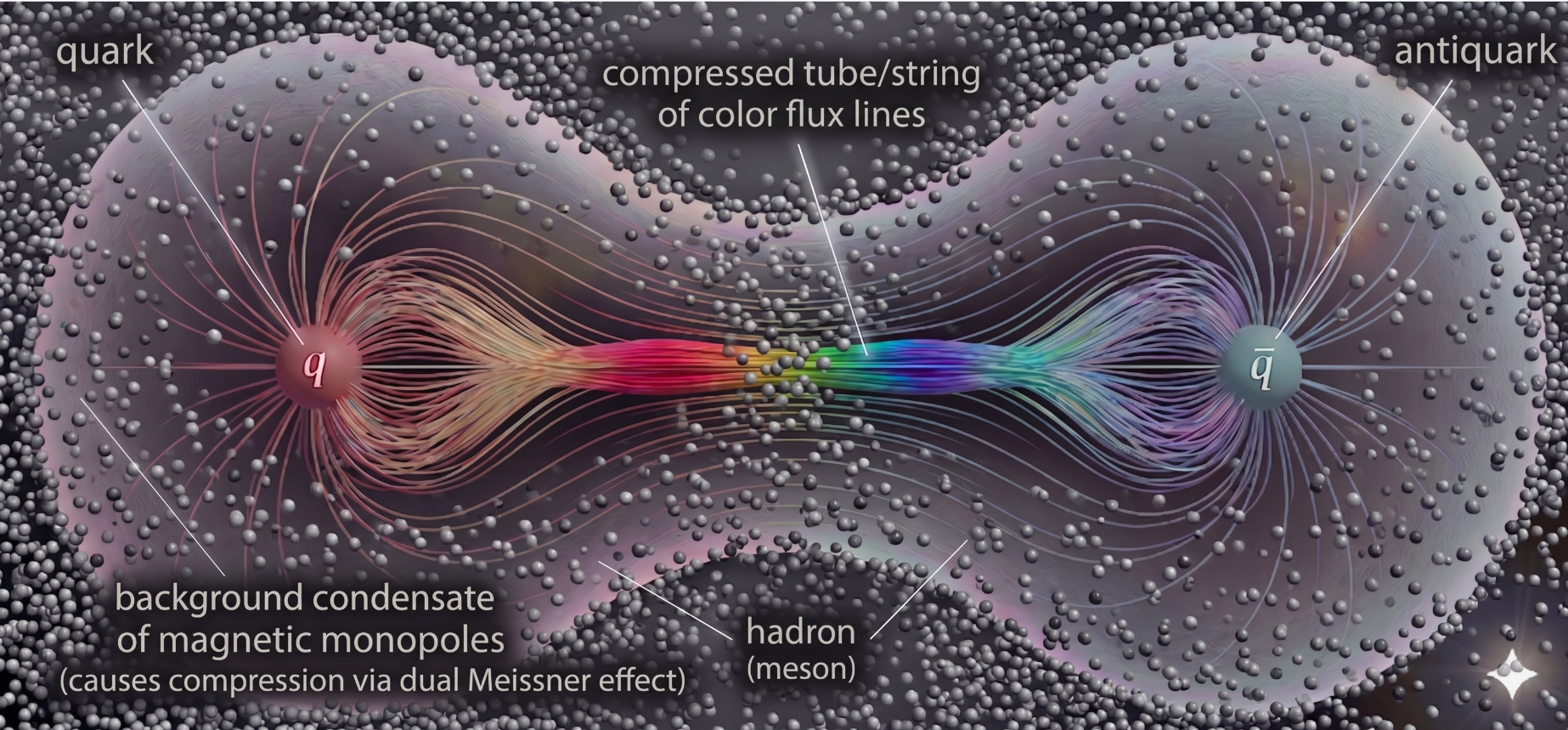
Now, in ordinary superconductors it is well-known that the Meissner effect causes magnetic flux lines to (no longer spread out radially but) be bundled into flux tubes (through Abrikosov vortices). Hence by appeal to electric-magnetic duality one may expect that, dually, in such a magnetic monopole condensate superinsulator it is instead the color-electric flux lines which are bundled into flux tubes/string by a dual Meissner effect:
(graphics from Sc 2026)
But such color-electric flux tubes between quarks are exactly what, in turn, is expected (cf. Polyakov gauge-string duality) to conceptually explain the confinement of quarks inside mesons (and more generally inside baryons, hence generally inside hadrons).
Properties
Relation to Fadeev-Skyrme model
For gauge group SU(2) the coset space parameterizing the reduction of the structure group along to the maximal torus is equivalently the 2-sphere base of the complex Hopf fibration, . Accordingly, in this case there is a close relation between the dual superconductor model of QCD and the Fadeev-Skyrme model, see references below.
Comparison to lattice simulation
The dual superconductor model compares favorably with lattice QCD simulations in suitable parameter ranges (cf. Greensite 2003 §7.5, CCCP 2017).
Successes
-
Abelian and Monopole Dominance: In the maximally Abelian (MA) gauge, off-diagonal gluons acquire a large effective mass (around 1 GeV), which successfully reduces the infrared region of QCD into an Abelian-like theory (Suganuma & Sakumichi 2018, p. 2). Lattice simulations demonstrate “perfect Abelian dominance,” where the Abelian part of the gauge field alone reproduces the full string tension for static quark-antiquark () systems on large physical-volume lattices (Suganuma & Sakumichi 2014, p. 1; Suganuma & Sakumichi 2018, p. 1). This perfect Abelian dominance is also successfully verified for three-quark (3Q) systems (Suganuma & Sakumichi 2018, p. 1).
-
Isolation of Confinement Dynamics: The QCD vacuum in these simulations reveals a large clustering of the monopole-current network (Suganuma & Sakumichi 2016, p. 1). When the system is decomposed, the monopole part alone is found to be responsible for quark confinement, chiral symmetry breaking, and the presence of instantons, whereas the off-diagonal “photon” part contributes zero string tension (Suganuma & Sakumichi 2014, p. 2).
-
Flux Tube Profiles: The transverse shape of the longitudinal chromoelectric field midway between static sources can be accurately described by the dual superconductivity picture (Cea, Cosmai, Cuteri & Papa 2017, p. 1). By fitting the lattice data to dual versions of superconductor vortex models, parameters can be extracted that indicate the pure gauge vacuum behaves as a type-I superconductor (Cea, Cosmai, Cuteri & Papa 2017, p. 5). In this pure gauge theory, the dual London penetration length () and the mean width of the field profile remain fairly stable as the distance between sources varies (Cea, Cosmai, Cuteri & Papa 2017, p. 5).
-
Order Parameters: Using a corrected definition of the order parameter for dual superconductivity, simulations show that the confined phase is superconducting while the deconfined phase behaves as a normal medium (Di Giacomo 2001, p. 1). Similarly, suitably defined monopole creation operators acquire a non-zero expectation value strictly in the confinement phase (Greensite 2003, Sec. 7.5).
Drawbacks and Limitations
-
Casimir Scaling and Representation Dependence: The dual superconductor model predicts that the string tension should be strictly proportional to the Abelian electric charge, which contradicts the intermediate-distance Casimir scaling observed in QCD (Greensite 2003, Sec. 7.6.1). Consequently, quarks in the adjoint representation, which have zero electric charge, should not experience confinement under the monopole gas model, yet they are known to exhibit a linear confining potential up to the onset of color screening (Greensite 2003, Sec. 7.6.1; Del Debbio et al. 1997, p. 2).
-
Asymptotic Distance Failures: At asymptotic distances, QCD string tension depends only on N-ality, meaning the tension for double-charged Abelian Wilson loops should vanish due to screening by off-diagonal gluons (Greensite 2003, Sec. 7.6.2). However, the monopole dominance approximation fails to capture this; lattice data for double-charged Polyakov lines drastically disagree with the predictions of the monopole models, which incorrectly neglect the long-range effects of the off-diagonal gluons (Greensite 2003, Sec. 7.6.2).
-
Unobserved Flux Tubes: The dual abelian Higgs models theoretically predict a multiplicity of different types of electric flux tubes that are not observed in actual QCD (Greensite 2003, Sec. 7.6.1).
-
Potential Gauge Artifacts: There are concerns that the “Abelian dominance” observed on the lattice might be an artifact of the gauge-fixing procedure rather than a reflection of the underlying confinement mechanism, as alternative projections (like center projection) yield different dominant topological configurations (Del Debbio et al. 1997, p. 2).
-
Complications with Dynamical Quarks: The dual superconductor picture is less robust when transitioning from pure gauge theories to (2+1)-flavor QCD with physical dynamical quarks (Cea, Cosmai, Cuteri & Papa 2017, p. 5). The presence of dynamical fermions introduces larger uncertainties and the possible onset of string breaking, which limits the explorable distance ranges and obscures clear trends in the flux tube parameters (Cea, Cosmai, Cuteri & Papa 2017, p. 5).
-
Theoretical Model Limitations: The standard Abrikosov vortex ansatz diverges at the exact center of the flux tube, requiring alternative analytic functions to properly fit the lattice data (Cea, Cosmai, Cuteri & Papa 2017, p. 4). Furthermore, at very large distances between sources, the dual superconductivity hypothesis is expected to eventually fail and transition into an effective string theory description (Cea, Cosmai, Cuteri & Papa 2017, p. 2).
Related concepts
References
Dual superconductor model of confinement
General
Precursor discussion identifying the Polyakov dual flux tube strings as (akin to) vortices in a superconductor medium:
-
Holger Bech Nielsen, Poul Olesen: Vortex-line models for dual strings, Nuclear Physics B 61 (1973) 45-61 [doi:10.1016/0550-3213(73)90350-7]
-
Yoichiro Nambu: Strings, monopoles, and gauge fields, Phys. Rev. D 10 (1974) 4262 [doi:10.1103/PhysRevD.10.4262]
and discussion of confinement via monopole condensation (not yet under this name) in the abelian toy example of 3D compact QED:
-
Alexander M. Polyakov: Compact Gauge Fields and the Infrared Catastrophe, Physics Letters B 59 1 (1975) [doi:10.1016/0370-2693(75)90162-8]
-
Alexander M. Polyakov: Quark confinement and topology of gauge theories, Nuclear Physics B 120 3 (1977) 429–458 [doi:10.1016/0550-3213(77)90086-4]
-
Alexander Polyakov: Confining strings, Nuclear Physics B 486 1–2 (1997) 23–33 [doi:10.1016/S0550-3213(96)00601-3]
The articles now credited with (independently) proposing the dual superconductor model of color confinement:
-
Stanley Mandelstam: Vortices and quark confinement in non-abelian gauge theories, Physics Letters B 53 5 (1975) 476–478 [doi:10.1016/0370-2693(75)90221-X]
-
Gerard ’t Hooft; p 4-5 in: Gauge Fields with Unified Weak, Electromagnetic, and Strong Interactions, Rapporteur’s talk at E.P.S. International Conference on High Energy Physics, Palermo, Sicily (June 1975) [spire:2781, pdf, pdf]
-
Gerard ’t Hooft: On the phase transition towards permanent quark confinement, Nuclear Physics B 138 1 (1978) 1–25 [doi:10.1016/0550-3213(78)90153-0]
Further discussion:
-
Grigorios I. Poulis: Abelian dominance and adjoint sources in lattice QCD, Phys. Rev.D 54 (1996) 6974–6985 [doi:10.1103/PhysRevD.54.6974, arXiv:hep-lat/9601013]
-
L. Del Debbio, M. Faber, Jeff Greensite, S. Olejnik: Some Cautionary Remarks on Abelian Projection and Abelian Dominance, Nucl. Phys. Proc. Suppl. 53 (1997) 141–147 [doi:10.1016/S0920-5632(96)00608-1, arXiv:hep-lat/9607053]
-
Hiroko Ichie, Hideo Suganuma: Abelian dominance for confinement and random phase property of off-diagonal gluons in the maximally abelian gauge, Nuclear Physics B 548 1–-3 (1999) 365-382 [doi:10.1016/S0550-3213(99)00132-7, arXiv:hep-lat/9807025]
-
John Ellis, N. E. Mavromatos: Confinement in Gauge Theories from the Condensation of World-Sheet Defects in Liouville String, Int . J. Mod. Phys. A 14 (1999) 3761–3788 [doi:10.1142/S0217751X99001743, arXiv:hep-th/9808172]
-
Y. M. Cho, D. G. Pak: Magnetic Confinement in QCD, J. Korean Phys. Soc. 38 (2001) 151–154 [arXiv:hep-th/9906198]
-
Y. M. Cho, D. G. Pak: Dynamical Symmetry Breaking and Magnetic Confinement in QCD [arXiv:hep-th/0006051]
-
Y. M. Cho, D. G. Pak: Monopole condensation in QCD, Phys. Rev. D 65 (2002) 074027 [doi:10.1103/PhysRevD.65.074027, arXiv:hep-th/0201179]
-
Kei-Ichi Kondo: Gauge-invariant gluon mass, infrared Abelian dominance and stability of magnetic vacuum, Phys. Rev. D 74 (2006) 125003 [doi:10.1103/PhysRevD.74.125003, arXiv:hep-th/0609166]
-
Kei-Ichi Kondo, A. Shibata, T. Shinohara, S. Kato: Non-Abelian Dual Superconductor Picture for Quark Confinement, Phys. Rev. D 83 (2011) 114016 [doi:10.1103/PhysRevD.83.114016, arXiv:1007.2696]
-
Y. M. Cho: Dimensional Transmutation by Monopole Condensation in QCD, Phys. Rev. D. 87 (2013) 085025 [doi:10.1103/PhysRevD.87.085025, arXiv:1206.6936]
-
Y. M. Cho: Monopole Condensation and Mass Gap in QCD, International Journal of Modern Physics A 29 03n04 (2014) 1450013 [doi:10.1142/S0217751X14500134]
Review:
-
Thomas Schaefer, Edward Shuryak; section III D of: Instantons in QCD, Rev. Mod. Phys. 70 (1998) 323–426 [doi:10.1103/RevModPhys.70.323, arXiv:hep-ph/9610451]
-
Adriano Di Giacomo: Confinement of Color by Dual Superconductivity, Acta Physica Polonica B 28 12 (1997)
-
Jeff Greensite: The Confinement Problem in Lattice Gauge Theory, Prog. Part. Nucl. Phys. 51 (2003) 1 [doi:10.1016/S0146-6410(03)90012-3, arXiv:hep-lat/0301023]
-
Adriano Di Giacomo: Confinement of Color: Recent Progress [arXiv:hep-lat/0310021]
-
Georges Ripka: Dual superconductor models of color confinement, Lecture Notes in Physics 639, Springer (2004) [doi:10.1007/b94800, arXiv:hep-ph/0310102]
-
Adriano Di Giacomo: A Strategy to Study Confinement in QCD, Braz. J. Phys. 37 (2007) 208–213 [arXiv:hep-lat/0610027]
-
Adriano Di Giacomo: Confinement by dual superconductivity: an update (2001) [pdf]
-
Adriano Di Giacomo: The Dual Superconductor Picture for Confinement, in: Confinement, Duality, and Non-Perturbative Aspects of QCD, NATO Science Series: B 368, Springer (2002) 415–437 [doi:10.1007/0-306-47056-X_15]
-
Kei-Ichi Kondo, Seikou Kato, Akihiro Shibata, Toru Shinohara: Quark confinement: Dual superconductor picture based on a non-Abelian Stokes theorem and reformulations of Yang–Mills theory, Physics Reports 579 (2015) 1–226 [doi:10.1016/j.physrep.2015.03.002]
(emphasis on role of nonabelian Stokes theorem)
-
Maxim Chernodub: QCD Vacuum as Dual Superconductor: Quark Confinement and Topology, Handbook of Nuclear Physics, Springer (2023) [doi:10.1007/978-981-19-6345-2_23]
See also:
- Tereza Mendes, Luis E. Oxman, Gustavo M. Simões, Rafael C. S. Tonhon: Cartan Fluxes in Lattice Gauge Theory [arXiv:2604.25003]
The DGC-decomposition
On decomposing, in a gauge invariant way, the gauge potential into an abelian background and nonabelian fluctuations:
The original articles:
-
Yi-Shi Duan, Mo-Lin Ge: gauge theory and electrodynamics of moving magnetic monopoles, Scientia Sinica Mathematica 9 11 (1979) 1072–1081, reprinted in: Memorial Volume for Yi-Shi Duan, World Scientific (2018) 1-15 [doi:10.1142/9789813237278_0001]
-
Y. M. Cho: Colored Monopoles, Phys. Rev. Lett. 44 (1980) 1115, Erratum Phys. Rev. Lett. 44 (1980) 1566 [doi:10.1103/PhysRevLett.44.1115]
Further discussion:
-
Sergei V. Shabanov: An effective action for monopoles and knot solitons in Yang-Mills theory, Phys. Lett. B 458 (1999) 322–330 [doi:10.1016/S0370-2693(99)00612-7, arXiv:hep-th/9903223]
-
Michael L. Walker, Steven Duplij: Cho-Duan-Ge decomposition of QCD in the constraintless Clairaut-type formalism, Phys. Rev. D 91 064022 (2015) [doi:10.1103/PhysRevD.91.064022, arXiv:1411.6968]
-
Kei-Ichi Kondo, T. Murakami, T. Shinohara: Yang-Mills theory constructed from Cho–Faddeev–Niemi decomposition, Prog. Theor. Phys. 115 (2006) 201–216 [doi:10.1143/PTP.115.201, arXiv:hep-th/0504107]
-
Kei-Ichi Kondo, T. Murakami, T. Shinohara: BRST symmetry of Yang-Mills theory in Cho–Faddeev–Niemi decomposition, Eur. Phys. J.C 42 (2005) 475–481 [doi:10.1140/epjc/s2005-02344-4, arXiv:hep-th/0504198]
(via BRST cohomology)
Review:
Relation to Faddeev-Skyrme model
Relation (for gauge group , hence with coset space the 2-sphere ) to the Fadeev-Skyrme model and Hopfion-like knot field configurations:
-
Ludvig Faddeev, Antti J. Niemi: Partially Dual variables in Yang-Mills Theory, Phys. Rev. Lett. 82 (1999) 1624–1627 [doi:10.1103/PhysRevLett.82.1624, arXiv:hep-th/9807069]
-
W. S. Bae, Y. M. Cho, Sang-Woo Kim: QCD versus Skyrme-Faddeev Theory, Phys. Rev. D 65 (2002) 025005 [doi:10.1103/PhysRevD.65.025005, arXiv:hep-th/0105163]
In lattice gauge theory
On the dual superconductor model of confinement in view of lattice QCD computations/simulations:
-
Michael E. Peskin: Mandelstam ‘t Hooft Duality in Abelian Lattice Models, Annals Phys. 113 (1978) 122 [doi:10.1016/0003-4916(78)90252-X]
-
Tsuneo Suzuki, Ichiro Yotsuyanagi: Possible evidence for Abelian dominance in quark confinement, Phys. Rev. D 42 (1990) 4257(R) [doi:10.1103/PhysRevD.42.4257]
-
Paolo Cea, Leonardo Cosmai: Lattice investigation of dual superconductor mechanism of confinement, Nuclear Physics B - Proceedings Supplements 30 (1993) 572–575 [doi:10.1016/0920-5632(93)90276-C]
-
Paolo Cea, Leonardo Cosmai: Dual Superconductor Mechanism of Confinement on the Lattice, Nuov Cim A 107 (1994) 541547 [doi:10.1007/BF02768788, arXiv:hep-lat/9210030]
-
Paolo Cea, Leonardo Cosmai: The Confining Vacuum as a Dual Superconductor, Nucl. Phys. Proc. Suppl. 47 (1996) 318–321 [doi:10.1016/0920-5632(96)00065-5, arXiv:hep-lat/9509007]
-
Hideo Suganuma, H. Ichie, K. Amemiya: Origin of Abelian Dominance in QCD in the Maximally Abelian Gauge, in: Quark Confinement and the Hadron Spectrum III, World Scientific (2000) 207–210 [doi:10.1142/9789812793713_0026]
-
Hideo Suganuma, Naoyuki Sakumichi: Perfect Abelian dominance of confinement in quark-antiquark potential in lattice QCD [arXiv:1412.8489]
-
Hideo Suganuma, Naoyuki Sakumichi: The three-quark potential and perfect Abelian dominance in lattice QCD, PoS LATTICE2015 (2016) 323 [arXiv:1511.05244 hep-lat]
-
Paolo Cea, Leonardo Cosmai, Francesca Cuteri, Alessandro Papa: Flux tubes in the QCD vacuum, Phys. Rev. D 95 (2017) 114511 [doi:10.1103/PhysRevD.95.114511, arXiv:1702.06437 hep-lat]
-
Hideo Suganuma, Naoyuki Sakumichi: Monopole Dominance of Confinement in Lattice QCD, PoS 336 267 (2018) [arXiv:1812.06827 hep-lat, pos:336/267, pdf]
-
Zeinab Dehghan, Manfried Faber: What do we know about the confinement mechanism?, Phys. Part. Nuclei 56 (2025) 1148–1154 [doi:10.1134/S1063779625700236, arXiv:2412.10767 hep-lat]
In super-Yang-Mills theory
The dual superconductor model of confinement becomes analytically exact in super Yang-Mills theory (cf. Seiberg-Witten theory) when broken to :
-
Nathan Seiberg, Edward Witten: Monopole Condensation, And Confinement in Supersymmetric Yang-Mills Theory, Nucl. Phys. B 426 (1994) 19–52 Erratum-ibid. B 430 (1994) 485-0486 [doi:10.1016/0550-3213(94)90124-4, arXiv:hep-th/9407087]
-
Nathan Seiberg, Edward Witten: Monopoles, Duality and Chiral Symmetry Breaking in Supersymmetric QCD, Nucl. Phys. B 431 (1994) 484–550 [doi:10.1016/0550-3213(94)90214-3, arXiv:hep-th/9408099]
Reviews with discussion of the impact on confinement in plain YM:
-
Alexei Yung: What Do We Learn about Confinement from the Seiberg-Witten Theory, 3rd Moscow School of Physics and 28th ITEP Winter School of Physics [spire:527017,arXiv:hep-th/0005088]
-
Michael Dine: On the Possibility of Demonstrating Confinement in Non-Supersymmetric Theories by Deforming Confining Supersymmetric Theories [arXiv:2211.17134]
In solid state physics
On experimentally accessible analogs of the dual superconductor model of confinement in solid state physics (namely in superinsulators):
-
M. Cristina Diamantini, Carlo A. Trugenberger, Valeri M. Vinokur: Confinement and Asymptotic Freedom with Cooper pairs, Nature Comm. Phys. 1 77 (2018) [doi:10.1038/s42005-018-0073-9, arXiv:1807.01984]
-
M. Cristina Diamantini, Carlo A. Trugenberger: Superinsulators: a toy realization of QCD in condensed matter, Ch. 23 in Roman Jackiw – 80th Birthday Festschrift, World Scientific (2020) 275-286 [arXiv:2008.12541]
Review:
-
Carlo A. Trugenberger: Superinsulators, Bose Metals and High- Superconductors: The Quantum Physics of Emergent Magnetic Monopoles, World Scientific (2022) [doi:10.1142/12688]
-
Carlo A. Trugenberger: Superinsulation: Magnetic Monopoles and Electric Confinement in Condensed Matter, talk at CQTS (Feb 2025) [slides:pdf]
-
M. Cristina Diamantini, Carlo A. Trugenberger, Valeri M. Vinokur: Superinsulation, in: Encyclopedia of Condensed Matter Physics — Second Edition volume 2, Academic Press (2024) 804–816 [[doi:10.1016/B978-0-323-90800-9.00220-1, ISBN:9780323914086]
Via holographics QCD
Discussion of the dual superconductor model of color confinement via holographic QCD:
-
Tsung-Sheng Huang, Wen-Yu Wen: Holographic Model of Dual Superconductor for Quark Confinement [arXiv:1607.08171]
-
Antón F. Faedo, Carlos Hoyos, Javier G. Subils: Monopoles and confinement in three dimensions from holography, J. High Energ. Phys. 2023 218 (2023) [doi:10.1007/JHEP03(2023)218, arXiv:2212.04996]
Last revised on May 14, 2026 at 09:49:00. See the history of this page for a list of all contributions to it.