nLab cosmic inflation
Contents
Idea
In the context of cosmology, cosmic inflation is a model (in theoretical physics) that can explain certain large-scale features of the observable universe (flatness, horizon problem, CMB anisotropy) by assuming a finite period of drastic expansion of the universe shortly after the big bang. Cosmic inflation is part of the standard model of cosmology.
The typical model of cosmic inflation adds to a standard FRW model simply a scalar field – then called the inflaton field – with standard kinetic term and some potential term. If the potential term is chosen suitably one can obtain solutions to Einstein's equations of this simple homogenous and isotropic model which exhibit “slow roll behaviour” for , meaning that (homogeneous in space) starts out in the vicinity of the big bang with some finite value and then slowly “rolls down” its potential well (where one speaks in the analogy with the model describing a single particle on the real line in the given potential, which has the same kind of action functional). Therefore in this “slow roll” period the contribution of to the FRW model is essentially that of a cosmological constant and so this drives the expansion of the “universe” in this model. But since is only approximately constant it eventually reaches the minimum of its potential well. Again, if the potential parameters of the model are chosen suitably one can arrange that it stays there (called the “graceful exit property” of the inflationary model) and so it stops driving the expansion of the “universe”. In conclusion this yields variants of the FRW model that exhibit pronounced expansion shortly after the initial singularity and then asymptote to the behaviour of the plain FRW model. This is what is called cosmic inflation.
Simple as it is, this model has proven to successfully match the observations that it was designed to match (the large-scale homogeneity of the observable universe, notably). But of course people are trying all kinds of variants, too. A central conceptual problem of most of these models is that it is unclear what the field should be in terms of particle physics or other known phyisics. In some variants it is identified with the Higgs field, in other it is a scalar moduli field of some Kaluza-Klein compactification, but all of this is speculative.
Experimental data
The experimental data (Planck Collaboration 2013, BICEP-Keck-Planck 2015, Planck Collaboration 2015) strongly favors the Starobinsky model of cosmic inflation and equivalent models with plateau-shaped potentials:
Models of Starobinsky-type are favored by experimental results (PlanckCollaboration 13, BICEP2-Keck-Planck 15, PlanckCollaboration 15, BICEP3-Keck 18) which give a low upper bound on , well below (whereas other models like chaotic inflation are disfavored by these values), see (PlanckCollaboration 13, page 12).
With respect to this data, the Starobinsky model (or “ inflation”) is the model with the highest Bayesian evidence (Rachen, Feb 15, PlanckCollaboration 15XX, table 6 on p. 18) as it is right in the center of the likelihood peak, shown in dark blue in the following plots (PlanckCollaboration 13, figure 1, also Linde 14, figure 5) and at the same time has the lowest number of free parameters :
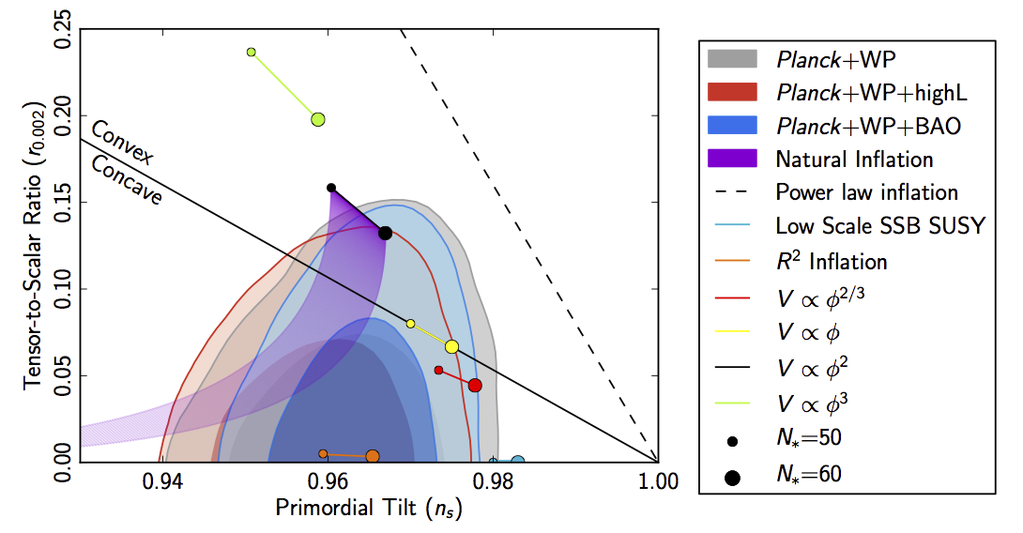
This remains true with the data of (PlanckCollaboration 15), see (PlanckCollaboration 15 XIII, figure 22) and in the final analysis (PlanckCollaboration 18X, Fig 8), which gives the following (from here):
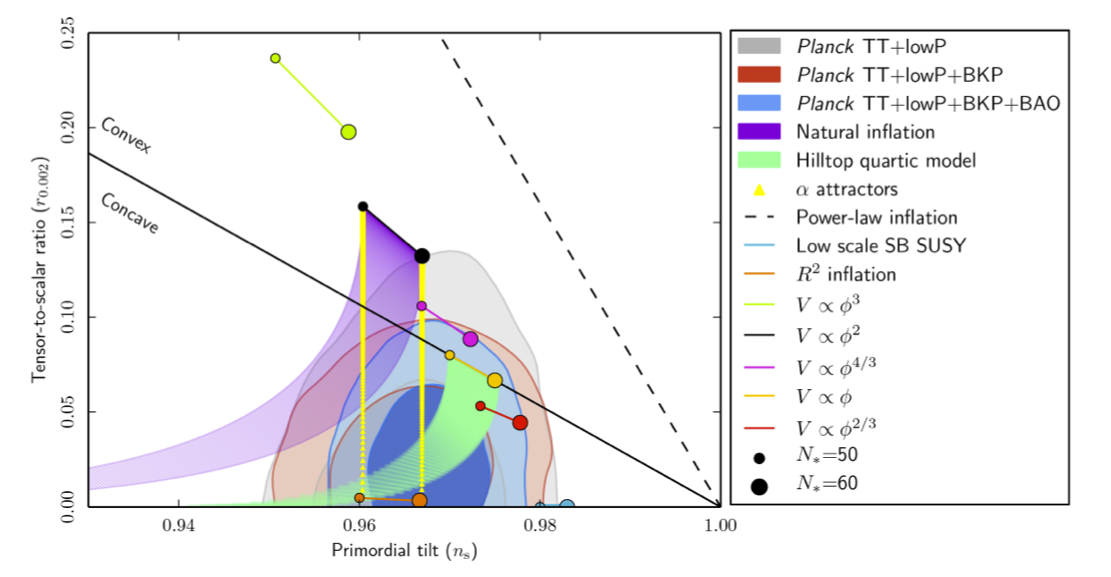
inflation has the strongest evidence among the models considered here. However, care must be taken not to overinterpret small differences in likelihood lacking statistical significance. The models closest to in terms of evidence are brane inflation and exponential inflation, which have one more parameter than (PlanckCollaboration 15XX, p. 18)
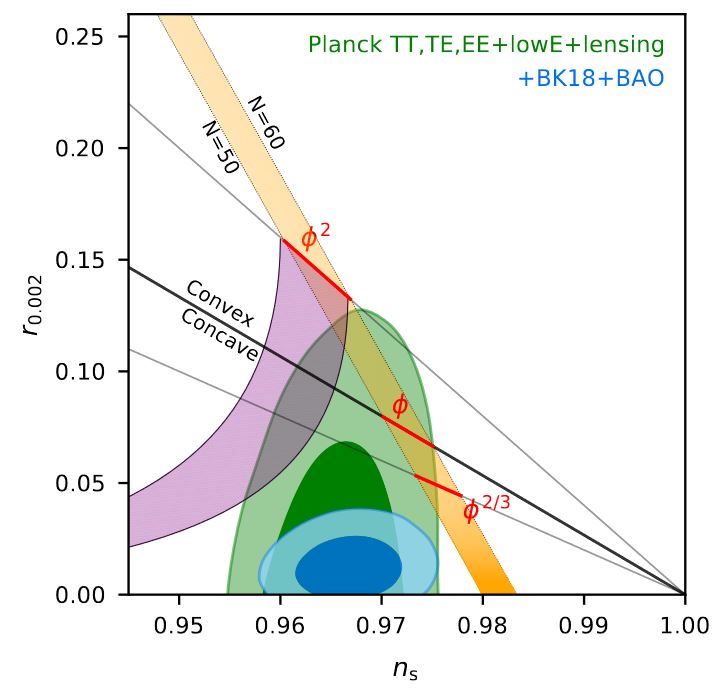
This picture is further confirmed by observations of the BICEP/Keck collaboration reported in BICEP-Keck 2021, whose additional data singles out the dark blue area in the following (Fig. 5):
See also Ellis 13, Ketov 13, Efstathiou 2019, 50:49 for brief survey of Starobinsky inflation in relation to observation, and see Kehagias-Dizgah-Riotto 13 for more details. There it is argued that the other types of inflationary models which also reasonably fit the data are actually equivalent to the Starobinsky model during inflation.
Variants
Old inflation
New inflation
(Linde 82, Albrecht-Steinhardt 82)
Eternal inflation
Chaotic inflation
(Linde 83)
Candidates for the inflaton field
Higgs inflation
The idea that the inflaton field in cosmology might be the Higgs field from the standard model of particle physics is as old as the idea of inflation itself, but at least in the naive versions it seems to be ruled out by data. However, with the experimental detection of the previously hypothesized Higgs field itself, the topic is gaining interest again and various variations are being proposed to solve the problems with the naive idea, for instance a small non-minimal coupling of the Higgs field to gravity (see e.g. Atkins 12, Kamada 12, Kehagias 12).
In particular, the near-criticality of the Higgs potential (see there) has been argued to be just the right condition to make Higgs inflation viable (Jegerlehner 13, Jegerlehner 14, Jegerlehner 15, Jegerlehner 18), for review see also Rubio 18.
Axion inflation
see axion inflation
Higher curvature inflation (Starobinsky model)
It is possible that instead of the inflaton being a fundamental scalar field, it is an effective result of higher curvature corrections to gravity.
The first such correction leads to the Starobinsky model of cosmic inflation, which sits right in the middle of the parameter space preferred by the PLANCK satellite data.
Discussion of inflationary effects of ever higher curvature corrections includes Arciniega-Edelstein-Jaime 18, ABCEHJ 18.
Ekpyrotic cosmology
See ekpyrotic cosmology.
Supergravity models
There are scalar fields in D=4 N=1 supergravity that naturally serve as inflatons.
-Attractor mechanism
Remarkably, there is an attractor mechanism at work in D=4 N=1 supergravity (Kallosh, Linde & Roest 2013, cf. Carrasco, Kallosh & Linde 2015; Kallosh & Linde 2026) which makes inflaton dynamics in supergravity models effectively tend to the behaviour of models with plateau-shaped shaped potential (including the Starobinsky model of cosmic inflation) whose predictions stand out as squarely matching experimental observations of the Planck Collaboration and the BICEP/Keck experiment.
CKL15: “This new class of models accomplishes for inflationary theory something similar to what inflation does for cosmology. Inflation stretches the universe making it flat and homogeneous, and the structure of the observable part of the universe becomes very stable with respect to the choice of initial conditions in the early universe. Similarly, stretching of the moduli space near its boundary upon transition to canonical variables makes inflationary potentials very flat and results in predictions which are very stable with respect to the choice of the inflaton potential.”
KS26: “This large class of inflationary models gives predictions that are stable with respect to even very significant modifications of inflationary potentials. These predictions match all presently available CMB-related cosmological data.”
However, it remains unclear whether these D=4 supergravity models of inflation can arise as KK-reductions from D=10 or D=11 supergravity — unless higher curvature corrections are included (cf. here) or time-dependent moduli are allowed (cf. here).
-Problem resolution
The -problem in inflationary cosmology is the issue that quantum corrections to the inflaton potential tend to destroy the slow-roll regime.
It is argued that this is naturally solved in D=4 supergravity with “nilpotent” superfields (Ferrara, Kallosh & Linde 2014), which may be understood as an effective descrition of anti-brane annihilation (Quevedo et al. 2025, Villa 2025).
Related concepts
fields and particles in particle physics
and in the standard model of particle physics:
matter field fermions (spinors, Dirac fields)
| flavors of fundamental fermions in the standard model of particle physics: | |||
|---|---|---|---|
| generation of fermions | 1st generation | 2nd generation | 3d generation |
| quarks () | |||
| up-type | up quark () | charm quark () | top quark () |
| down-type | down quark () | strange quark () | bottom quark () |
| leptons | |||
| charged | electron | muon | tauon |
| neutral | electron neutrino | muon neutrino | tau neutrino |
| bound states: | |||
| mesons | light mesons: pion () ρ-meson () ω-meson () f1-meson a1-meson | strange-mesons: ϕ-meson (), kaon, K*-meson (, ) eta-meson () charmed heavy mesons: D-meson (, , ) J/ψ-meson () | bottom heavy mesons: B-meson () ϒ-meson () |
| baryons | nucleons: proton neutron |
(also: antiparticles)
hadrons (bound states of the above quarks)
minimally extended supersymmetric standard model
bosinos:
dark matter candidates
Exotica
References
Reviews
-
Andrei Linde, Particle Physics and Inflationary Cosmology, Harwood, Chur (1990).
-
A. R. Liddle, D. H. Lyth, Cosmological inflation and large-scale structure, Cambridge University Press (2000).
-
Shinji Tsujikawa, Introductory review of cosmic inflation, lecture notes given at The Second Tah Poe School on Cosmology Modern Cosmology, Naresuan (2003) (arXiv:hep-ph/0304257).
-
Jerome Martin, Christophe Ringeval, Vincent Vennin, Encyclopaedia Inflationaris, Phys. Dark Univ. 5-6 (2014) 75-235 [arXiv:1303.3787, doi:10.1016/j.dark.2014.01.003]
-
Jerome Martin, The Theory of Inflation (arXiv:1807.11075)
-
Debika Chowdhury, Jerome Martin, Christophe Ringeval, Vincent Vennin, Inflation after Planck: Judgment Day (arXiv:1902.03951)
-
John Ellis, David Wands: Inflation (2023) [arXiv:2312.13238]
-
Renata Kallosh, Andrei Linde: On the Present Status of Inflationary Cosmology [arXiv:2505.13646]
-
Alberto Salvio: Inflationary scenarios beyond the Standard Model, in: Encyclopedia of Particle Physics [arXiv:2501.08380]
-
Martin S. Sloth: Three Advanced Lectures on Inflation [arXiv:2606.06581]
With emphasis on the Schwinger effect:
- Jerome Martin, Inflationary Perturbations: the Cosmological Schwinger Effect, Lect. Notes Phys. 738:193-241, 2008 (arXiv:0704.3540, doi:10.1007/978-3-540-74353-8_6)
See also:
- Wikipedia, Inflation (cosmology)
Original articles
-
Demosthenes Kazanas, Dynamics of the universe and spontaneous symmetry breaking, Astrophysical Journal, Part 2 - Letters to the Editor, 241 (Oct. 15, 1980) L59-L63 [doi:10.1086/183361]
-
Aleksei Starobinsky, A new type of isotropic cosmological models without singularity, Phys. Lett. B 91 (1980) 99-102 [doi:10.1016/0370-2693(80)90670-X]
-
Alan Guth, Phys. Rev. D 23, 347 (1981).
-
K. Sato, Mon. Not. R. Astron. Soc. 195, 467 (1981); Phys. Lett. 99B, 66 (1981)
-
Andrei Linde, Phys. Lett. 108B, 389 (1982)
-
A. Albrecht and Paul Steinhardt, Phys. Rev. Lett. 48, 1220 (1982)
-
Andrei Linde, Phys. Lett. 129B, 177 (1983).
On structure formation during inflation by inhomogeneous quantum cosmology:
- Martin Bojowald, Ding Ding, Canonical description of cosmological backreaction, JCAP 03 (2021) 083
In supersymmetric quantum cosmology:
- N.E. Martínez-Pérez, C. Ramírez, V.M. Vázquez Báez, Phenomenological inflationary model in Supersymmetric Quantum Cosmology [arXiv:2208.04412]
Experimental evidence
-
C. L. Bennett et al. First Year Wilkinson Microwave Anisotropy Probe (WMAP) Observations: Preliminary Maps and Basic Results, Astrophys.J.Suppl.148:1 (2003) (arXiv:astro-ph/0302207)
-
H .V. Peiris et al, First Year Wilkinson Microwave Anisotropy Probe (WMAP) Observations: Implications for Inflation, Astrophys.J.Suppl.148:213,2003 (arXiv:astro-ph/0302225)
-
Planck Collaboration, Planck 2013 results. XXII. Constraints on inflation (arXiv:1303.5082)
-
Resonaances, Planck about inflation
-
Andrei Linde, Inflationary Cosmology after Planck 2013 (arXiv:1402.0526)
-
-
A Joint Analysis of BICEP2/Keck Array and Planck Data (arXiv:1502.00612)
-
Planck Collaboration, Planck 2015, Overview of results (pdf)
-
Debika Chowdhury, Jerome Martin, Christophe Ringeval, Vincent Vennin, Inflation after Planck: Judgment Day (arxiv:1902.03951)
Inflation from higher curvature corrections
Besides the references at Starobinsky model of cosmic inflation the following discuss inflation driven by higher curvature corrections:
-
Gustavo Arciniega, Jose D. Edelstein, Luisa G. Jaime, Towards purely geometric inflation and late time acceleration (arXiv:1810.08166)
-
Gustavo Arciniega, Pablo Bueno, Pablo A. Cano, Jose D. Edelstein, Robie A. Hennigar, Luisa G. Jaimem, Geometric Inflation (arXiv:1812.11187)
Higgs field inflation
Literature discussing whether or how the Higgs field might be identified as the inflaton field includes
-
Michael Atkins, Could the Higgs boson be the inflaton?, talk (March 2012) (pdf)
-
Kohei Kamada, Generalized Higgs inflation models, talk at PLANCK 2012 (May 2012)(pdf)
-
Alex Kehagias, New Higgs inflation, talk (September 2012) (pdf)
-
Takehiro Nabeshima, A model for Higgs inflation and its testability at the ILC, talk (October 2012) (pdf)
-
Javier Rubio, Higgs inflation, Front. Astron. Space Sci. 5:50 (2019) (arXiv:1807.02376)
A popular account in the context of the 2013 Plack Collaboration results is in
Discussion of Higgs inflation with emphasis on relation to the near-criticality of the Higgs field:
-
Fred Jegerlehner, The hierarchy problem of the electroweak Standard Model revisited (arXiv:1305.6652)
-
Fred Jegerlehner, Higgs inflation and the cosmological constant, Acta Phys.Polon. B45 (2014) 1215-1254 (arXiv:1402.3738)
-
Fred Jegerlehner, About the role of the Higgs boson in the evolution of the early universe (arXiv:1406.3658)
-
Fred Jegerlehner, The hierarchy problem and the cosmological constant problem in the Standard Model (arXiv:1503.00809)
-
Fred Jegerlehner, The Hierarchy Problem and the Cosmological Constant Problem Revisited – A new view on the SM of particle physics (arXiv:1812.03863)
See also
-
Tommi Tenkanen, Eemeli Tomberg, Initial conditions for plateau inflation (arXiv:2002.02420)
-
A. Tronconi, G. Venturi: An Effective Theory for Higgs Inflation [arXiv:2505.06197]
Gauge field inflation
Literature discussing whether or how gauge field might be identified as the inflaton field include
- A. Maleknejad, M. M. Sheikh-Jabbari, J. Soda, Gauge Fields and Inflation (arXiv:1212.2921)
Inflationary cosmology in Supergravity
On models of cosmic inflation in D=4 supergravity and the -attractor mechanism & the -problem resolution:
(See also at Starobinsky model of cosmic inflation the references on its embedding into supergravity).
-
Dimitri V. Nanopoulos, Keith A. Olive, Mark Srednicki, K. Tamvakis: Primordial inflation in simple supergravity, Phys. Lett. B 123 (1983) 41–44 [doi:10.1016/0370-2693(83)90954-1]
-
R. Holman, Pierre Ramond, G. G. Ross: Supersymmetric inflationary cosmology, Physics Letters B 137 (1984) 343 [doi:10.1016/0370-2693(84)91729-5]
-
S. James Gates Jr., Sergei V. Ketov: Superstring-inspired supergravity as the universal source of inflation and quintessence, Physics Letters B 674 (2009) 59–63 [doi:10.1016/j.physletb.2009.03.005, arXiv:0901.2467]
-
Masahide Yamaguchi: Supergravity based inflation models: a review, Class. Quantum Grav. 28 (2011) 103001 [doi:10.1088/0264-9381/28/10/103001, arXiv:1101.2488]
-
Sergio Ferrara, Renata Kallosh, Andrei Linde, Massimo Porrati: Minimal Supergravity Models of Inflation, Phys. Rev. D 88 (2013) 085038 [doi:10.1103/PhysRevD.88.085038, arXiv:1307.7696]
-
Renata Kallosh, Andrei Linde, Diederik Roest: Superconformal Inflationary -Attractors, J. High Energ. Phys. 2013 198 (2013) [doi:10.1007/JHEP11(2013)198, arXiv:1311.0472]
-
Renata Kallosh, Andrei Linde, Diederik Roest: Large Field Inflation and Double -Attractors, J. High Energ. Phys. 2014 52 (2014) [doi:10.1007/JHEP08(2014)052, arXiv:1405.3646]
-
Sergei V. Ketov, Takahiro Terada: Inflation in Supergravity with a Single Chiral Superfield, Physics Letters B 736 (2014) 272–277 [doi:10.1016/j.physletb.2014.07.036, arXiv:1406.0252]
-
Sergio Ferrara, Renata Kallosh, Andrei Linde: Cosmology with Nilpotent Superfields, J. High Energ. Phys. 2014 143 (2014) [doi:10.1007/JHEP10(2014)143, arXiv:1408.4096]
-
Renata Kallosh, Andrei Linde, Marco Scalisi: Inflation, de Sitter Landscape and Super-Higgs effect, J. High Energ. Phys. 2015 111 (2015) [doi:10.1007/JHEP03(2015)111, arXiv:1411.5671]
-
John Joseph M. Carrasco, Renata Kallosh, Andrei Linde: Cosmological Attractors and Initial Conditions for Inflation, Phys. Rev. D 92 (2015) 063519 [doi:10.1103/PhysRevD.92.063519, arXiv:1506.00936]
-
Takahiro Terada: Inflation in Supergravity with a Single Superfield, Phd thesis, Tokyo (2015) [arXiv:1508.05335]
-
Sergio Ferrara, Renata Kallosh, Jesse Thaler: Cosmology with orthogonal nilpotent superfields, Phys. Rev. D 93 043516 (2016) [doi:10.1103/PhysRevD.93.043516, arXiv:1512.00545]
-
Sergio Ferrara, Renata Kallosh: Seven-Disk Manifold, -attractors and -modes, Phys. Rev. D 94 (2016) 126015 [doi:10.1103/PhysRevD.94.126015, arXiv:1610.04163]
-
Llibert Aresté Saló, David Benisty, Eduardo I. Guendelman, Jaume de Haro: -attractors in Quintessential Inflation motivated by Supergravity, Phys. Rev. D 103 (2021) 123535 [doi:10.1103/PhysRevD.103.123535, arXiv:2103.07892]
-
Sergei Ketov: Inflationary Cosmology from Supergravity, in Handbook of Quantum Gravity (2023) [doi:10.1007/978-981-19-3079-9_51-1, pdf]
-
Ignatios Antoniadis, Emilian Dudas, Fotis Farakos, Augusto Sagnotti: Non-Linear Supergravity and Inflationary Cosmology [arXiv:2409.14943]
-
Michele Cicoli, Christopher Hughes, Ahmed Rakin Kamal, Francesco Marino, Fernando Quevedo, Mario Ramos-Hamud, Gonzalo Villa: Back to the origins of brane-antibrane inflation, Eur. Phys. J. C 85 315 (2025) [doi:10.1140/epjc/s10052-025-13982-9, arXiv:2410.00097]
-
Renata Kallosh, Andrei Linde: Attractors in Cosmology, section 3 of: Attractors in Supergravity, chapter 22 in: Half a Century of Supergravity Part II – Structure and Properties of Sugra (2026) 188–199 [doi:10.1017/9781009575874.025, arXiv:2503.13682]
-
Renata Kallosh, Andrei Linde: Streamlined Supergravity, J. High Energ. Phys. 2026 176 (2026) [doi:10.1007/JHEP03(2026)176, arXiv:2511.15815]
-
Renata Kallosh, Andrei Linde: Singular -attractors, Journal of Cosmology and Astroparticle Physics, 2026 (2026) [doi:10.1088/1475-7516/2026/04/075, arXiv:2512.02969]
-
Gonzalo Villa: Remarks on brane-antibrane inflation, PoS 474 (2025) [doi:10.22323/1.474.0006, arXiv:2501.09074]
-
Renata Kallosh, Andrei Linde: Unification of polynomial and exponential cosmological attractors [arXiv:2607.07684]
Discussion in D=6 supergravity with 3-branes:
- Y. Aghababaie, Cliff P. Burgess, S. L. Parameswaran, Fernando Quevedo: Towards a Naturally Small Cosmological Constant from Branes in 6D Supergravity, Nucl. Phys. B 680 (2004) 389-414 [doi:10.1016/j.nuclphysb.2003.12.015, arXiv:hep-th/0304256]
String modeled inflation
In string theory the inflaton field can be modeled by various effects, such as
- open string stretching between D-brane-anti D-brane pairs.
Review and further pointers:
-
Cliff Burgess, M. Cicoli, F. Quevedo, String Inflation After Planck 2013 (arXiv:1306.3512)
-
Daniel Baumann, Liam McAllister, Inflation and String Theory, Cambridge University Press (2015) [arXiv:1404.2601, doi:10.1017/CBO9781316105733]
See also:
-
Sukŗti Bansal: Loop Blow-up Inflation: An Overview [arXiv:2604.07288]
Last revised on June 29, 2026 at 04:53:51. See the history of this page for a list of all contributions to it.